 |
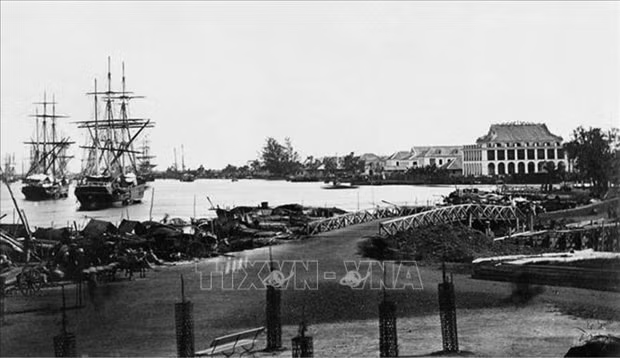
| A view of Nha Rong Wharf in Saigon in the early 20th century. From this place, the patriotic Nguyen Tat Thanh boarded the vessel Latouche-Tréville to leave Vietnam to realise his ambition to liberate the country from the colonial rule (File photo: VNA) |
Exactly 110 years ago, on June 5, 1911, the young Nguyen Tat Thanh, using the name Van Ba, boarded the vessel Latouche-Tréville in Vietnam and headed overseas to seek a way to save the country.
During his 30-year odyssey, Nguyen Tat Thanh, who later became President Ho Chi Minh, identified a path to national liberation, turning Vietnam into an independent, free, and unified country moving towards socialism.
He chose Saigon, now Ho Chi Minh City, as the place he would leave the country because it was the gateway to the southern region and had many large shipping companies operating the France - Indochina route, which allowed him to reach France, which was imposing colonial rule over Vietnam and Indochina as a whole.
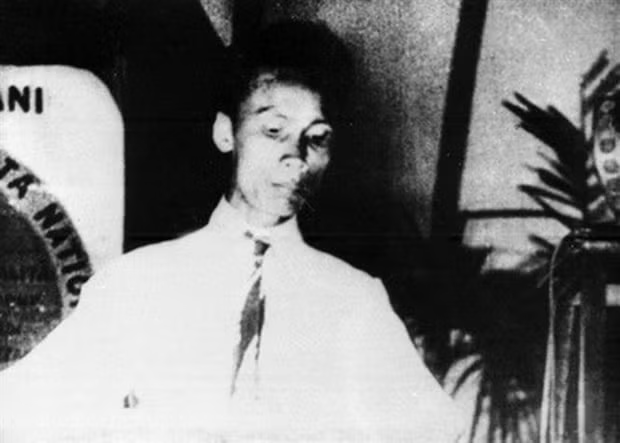 |
| Nguyen Ai Quoc delivers a speech as a delegate from the French Communist Party's ministry of colonial affairs at the fifth congress of the Communist International, held in Moscow from June 17 to July 8, 1924 (File photo) |
On January 18, 1919, the Paris Peace Conference began, gathering together 27 victorious countries in World War I, including France, to discuss the setting up of a new world order.
Under the name Nguyen Ai Quoc, Ho Chi Minh sent the “Petition from the People of An Nam” to the conference on June 18, 1919.
The petition left an impression on international public opinion and delivered the key message that the Vietnamese people wished to have true independence recognised by the international community. Since then, the name Nguyen Ai Quoc - Nguyen the Patriot - became known around the world.
Historians describe the petition as the first modern political manifesto in Vietnam’s history. It was relatively moderate and only intended to claim political and democratic rights for the country.
The important thing was that Nguyen Ai Quoc was the first to state the political issues facing Vietnam at an international gathering and to demand fundamental rights.
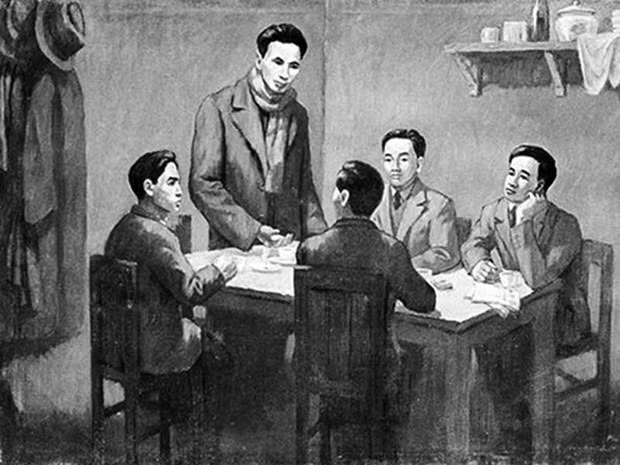 |
| From January 6 to February 7, 1930, the meeting to unite communist organisations to establish the Communist Party of Vietnam took place in the Kowloon Peninsula of Hong Kong under the chair of Nguyen Ai Quoc as a representative of the Communist International (Source: VNA) |
He joined the French Socialist Party, as this was the only organisation in France that stood up for the colonial territories and followed the ideal of the Great French Revolution.
On December 25, 1920, the French Socialist Party’s 18th congress, held in the city of Tours, marked the fundamental switch to the proletarian revolution path by left-wing socialists, laying a cornerstone for the establishment of the French Communist Party. Nguyen Ai Quoc was the only delegate from Indochina at the congress.
In mid-July 1920, the L’Humanité newspaper, the organ of the French Socialist Party, published a draft thesis on national and colonial questions written by V. I. Lenin. Nguyen Ai Quoc repeatedly read the thesis and then finally grasped its main points.
In his essay “The path that led me to Leninism”, written in 1960, he said: “What emotion, enthusiasm, clear-sightedness and confidence it [Lenin’s thesis] instilled in me! I was overjoyed to the point of tears. Though sitting alone in my room, I shouted out aloud as if addressing large crowds: ‘Dear martyrs, compatriots! This is what we need, this is the path to our liberation!’”
Nguyen Ai Quoc remained persistent on the path he had chosen and fully trusted Lenin, the Russian Revolution, and proletarian internationalism.
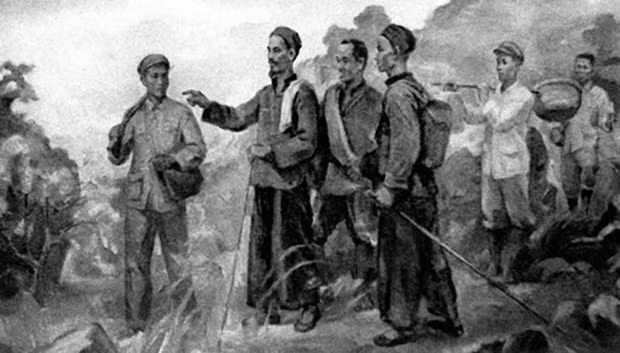 |
| After the 30-year journey to seek a path to national liberation, Nguyen Ai Quoc arrives in Pac Bo, Cao Bang province, on January 28, 1941 to directly lead the revolution in Vietnam (Source: VNA) |
The Russian State Archive of Socio-Political History (RGASP), located in downtown Moscow, stores a large number of precious materials relating to Ho Chi Minh’s activities during the time he was in the Soviet Union.
His arrival is considered a historic event creating a significant turning point in his revolutionary career and also for Vietnam’s revolution.
Professor Vladimir Kolotov, head of the Department of History of the Far East Countries and Director of the Ho Chi Minh Institute at the Saint Petersburg State University, said the first thing Ho Chi Minh did when arriving in the Soviet Union was to learn more about revolutionary theories, including Marxism-Leninism ideology, and identify ways for Party building and personnel training, points of time for seizing power and carrying out a revolution, and management methods after power was seized.
From these first steps, he fostered generations of faithful communists for the Communist Party of Vietnam, thereby instilling the communist ideology into the people to lead Vietnam’s revolution to success, Kolotov noted.
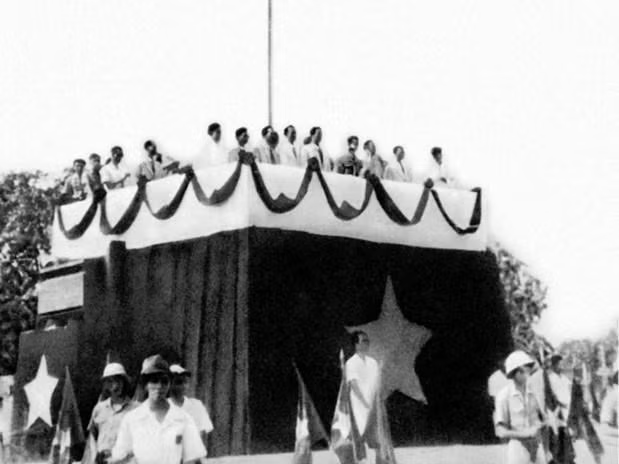 |
| President Ho Chi Minh reads the Declaration of Independence at Ba Dinh Square in Hanoi on September 2, 1945, proclaiming the foundation of the Democratic Republic of Vietnam, now the Socialist Republic of Vietnam (File photo: VNA) |
Exactly 110 years ago, the 21-year-old Nguyen Tat Thanh departed Nha Rong Wharf in Saigon with the ambition and burning desire to gain freedom for his compatriots and for the Fatherland.
Finding a path towards national liberation during his 30-year journey, he returned to lead Vietnam’s revolution and overcome countless difficulties and challenges to record consecutive victories.
Professor Dr Hoang Chi Bao stressed that Ho Chi Minh’s odyssey to seek a path towards national liberation was also a journey for Vietnam to become an independent and strong country, establishing itself as comparable to others around the globe, and