A Global Breakthrough in the Fight Against Cybercrime

The newly adopted United Nations Convention Against Cybercrime (the Hanoi Convention) marks a major milestone in the global effort to tackle increasingly complex cybersecurity challenges.

A Global Breakthrough in the Fight Against Cybercrime -0
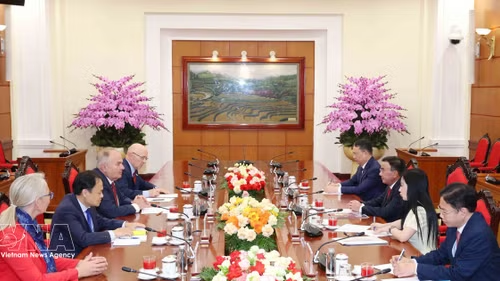
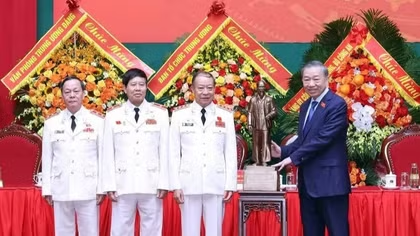
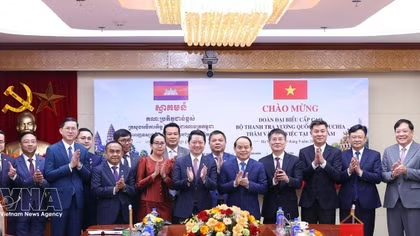
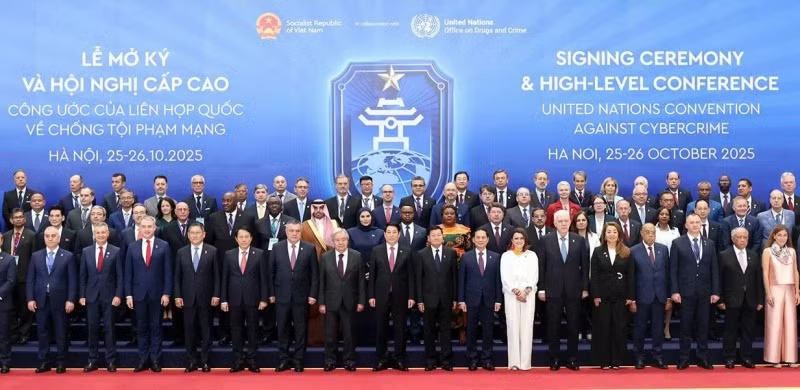
President Luong Cuong and delegates at the official welcoming ceremony for the heads of delegations attending the signing ceremony of the Hanoi Convention.

With its comprehensive scope and human-centered commitments, the Hanoi Convention is hailed as the first international legal instrument that lays a foundation for worldwide cooperation in preventing and combating cybercrime.

As a UN-adopted treaty, the Hanoi Convention carries the broadest reach of any international legal framework on cybersecurity to date. Similar to the UN Convention against Transnational Organized Crime (UNTOC) and the UN Convention against Corruption (UNCAC), it is expected to achieve near-universal participation, providing a comprehensive law-binding framework for cooperation in addressing cross-border cybercrime.

During the signing ceremony on October 25 alone, 69 countries officially signed the Convention.

In the context where cybercrime is becoming increasingly organized, borderless, and often target countries with their vulnerable infrastructure, the Hanoi Convention represents a timely and necessary global response.

Based on successive UN documents such as the Budapest Convention (adopted by the European Council in 2001) and the Malabo Convention (adopted by the African Union in 2014), the Hanoi Convention also introduces new and updated provisions reflecting today’s realities of cybercrime.

For example, the convention includes emerging offenses in cyberspace, such as online fraud, child exploitation and the non-consensual sharing of private images. These updates reflects the reality of current cybersecurity and provides legal approaches to effectively address arising cybersecurity threats.
A Global Breakthrough in the Fight Against Cybercrime -0
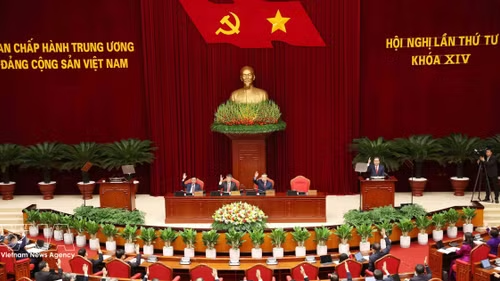
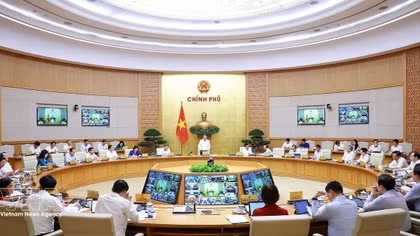
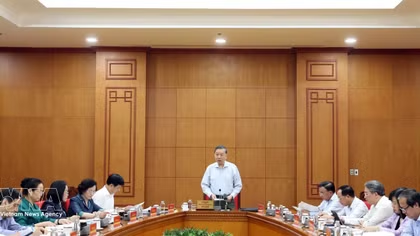
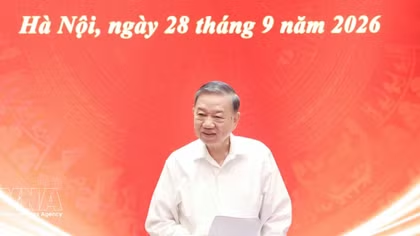
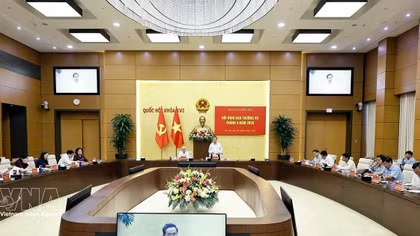
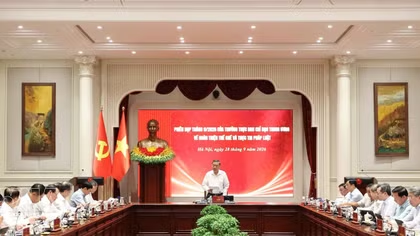
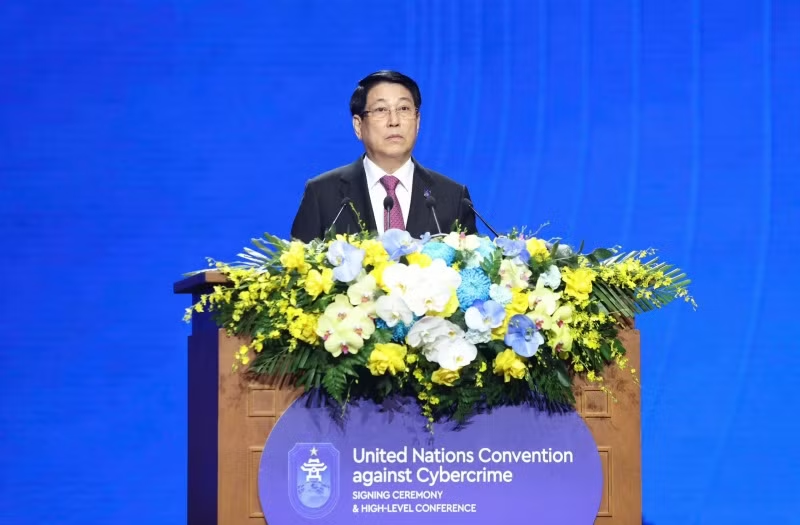
State President speaks at the opening ceremony. 

One of the Convention’s key features is its clear framework for the exchange of electronic evidence among nations — a critical tool for investigating serious crimes such as terrorism and transnational organized crime in cyberspace.

By facilitating the sharing of information and digital evidence, the Convention enhances the ability of law enforcement agencies worldwide to prevent, apprehend, and prosecute cyber offenders, thereby contributing to global security and stability.

Compared with earlier regional agreements, the Hanoi Convention offers broader and stronger provisions. It sets out detailed measures for the protection of victims and witnesses, the recovery of illicit assets, and cooperation in joint investigations, extradition and police coordination. Additionally, these mechanisms create a robust legal toolkit that allows countries to proactively execute all steps from detection and investigation to prosecution, trial and post-crime remediation.

The Convention also demonstrates the spirit of solidarity and shared responsibility among nations. It includes concrete commitments on technical assistance, technology transfer and capacity building for developing countries, enabling them to participate more effectively in the global campaign against cybercrime.

Additionaly, it requires member nations — regardless of size or capability — to commit themselves to actively making their part to collective cybersecurity efforts.

Specially, the UN and its member states have emphasized the importance of strengthening domestic legal frameworks, training law enforcement personnel, and enhancing national capacities to prevent, investigate, and prosecute cybercrime so that no country is left behind in this global fight.
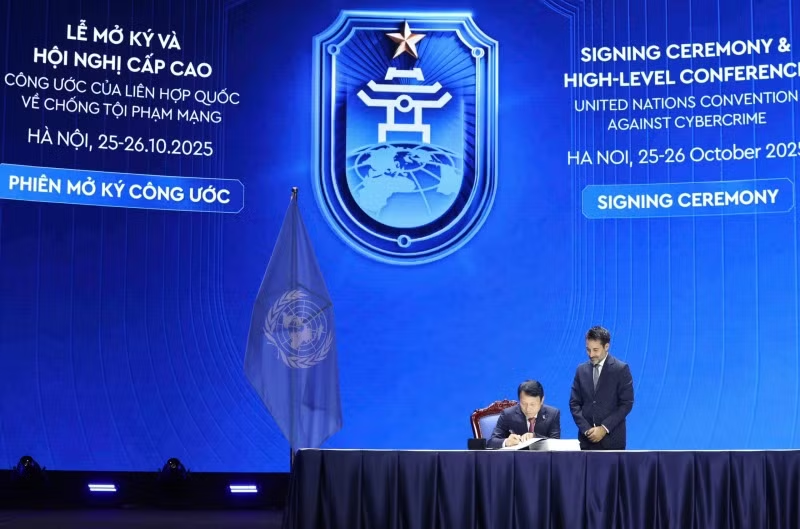
A Global Breakthrough in the Fight Against Cybercrime -0
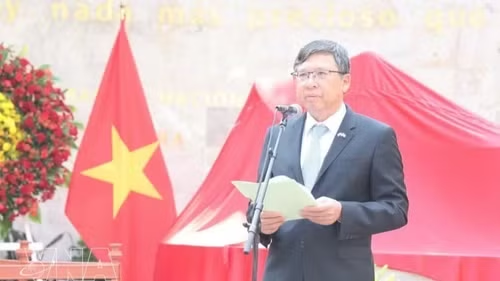
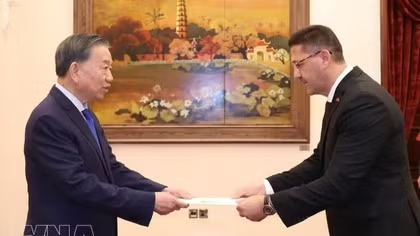
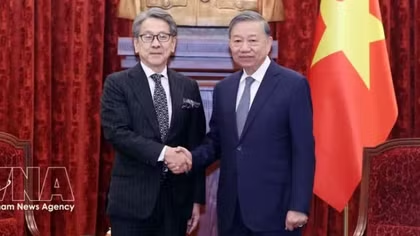
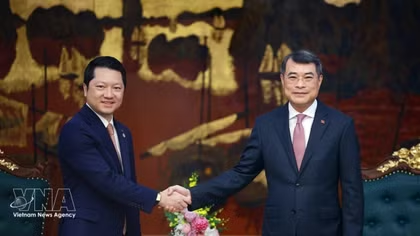
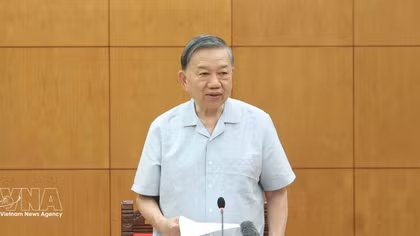
Minister of Public Security signs the Convention. 

Another significant advancement is the Convention’s strong emphasis on protecting human rights in cyberspace. Its procedural and investigative provisions underline the need to protect privacy and personal data.

Specially, the convention, for the first time, clearly defines the responsibilities of service providers and digital platforms, contributing to establishing a foundation for a safer, more transparent, and more accountable digital environment.

With its wide coverage, updated content and flexible cooperation mechanisms, the Hanoi Convention represents not only a major leap forward in terms of legal framework for combating cybercrime, but also a symbol of international goodwill and unity.

It reflects the concerted determination of the global community to build a secure, fair, and humane cyberspace — for the benefit of all nations and peoples.
By DT

Other News

National Assembly Chairman urges renovation in leadership, working style

National Assembly Chairman urges renovation in leadership, working style

The NA's Committee for Cultural and Social Affairs has moved fast to reshuffle its organisation after the 14th National Party Congress and the election of deputies to the 16th NA, updating its work agenda to match new directives set out in the resolutions of the 14th National Party Congress and the first Congress of the NA Party Organisation for the 2025–2030 term.

Vietnam treasures ties with Croatia: PM

Vietnam treasures ties with Croatia: PM

Vietnam and Croatia should strive to double bilateral trade turnover from the current level of 161 million USD; study the establishment of a Joint Committee on Economic Cooperation to create a long-term, stable, and effective framework for collaboration, said Prime Minister Le Minh Hung.

President Ho Chi Minh's enduring legacy highlighted at Venezuela commemoration

President Ho Chi Minh's enduring legacy highlighted at Venezuela commemoration

Vice President of the United Socialist Party of Venezuela (PSUV) Jesús Faria expressed deep admiration for President Ho Chi Minh and Vietnam’s indomitable struggle for national independence. He described President Ho Chi Minh as an immortal symbol of 20th-century national liberation movements, whose legacy continues to inspire leftist parties, progressive movements, and peoples across Latin America, including Venezuela.

Vietnam proposes key cooperation orientations at BRICS Foreign Ministers' Meeting

Vietnam proposes key cooperation orientations at BRICS Foreign Ministers' Meeting

Deputy Foreign Minister Nguyen Minh Hang shared Vietnam’s approach to building an independent and self-reliant economy linked to deep international integration, while proposing several key areas for enhanced cooperation between BRICS and partner countries at the Expanded BRICS Foreign Ministers' Meeting that opened on May 14 in India.

Vietnam asks parties to respect its sovereignty over Truong Sa

Vietnam asks parties to respect its sovereignty over Truong Sa

PSNews - The spokesperson stated that the dispatch of personnel by relevant parties to features belonging to Truong Sa without Vietnam’s permission constitutes a violation of Vietnam’s sovereignty under international law. She stressed that such actions run counter to the Declaration on the Conduct of Parties in the East Sea (DOC) as well as ongoing efforts by countries to negotiate a Code of Conduct in the East Sea (COC).

Hanoi to host ASEAN Future Forum 2026 in mid-June

Hanoi to host ASEAN Future Forum 2026 in mid-June

PSNews - Vietnam’s proposals placed the highest priority on ensuring a peaceful and stable environment conducive for continued sustainable development and improving the well-being and happiness of the ASEAN people. They were praised by member states and incorporated into the core contents of the ASEAN Leaders’ Statement on the response to the Middle East crisis.

Vietnam promotes cooperation with United Nations on crime prevention

Vietnam promotes cooperation with United Nations on crime prevention

Vietnam highly values the support of the United Nations Office on Drugs and Crime (UNODC) in strengthening national capacity in crime prevention and criminal justice, drug control, and addressing emerging challenges, particularly cybercrime, said Ambassador Vu Le Thai Hoang.

Party, State leader calls for consolidation of central steering committees on legal, judicial reform

Party, State leader calls for consolidation of central steering committees on legal, judicial reform

Consolidating the central steering committees for institutional and legal reform and for judicial reform is necessary in order to streamline organisational structures without reducing responsibilities, while ensuring clear accountability, measurable outputs and concrete results. Following the restructuring, the body will be renamed the central steering committee for institutional improvement and law enforcement, with the Party General Secretary and State President serving as its head.

Vietnam strives for substantive outcome at NPT review conference

Vietnam strives for substantive outcome at NPT review conference

At the meeting this week, Ambassador Viet briefed the UNGA President on developments during the first two weeks of the conference. He stressed that the current international geopolitical landscape poses numerous complex challenges, while reaffirming Vietnam’s determination, together with other member states, to promote substantive and balanced outcomes at the conference.

Top leader of Vietnam receives Vientiane official in Hanoi

Top leader of Vietnam receives Vientiane official in Hanoi

The host leader stressed that cooperation between localities, particularly between the capitals of Hanoi and Vientiane, plays an especially important role as a pioneering force in effectively implementing the foreign polices of the two Parties and States, while also serving as a bridge between politics and development, as well as between strategy and concrete action.