- ASEAN looks towards stronger group
- ASEAN+ children festival opens in Hanoi
- SOM of ASEAN+3 and EAS discuss regional concerns
- Vietnam to host World Economic Forum on ASEAN 2018
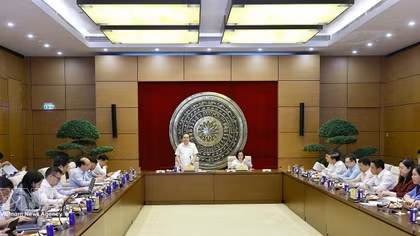
The conference, which drew the participation of famous domestic and international scientists and experts, was part of the activities carried out by the network of the ASEAN Institutes of Strategic and International Studies to observe the 50
th founding anniversary of ASEAN and to welcome new ideas and initiatives supporting the realization of the ASEAN Community Vision 2025.
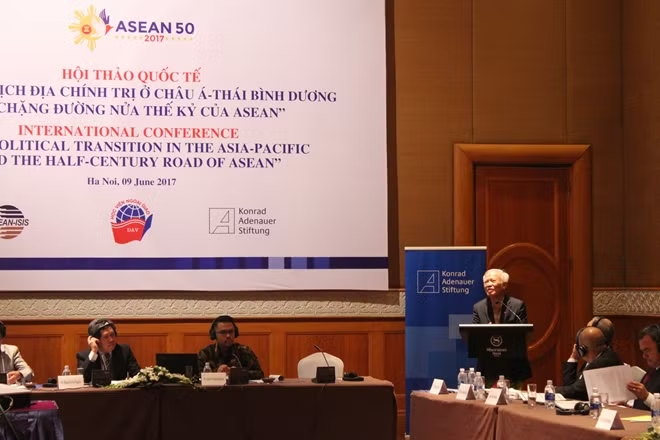 |
| Former Deputy Prime Minister Vu Khoan speaking at the event. |
ASEAN’s role in connecting up the region
50 years ago on August 8 1967, The Bangkok Statement was signed, leading to the birth of the Association of Southeast Asian Nations (ASEAN). Discussing the half-century road of the bloc, Associate Professor, Doctor Nguyen Vu Tung, Rector of the Vietnam Diplomatic Academy, said, ASEAN has reached historic achievements. Founded at the beginning of the Cold War with its membership of 5 regional nations, ASEAN has now developed into a closely connected community in Southeast Asia gathering in all the 10 regional nations. The development of the bloc has also turned a Southeast Asia with much conflict and tension, into a region of peace, stability and development. Likewise, the bloc’s development has grouped 10 regional countries with various differences into a united community pursuing the principles of dialogue, amity, unanimity, development and joint effort to deal with regional issues. From its initial position of a sub-regional cooperation arrangement, the bloc has now functioned as the nucleus and central role in Asia-Pacific cooperation mechanisms and structures as well as attracted the participation of major powers and international organizations from the region and world to the bloc-led multilateral cooperation mechanisms for common peace, stability and development.
“It can be said that ASEAN, which has overcome numerous difficulties and obstacles in the region and world over the past five decades, has now become the most successful regional cooperation organization in the world. The success of ASEAN is more valuable and proud as the European Union is busy dealing with the Brexit issue, the Asia-Pacific is experiencing increasing complexity with tough competition between major powers and the Middle-East is facing the ongoing diplomatic crisis,” Doctor Tung said.
Meanwhile, Deputy Foreign Minister Nguyen Quoc Dung highlighted the foundation of the ASEAN Community built on the three major pillars of politico-security, economy and socio-culture on December 31 2015 as a turning point in ASEAN’s history. He considered that the foundation of the community has marked a new phase of ASEAN’s development, helping the bloc unite itself, expand cooperation and connection in both internal and external terms, and make good preparations for an ASEAN Community with its close political connection, economic link and social responsibility sharing.
According to him, ASEAN is now seen as a stable but also dynamic economic entity, which is very adaptable to changes in the region and world. The bloc with a population of some 625 million, total GDP of US$ 3,000 billion and trade value of US$ 1,000 billion is the most potential market in the Asia-Pacific. What is more, the bloc has signed free trade agreements with all major regional partners, and is playing the central role in regional economic cooperation mechanisms as well as an important role in connecting the region with other major non-regional partners.
Sharing his view, Andrew Wiguna Mantong, a researcher at the Indonesian Institute of Strategic and International Studies, highlighted ASEAN’s significant achievements over the past 50 years. During the time, the bloc has successfully maintained regional stability via security cooperation and dialogue and on the basis of the ASEAN Ways: mutual resect for national independence, sovereignty and territorial integrity. The bloc also succeeded in attracting the engagement of major powers in regional arrangements for peace, stability and sustainable development in the region and world. Next, the bloc with its own Charter has a full legal status in relations with all countries, including major powers, as well as regional and international organizations. Finally, From economic perspective, the ASEAN economy has still maintained its stable growth while the global economy is witnessing a slow recovery.
“The amount of foreign direct investment of ASEAN countries in other ASEAN countries continuously increases. The number of tourists from ASEAN countries to other ASEAN countries also sees a sharp rise. Cooperation between/among ASEAN countries on transnational crime is expanded and deepened,” Andrew Wiguna Mantong stressed.
Challenges for ASEAN
Although ASEAN on its way to a regional community has a number of opportunities, it still faces many challenges for its future development.
The region and world have entered the 21
st century with unpredictable and complex changes, leading to a transition of power among major players and centers. The geostrategic changes have triggered a number of new challenges and emergent factors affecting regional and global security, such as violence waves, extremism, terrorism, nationalism and protectionism. Additionally, “hot spots” develop in terms of both number and intensity, and force rallying and competition between major powers for influence become more acute in several regions.
The Asia-Pacific, which has generated the fastest growth and the most dynamic economic development to the world, continues bringing a large number of opportunities to regional nations but also poses potential risks and challenges, mainly coming from the competition between major powers.
Thus, building strategic confidence and responsibly observing international law are central to all regional nations, particularly when a new regional order is taking shape.
What is more, the Korean peninsular issue, the North China Sea issue and East Sea (South China Sea) issue, which are all critical but unsettled, have made the region more fluid and left a negative impact on development of each country and the region as a whole.
“Facts show that continuous changes in the region and world bring both opportunities and challenges to ASEAN. Against this backdrop, ASEAN should seek good approaches to effectively respond to the challenges while successfully fulfilling its four major objectives: building a strong ASEAN Community and bringing more practical benefits to its people; strengthening its central role in the region and raising its status in the world; boosting intraregional economic connection and trade, promoting ASEAN’s competitiveness and attractiveness; and boosting social welfare, in line with the Sustainable Development Goals of the 2030 Agenda for Sustainable Development (SDG 2030), and increasing people connection and the Community’s values,” Vietnamese Deputy Foreign Minister said.
Regarding challenges facing ASEAN in the coming time, Professor Suchit Bunbongkarn, senior researcher at the Thai Institute for Security and International Studies, pointed out the Trump Administration’s unclear policy toward the Asia-Pacific region.
“No-one knows for sure what role the US will play in regional security under the Trump Administration. For many observers, President D. Trump is unpredictable. US policies could change from day to day,” Professor Suchit Bunbongkarn spoke at the conference.
According to Andrew Wiguna Mantong, ASEAN also faces political instability in some ASEAN member countries, and potentical risks that he called “wrong inspiration” the Brexit.
Underpinning “Unity in Variety”
ASEAN has been renowned for its nature “Unity in Variety”. Although ASEAN has received much support from the rest of the region and world, its successes have mainly resulted from its united strength and joint effort to overcome their differences. The half-century history of ASEAN has demonstrated that unity is the bloc’s strength and division will undermine the involved parites and the whole Community.
From recent complex developments in the region, there appear some doubts and worries about ASEAN unity and unanimity. Although many people believe that an exit will not happen to ASEAN, former Deputy Prime Minister Vu Khoan still suggested promoting intraregional unity and harmonizing benefits of a nation and interests of the ASEAN Community. The former Deputy Prime Minsiter cited a Vietnamese proverb, saying that one tree can not make a mount but three trees can do so. ASEAN has 10 “trees” so they can make a big mount when they are united, he concluded.
Further discussing the subject, Professor Suchit Bunbongkarn said, if ASEAN wants to continue its central role in regional issues and arrangements, it should improve its cacpacity by taking three major measures. First, ASEAN improves its capacity through augmenting national capacity of its member countries in all socio-political and economic terms. Second, leaders of ASEAN countries should drastically and seriously implement commitments for the sake of ASEAN, particularly in maintaining peace and stability, and at the same time, they should agree on political determination to together settle issues faced by ASEAN. Third, ASEAN should balance the region or ASEAN’s interests and national interests of ASEAN’s member countries. Finally, people in the ASEAN Community should be continuously encouraged to contribute to promoting regional peace and stability.