 |
Following is the full text of the article.
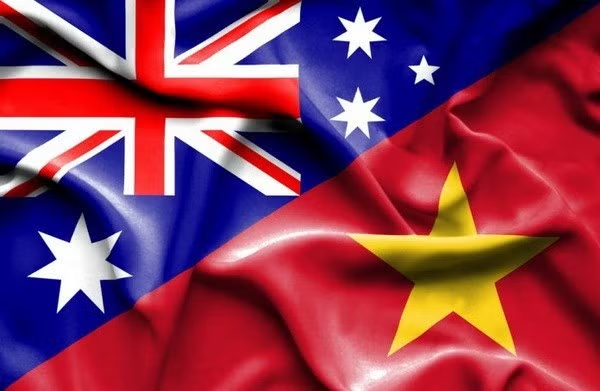
“The Prime Ministers of Australia and Vietnam, Malcolm Turnbull and Nguyen Xuan Phuc, will sign a strategic partnership agreement in Canberra on March 16.
This document will reflect the substantial progress in bilateral relations over the last forty-five years since diplomatic relations were established in 1973.
Over the last forty-five years Australia and Vietnam have built up strategic trust based on mutual respect and shared interests. In 2009, Australia and Vietnam agreed to form a comprehensive partnership (2009) and in 2015 they agreed to enhance the comprehensive partnership.
Today both countries cooperate in six major areas: trade and investment, development assistance, education, political and diplomatic, defence and security, science and technology and people-to-people exchanges.
Vietnam is Australia’s eighth largest trading partner, while Australia is Vietnam’s fifteenth largest trading partner. Two-way merchandise exports have grown to more than 10 billion AUD.
Australia’s provision of educational services tops its export list. Australia’s exports of metallurgical coal and minerals (aluminium, copper and zinc) have skyrocketed. Vietnam is Australia’s second largest live cattle and wheat market.
Australia is Vietnam’s nineteenth largest investor with a total of around 2 billion AUD in 378 projects (construction, services, education, processing industry and the agro-forestry-fisheries sector).
Australia’s official development assistance will total around 84 million AUD in 2017-18. There are six priority areas: private sector development, agriculture and rural development, infrastructure (Cao Lanh bridge), climate change mitigation, capacity building, innovation and gender equality.
Vietnam is Australia's fourth largest source of foreign students with nearly 25,000 Vietnamese students currently studying at all levels in Australia. By the end of 2018, more than 1,500 Australian students will have studied in Vietnam under the Australian government’s New Colombo Plan.
Australian universities are active in Vietnam. The Royal Melbourne Institute of Technology (RMIT) opened a campus in 2000. In recent years cooperation has deepened between education and research institutions. For example, the University of Technology Sydney offers a PhD in computer science in cooperation with Vietnam’s National University.
Australia and Vietnam regularly consult on political and diplomatic matters. For example, they hold a joint Foreign Affairs/Defence Strategic Dialogue at deputy-secretary/vice minister level annually.
Australia and Vietnam both share a commitment to regional peace, stability, and respect for international law. They work together in regional and international forums such as APEC and the East Asian Summit.
Australia and Vietnam also have an extensive defence and security relationship. Senior officials meet annually. In 2010, on the sidelines of the inaugural meeting of the ASEAN Defence Ministers’ Plus in Hanoi, Vietnam and Australia signed a Memorandum of Understanding Defence Cooperation. In 2013, the two countries inaugurated the Australia-Vietnam Defence Ministers' Meeting in Canberra.
Australia is a key provider of professional military education and training to the Vietnam People’s Army, particularly through the provision of English language skills. The Special Forces of both countries interact to share experience in countering terrorism. This year the Royal Australian Air Force will assist Vietnam in deploying a Level II field hospital to the United Nations Mission in South Sudan.
The Australian Federal Police (AFP) and Vietnam’s Ministry of Public Security cooperate to address a wide array of security matters such as law enforcement and transnational crime (people smuggling, drug trafficking and cyber crime).
Australia and Vietnam collaborate to promote science and technology including information and communications technology. The Commonwealth Scientific and Industrial Research Organisation (CSIRO) is extremely active in working with counterparts in Vietnam. According to one account, CSIRO officials make over one hundred and fifty visits to Vietnam each year. Recently the two sides inaugurated an annual high-level consultation on agriculture.
Finally, people-to-people exchanges round out the bilateral relationship. According to the 2016 Census, nearly 300,000 people in Australia claim Vietnamese ancestry. Citizens of both countries have developed personal ties through education, business, volunteer activities and tourism. In 2017, approximately 285,000 Australian tourists visited Vietnam.
Looking at what has been achieved is impressive but that is not enough. The new strategic partnership between Australia and Vietnam must be forward looking and reflect the reality that both countries have a growing convergence of national interests.
After the strategic partnership is signed both sides will have to work draw up a Plan of Action for the coming years. Three areas should be given priority:
First, the two sides should quickly move to initiate a ministerial-level consultation on the economic partnership to align trade, investment and development assistance to promote the greater integration of the two countries into the regional economy.
Second, Australia and Vietnam should step up defence and security cooperation to jointly meet emerging regional security challenges.
Third, both Australia and Vietnam need to promote innovation in all aspects of their bilateral relationship”