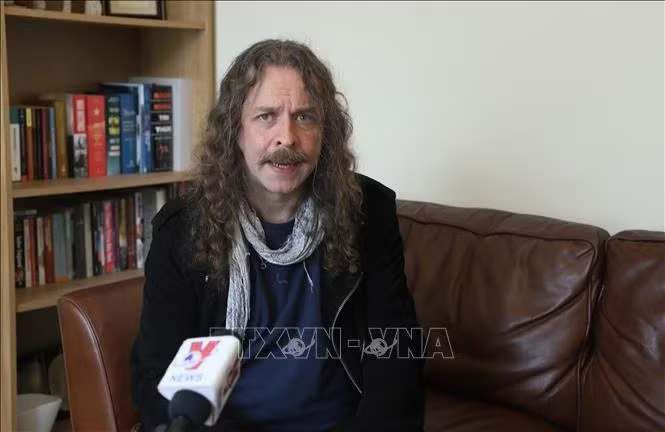
It is hard to see national liberation, reunification or path through peace and independence of Vietnam as a nation without the presence of President Ho Chi Minh and the stamp of his personality, British historian John Callow has said in a recent interview with the Vietnam News Agency on the occasion of the 134th birthday the later leader.
"Ho Chi Minh was an incredible figure on so many different levels: man of action, revolutionary, patriot, scholar, poet, politician, theorist and great Marxist, having all of these in his make-up, blended together like veins of gold running through him," stated John Callow.
According to the historian, Ho Chi Minh was a forerunner who he was on the road to where he wanted to be, to the great vision of unification. He laid a very clear road map to bring freedom, and prosperity to his country and people.
At times in his early career, Ho Chi Minh stood absolutely alone, the British scholar said, citing when he was at the founding conference of the Communist Party of France in the streets of Paris taking his message to the League of Nations appeals on behalf of the Vietnamese people who did not yet have a state. He always carried with him the vision of better days ahead and sought to achieve it.
"It was a long, incredibly rich career that saw him constantly learning, adapting, evolving, always carrying the people with him, always having a sense of what was new, of how the West and its industry and its ideas could not submerge Vietnam, but how those positive elements within it could enhance what was already there in Vietnamese culture," he noted.
The historian further said that is one of the secrets of the greatness of Ho Chi Minh, a man who could combine so many facets, a leader in the richest and most democratic sense of that word who could inspire people, who understood world culture and Vietnamese culture and combined the progressive legacies of Confucianism alongside the positive legacies of the West. Ho Chi Minh’s Marxism was not a dogma, was not something that could not be approved upon or applied, but was a guide to action that was creative, that could be individually tailored, and used above all in the service of the people.
For all these facts, Ho Chi Minh was truly remarkable. A world statesman of the highest calibre who understood socialist internationalism to his fingertips, who always saw unity- unity of the Party, of the people, but also of the wider socialist movement, he stated.
Speaking about Ho Chi Minh Thought, Callow said his writings, the four little volumes produced in the English language during the 1960s and the 1970s, are incredibly rich and varied. They deal with day to day topics, living in the moment, the problems of fighting imperialism, the problems of building in the future, items of Vietnamese traditional culture, the roles of religion, of women, and of the family.
According to Callow, there is nothing that his Thought does not touch, and within all of this, it is a creative conversation with his readership, with the people. It provides a spur to action, but also a very firm moral compass, rooted in the people, in the land, in the alliance with the small peasantry themselves. And all of these were the preconditions for victory, for transformation, for statehood, for breaking the shackles of empire and domination, and for removing the racism that had been vested upon the Vietnamese people, under French, and then under American colonisation.
The British scholar pointed out on all kinds of levels, President Ho Chi Minh’s message is freeing people, freeing their minds, freeing the chains of poverty, of absolute poverty, of subjugation, of allowing the nation to enjoy its full riches, to escape a poverty not only that is absolute in terms of having a good standard of living, but also a mental poverty being shackled into a colonial deferential mindset.
In his opinion, President Ho Chi Minh’s Thought is truly remarkable, because it folds just like the finely tempered steel of a metal blade, with so many different sources and ideas. Ho Chi Minh, whose father was a Confucian scholar, has seen Vietnamese traditional culture. But also he had been to Europe, and in that experience of really being in the centre of the European Enlightenment thought, the world of Spinoza as well as Marx or Lenin, never once did he abandon his own host culture.
He never lost sight of his people or their great cultural gains. So everything he learned, everything he brought back, the version of Marxism that he forged through the struggle of the Independence War, was a creative process where he was able to take the very best from Western thought and philosophy and economics and marry it to Vietnamese traditional culture.
"This has made Ho Chi Minh Thought so durable. It was a process to seeing the world, a guide to action, and a series of principles. He pointed out that has what has enabled the Party and people of Vietnam to go forward in a creative manner, to surmount the terrible difficulties they've had since the late 1980s, to survive in a world that so often is hostile to them, to creatively apply the principles of Doi Moi (Renewal)," he said.
The historian said today Vietnam is changing, being on the global scene and operating in global markets. The country has recovered itself splendidly and its young vibrant population deserve the good things in life. He believed President Ho Chi Minh’s creative dynamic could lead seamlessly to the achievements of national liberation through the terrible fights that inspired generations of Vietnamese to follow in his flame, to follow in his path, to make those sacrifices for a better world.
John Callow is a historian, author and trade unionist. He has written widely on Early Modern witchcraft, politics and popular culture. His books include Witchcraft & Magic in Sixteenth- and Seventeenth-Century Europe (co-authored with Professor Geoffrey Scarre); James II: King in Exile; Embracing the Darkness: A Cultural History of Witchcraft, and The Last Witches of England: A Tragedy of Sorcery and Superstition.