Capital Law 2026 paves way for Hanoi's new development model

One of the key breakthroughs of the new resolutions is the shift from a traditional management-oriented approach to a development-enabling model. The proposed policies are designed not only to address current issues but also to establish the foundation for a more modern, proactive and flexible system of urban governance.

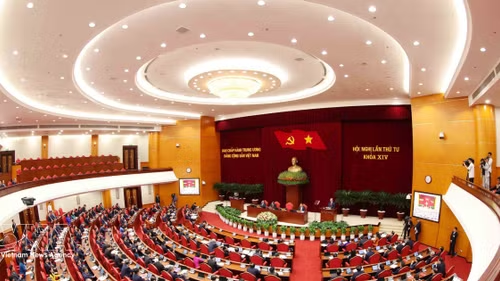
vnanet-khai-mac-ky-hop-thu-tu-hdnd-thanh-pho-ha-noi-khoa-xvii-anh-ttxvn.jpg
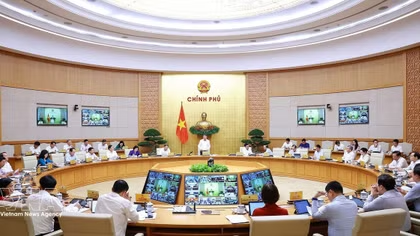
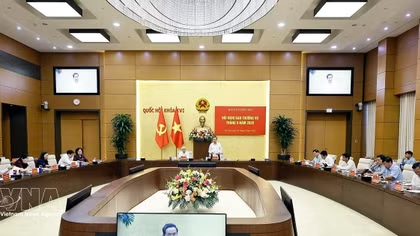
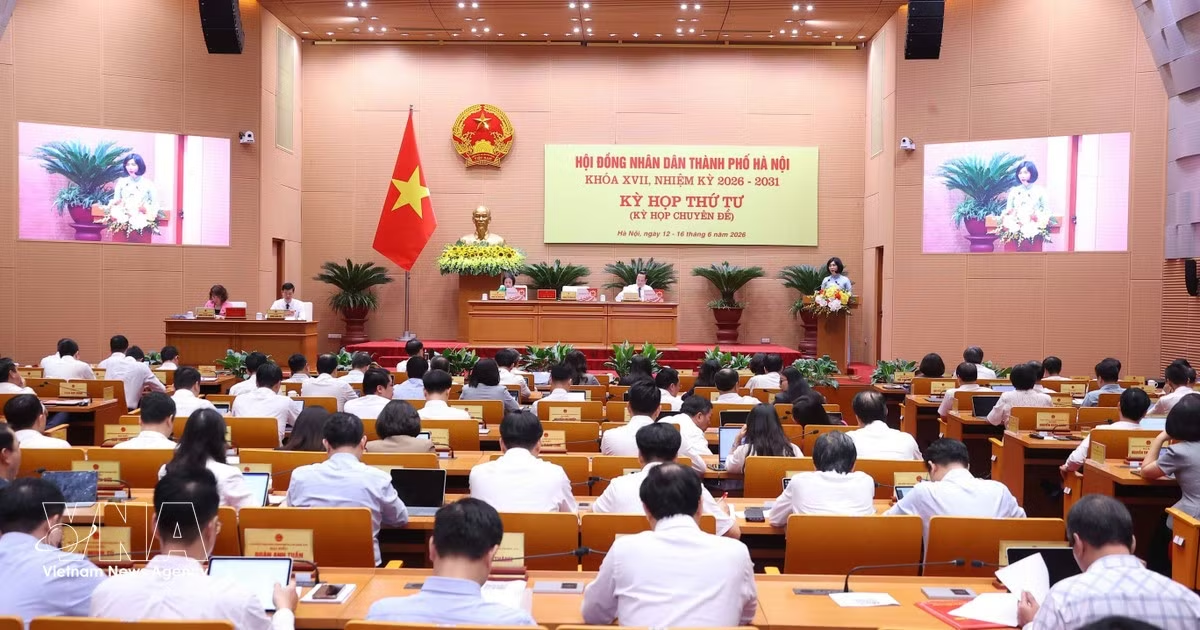
An overview of the 4th session of the 17th Hanoi People’s Council for the 2026–2031 term. (Photo: VNA)

The mechanisms and policies designed to implement the Capital Law 2026 will not only address immediate challenges but also open up new development opportunities, laying the foundation for a modern urban governance model and enhancing Hanoi’s long-term competitiveness.

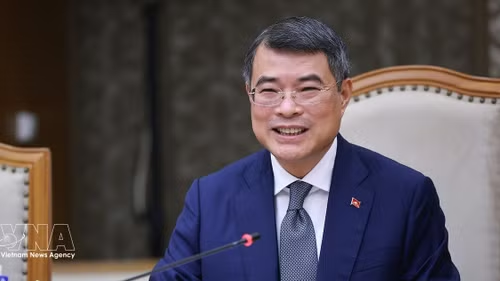
The statement was made by Chairman of the municipal People’s Committee Vu Dai Thang while presenting a package of special mechanisms and policies to implement the law at the 4th session of the 17th Hanoi People’s Council for the 2026–2031 term on June 12.

According to Thang, the session carries particular significance as it seeks to complete the entire system of resolutions needed to implement the Capital Law before it takes effect on July 1.

Under the implementation roadmap, Hanoi is required to translate all mechanisms and policies authorised under the law into specific regulations. To date, the municipal People’s Council has approved a number of important resolutions, and many others are expected to be considered and adopted during this session in order to complete the legal framework for the capital city’s next phase of development.

One of the key breakthroughs of the new resolutions is the shift from a traditional management-oriented approach to a development-enabling model. The proposed policies are designed not only to address current issues but also to establish the foundation for a more modern, proactive and flexible system of urban governance.

A major focus is expanding development space for the capital through strategic policy instruments. These include urban development based on a multi-layered, multi-centre model aligned with transit-oriented development (TOD) principles, as well as more efficient management and utilisation of land resources and development space, including underground infrastructure and emerging urban areas.

A series of resolutions relating to high-tech parks and high-tech industrial zones are expected to facilitate pilot economic development mechanisms. Construction, transport, green mobility, clean energy transition, science and technology, innovation and digital transformation have also been identified as priority sectors to support Hanoi’s future growth.

In the fields of healthcare, education, culture and social development, the city is introducing a range of special policies aimed at strengthening public service systems while preserving and promoting its cultural heritage.

Thang emphasised that all resolutions have been developed with people and businesses at the centre. Many of the policies are intended to improve the investment and business environment, attract strategic investors, enhance public services, expand social welfare programmes and improve access to high-quality healthcare, education and transport services.

The resolutions also focus on improving the quality of public administration and human resources. The Capital Law allows Hanoi to introduce special mechanisms for recruiting and utilising highly skilled talents, and establish dedicated policies for public officials, civil servants and employees paid from the municipal budget.

Acknowledging the challenges involved, the city leader noted that many of the policies are unprecedented and involve entirely new approaches. He stressed that the resolutions under consideration are not merely legal documents, but strategic decisions that will shape a new development model for Hanoi in the years ahead./.
VNA
en.vietnamplus.vn

Other News

Vietnam and Panama can become gateways linking two regions

Vietnam and Panama can become gateways linking two regions

"Panama can serve as a strategic platform for Vietnamese companies seeking greater access to Latin America and the Caribbean, while Vietnam represents an important gateway for strengthening Panama’s engagement with Southeast Asia", Ambassador Nubiela Ayala Modes confirmed.

Localities committed to achieving 2026 growth targets

Localities committed to achieving 2026 growth targets

Localities nationwide hailed effective and flexible directions delivered by the Government so far this year, resulting in positive nine-month socio-economic growth, and reaffirmed their commitment to achieving targets set for the whole 2026 at an online Government-locality conference on October 3.

Creating new drivers for Vietnam-Canada cooperation

Creating new drivers for Vietnam-Canada cooperation

The elevation of bilateral ties to a Strategic Partnership shows that Vietnam and Canada increasingly view each other not simply as trading partners, but as long-term partners in addressing economic, technological and regional challenges.

Top leader asks for sports development to build national strength

Top leader asks for sports development to build national strength

The top leader applauded the efforts of ministries, sectors, localities, social organisations, coaches, athletes, experts in developing physical education and sports in recent times, stressing that Resolution No. 08 has provided an important political foundation for sports development over the past 15 years, while Conclusion No. 70 set important orientations for the new period.

Vietnam mobilises resources to affirm its leadership role in APEC 2027

Vietnam mobilises resources to affirm its leadership role in APEC 2027

PSNews - Vietnam is recognised by its partners as an influential member of the Asia-Pacific Economic Cooperation (APEC) forum, with expectations that it will continue to demonstrate leadership when it hosts APEC for the third time in 2027, according to Standing Deputy Minister of Foreign Affairs Nguyen Minh Vu.

Top Vietnamese leader receives Chairman of Japan Bank for International Cooperation

Top Vietnamese leader receives Chairman of Japan Bank for International Cooperation

General Secretary and President Lam urged JBIC to continue promoting the substantive implementation of projects under the Asia Zero Emission Community (AZEC), and step up discussions on potential cooperation within the framework of the POWERR Asia (Partnership on Wide Energy and Resources Resilience Asia) initiative, including the development of strategic energy reserves.

NA, Government's Party committees meet on legislature's second session agenda

NA, Government's Party committees meet on legislature's second session agenda

National Assembly President Tran Thanh Man coordination must go beyond finishing the agenda to improve the quality of NA decisions and Government enforcement; deal with policies rather than just paperwork, especially in the fight against corruption and other negative phenomena; and pin down final responsibility for each product, not just progress.

Prime Minister receives Cambodian Minister of Inspection

Prime Minister receives Cambodian Minister of Inspection

Prime Minister Le Minh Hung asked the two countries' inspection agencies to build on their achievements by regularly exchanging information and experience, maintaining delegation exchanges, and coordinating inspections in areas related to bilateral economic, trade and investment cooperation.

Urgent action needed to address law enforcement as weak link: Top leader

Urgent action needed to address law enforcement as weak link: Top leader

General Secretary of the Communist Party of Vietnam Central Committee and President To Lam on September 28 called for urgent and fundamental improvements in law enforcement, stressing that legislation and its enforcement must form a unified whole and ultimately serve development, protect legitimate rights and interests, and strengthen public trust.

Vietnamese, Cambodian inspectors reinforce collaboration

Vietnamese, Cambodian inspectors reinforce collaboration

The Government Inspectorate of Vietnam broadly accepted the Cambodian ministry's proposals to maintain, renew and make more effective regular meetings between professional units and training establishments, and increase exchanges of senior, expert and specialised working-group delegations.