Many countries, including the United States and Australia, recently released statements and sent strongly-worded notes to the United Nations, rejecting the unlawful Chinese sovereignty claims in the South China Sea.
The move comes following a ruling made by the Permanent Court of Arbitration in the Hague on July 12, 2016, which ruled against China in the South China Sea disputes.
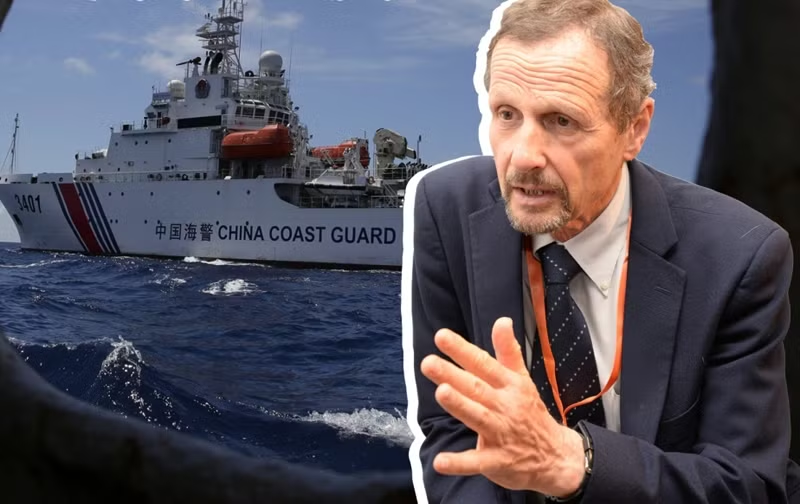
Dr. Leszek Buszynski, an Honorary Professor at Australia’s Strategic & Defence Studies Centre, says China ignores international law when it comes to the South China Sea issue.
Dr. Leszek Buszynski, an Honorary Professor at Australia’s Strategic & Defence Studies Centre, told VOV that the ruling offered the Asian superpower the chance to change its mind, although so far is seems to have failed to alter its course.
According to Dr. Buszynski, China knew very well that the US would ‘not take sides’ in ongoing sovereignty claims in the South China Sea, with the only issue it cared about was maintaining freedom of navigation and overflight in the area. Therefore, China has always appeared to support freedom of navigation and overflight, even going so far as to pledge not to militarise the South China Sea in an attempt to reassure the US and countries both inside and outside the region.
Despite these promises, the reality appears completely different. The northern neighbour still went ahead and reclaimed and transformed reefs into artificial islands around Vietnam’s Spratly Islands. It even built a wharf and a runway, while establishing administrative units and militarising the artificial islands, in an effort to turn them into “things of the past".
China also repeatedly pressed other East Sea claimants to halt oil and gas exploration and exploitation projects within their continental shelves, with the aim of intentionally turning undisputed waters into disputed ones, therefore seriously changing the status quo and the balance of forces in the South China Sea.
China and its escalating standoff in regional waters
It is noteworthy that the northern neighbour caused two controversial incidents in the South China Sea back in 2019, sparking widespread condemnation from the public. In one incident, a Chinese ship sank and abandoned a Philippine vessel that had 22 people onboard in June, with the crew later being rescued by a Vietnamese fishing vessel. Two months after this, it illegally moved its geological survey ship the Haiyang Dizhi 8 into the Vietnamese exclusive economic zone and continental shelf.
This year has seen China flex its muscles in the region by using its oppressive power to continue carrying out wrongful actions in all maritime zones within its unlawfully claimed “nine-dash line”.
April saw a Chinese coast guard ship ram and sink a Vietnamese fishing vessel with eight people on board as they were in the process of fishing in the waters of the country’s Paracel archipelago.
Following this incident, China was denounced after one of its warships had readied its guns for firing at a Philippine Navy ship near the Philippine-occupied Rizal Reef, also known as the Commodore reef, in the West Philippine Sea.
Simultaneously, the Asian superpower has been escalating its own maritime standoff with Malaysia. This comes after it moved its geological survey ship the Haiyang Dizhi 8 close to Malaysian waters where the West Capella, a drillship operated by London-managed Seadrill and contracted to Malaysia’s Petronas, was operating. At one point, the Haiyang Dizhi 8 was escorted by up to 10 Chinese Coast Guard and military ships.
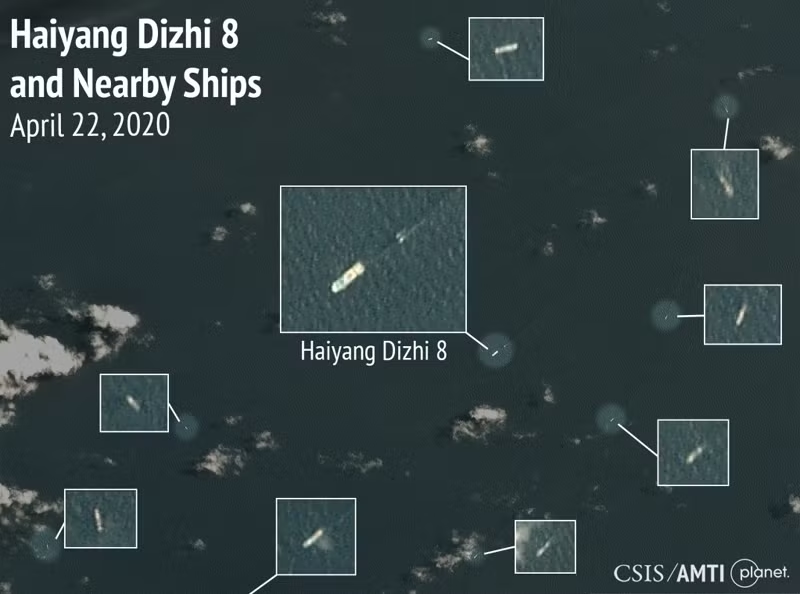
China's Haiyang Dizhi 8 at one point is escorted by up to 10 Chinese Coast Guard and military ships entering close to Malaysian waters in April 2020 (Photo: CSIS/AMTI)
Similar incidents occurred in both late 2019 and early this year, with a Chinese coast guard vessel escorting several Chinese fishing boats into waters within China’s self-proclaimed “nine-dash line”, despite also being inside Indonesia’s exclusive economic zone close to the Natuna Islands in the South China Sea. The incident forced Jakarta to deploy eight warships and several F-16 fighters to the area in order to “patrol and ensure security”.
Most dangerously, on April 18, the Chinese Ministry of Civil Affairs announced a decision by the Chinese State Council to establish two administrative districts named Xisha and Nansha under its so-called Sansha city in order to govern the Vietnamese Paracel and Spratly islands.
A day after this, the Chinese Ministry of Civil Affairs arbitrarily announced that it had given names to 25 islands, shoals, and reefs, along with 55 oceanic mountains and ridges within the vicinity of the Paracel and Spratly Islands.
Furthermore, they also ramped up tensions by setting up scientific research stations on artificial islands, sending fighters to the Paracel and Spratly Islands, increasing military exercises in the South China Sea, maintaining a fishing ban, and declaring a seabed mining ban under the Blue Sea Code campaign launched in April.
The ‘Four Sha’ claim represents new wine in an old bottle
Following the court ruling in 2016, China switched its tactics to put forward a so-called ‘Four-Sha’ claim, a literal expression of China’s so-called Nanhai Zhudao, known as the South China Sea Islands. China claimed that its Nanhai Zhudao consisted of Paracels, Spratlys, Pratas, and the Macclesfield Bank.
In addition to sending a note to the UN Secretary-General in which China unlawfully declared the establishment of two administrative units to govern the Paracel and Spratly archipelagos of Vietnam, the northern neighbour has been striving to institutionalise the so-called ‘Four-Sha’. This would see the policy be a part of its national administrative management system, a new step aimed at controlling territory in the South China Sea.
Commenting on its South China Sea policy, Gregory Poling, director of the Asia Maritime Transparency Initiative at the US-based Center for Strategic & International Studies, told VOV that China’s latest claim is nothing new, in fact, it can simply be considered to be new wine in an old bottle.
Similar to its previous ‘nine-dash line’ claim, Poling said the new ‘Four-Sha’ claim is also illegal, prompting the US, Australia, and several other countries to state that there is no legal basis for them to draw straight baselines which connect the outermost points of maritime features or ‘island groups’ in the South China Sea. Indeed, this includes around the ‘Four Sha’, ‘continental’, or ‘outlying’ archipelagos.
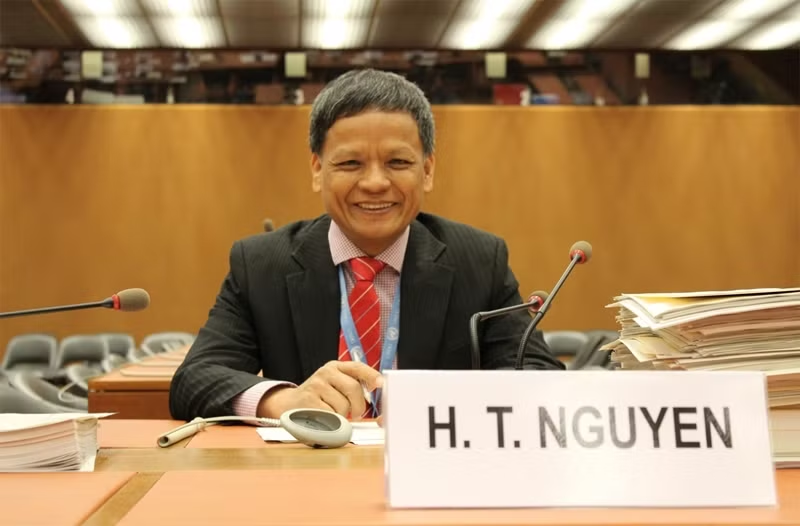
Ambassador, Assoc. Prof. & Dr. Nguyen Hong Thao, an expert on international law, states that China's Four-Sha claim represents new wine in an old bottle. (Photo: VNA)
Sharing Poling’s opinion, the Ambassador, Assoc. Prof. & Dr. Nguyen Hong Thao, an expert on international law, declared that China has put forward an extreme interpretation with regard to its latest claim, therefore enabling it to extend power beyond the so-called ‘nine-dash-line’.
China is continuing to use the tactic of turning the area into a disputed zone, deliberately adopting a vague, inexplicable stance aimed at inciting opponents, causing new problems, and creating a legal basis to establish a permanent presence and new administrative units in the South China Sea. These actions run in contrary to the United Nations Charter and the 1982 UN Convention of the Law of the Sea.
With the US recently taking a more direct approach to the South China Sea issue, many have expressed hope that US Secretary Mike Pompeo’s statement on July 13 will have a positive influence on the regional problem. Nevertheless, Dr. Buszynski said Secretary Pompeo’s statement will not settle any ongoing disputes at sea, with China set to continue rejecting the court’s ruling regardless of wider international support, nor will it help the causes of other claimants such as Malaysia, the Philippines, and Vietnam.
The key question therefore concerns China’s actual motive. Why is it that Beijing is not willing to listen to justice, despite international public opinion? Why does it continue to carry out wrongful actions in order to realise its irrational claims, especially in the context of the novel coronavirus pandemic raging across the globe?