China–Vietnam cooperation reaching new heights: Chinese expert

With continued high-level guidance, deeper strategic trust, expanded mutually beneficial cooperation and stronger public support, the building of the China–Vietnam community with a shared future is expected to make steady and substantive progress.

Cooperation between China and Vietnam is advancing to a new level, driven by shared strategic interests, development needs and a common responsibility for regional stability, according to a Chinese scholar.

Writing in the Global Times, a publication affiliated with the People's Daily, Lei Xiaohua, a researcher at the Guangxi Academy of Social Sciences, highlighted the outcomes of the recent state visit to China by General Secretary of the Communist Party of Vietnam Central Committee and State President To Lam from April 14–17.
China–Vietnam cooperation reaching new heights: Chinese expert -0
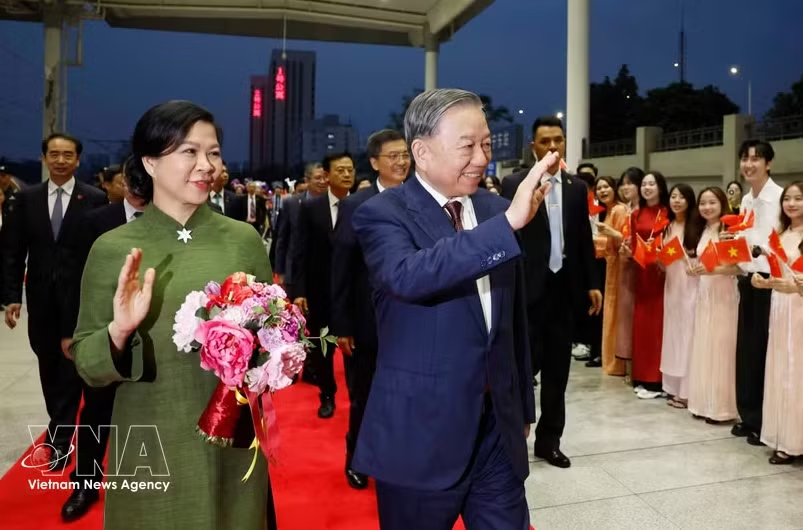
General Secretary of the Communist Party of Vietnam Central Committee and State President To Lam and his spouse Ngo Phuong Ly visit Nanning city as part of their state visit to China. Photo: VNA

During the visit, the two countries issued a joint statement on further deepening the Vietnam-China Comprehensive Strategic Cooperative Partnership and advancing the building of a China–Vietnam community with a shared future that carries strategic significance at a higher level, signaling an acceleration of bilateral ties into a new phase.

According to the author, profound changes in the international environment, marked by rising unilateralism and protectionism, shifts in global supply chains, intensifying geopolitical competition, and growing uncertainties, have made regional stability and strategic cooperation more critical than ever. In this context, enhancing strategic exchanges and deepening cooperation between the two countries is both necessary for their respective modernisation efforts and essential for addressing shared challenges.

The article identifies four key dimensions underpinning the elevation of bilateral cooperation. First, political trust has reached a higher level. The joint statement underscores shared aspirations and a common future, stating that the development of China–Vietnam relations carries strategic, comprehensive, and historical significance. It also affirms that “building the China–Vietnam community with a shared future that carries strategic significance at a higher level” as the general orientation for bilateral relations in the new phase. This indicates that upgrading China–Vietnam cooperation begins with further strengthening the positioning of the relationship and mutual strategic trust.

Second, strategic connectivity has been enhanced. The joint statement outlines concrete pathways, including aligning the Belt and Road Initiative with the “Two Corridors, One Economic Belt” framework, boosting bilateral trade connectivity with infrastructure, logistics and market linkages, and accelerating cross-border transport connectivity. Railway cooperation, in particular, is expected to become a new highlight of strategic collaboration.

Third, cooperation content has expanded in both scope and quality. A total of 32 cooperation agreements were signed during this visit across sectors such as economy, supply chains, customs, science and technology, human resources and social development. The emphasis is shifting from scale expansion to quality enhancement and modernisation, with science, technology and innovation identified as key drivers.

Fourth, public support has been strengthened. Both sides are promoting people-to-people exchanges through initiatives such as youth programmes, cultural forums and tourism cooperation, with a view to transforming traditional friendship into broader, more stable and sustainable social consensus, Lei wrote.

The researcher further noted that the elevation of China–Vietnam relations carries broader significance. It contributes to regional peace and stability, reinforces commitment to multilateralism and an international order centred on the United Nations, and makes important contributions to regional stability and prosperity amid global uncertainties.

In conclusion, the article emphasised that elevating bilateral cooperation is an inevitable choice to meet global shifts, regional dynamics and the evolving needs of both countries. With continued high-level guidance, deeper strategic trust, expanded mutually beneficial cooperation and stronger public support, the building of the China–Vietnam community with a shared future is expected to make steady and substantive progress.
VNA

Other News

National Assembly Chairman urges renovation in leadership, working style

National Assembly Chairman urges renovation in leadership, working style

The NA's Committee for Cultural and Social Affairs has moved fast to reshuffle its organisation after the 14th National Party Congress and the election of deputies to the 16th NA, updating its work agenda to match new directives set out in the resolutions of the 14th National Party Congress and the first Congress of the NA Party Organisation for the 2025–2030 term.

Vietnam treasures ties with Croatia: PM

Vietnam treasures ties with Croatia: PM

Vietnam and Croatia should strive to double bilateral trade turnover from the current level of 161 million USD; study the establishment of a Joint Committee on Economic Cooperation to create a long-term, stable, and effective framework for collaboration, said Prime Minister Le Minh Hung.

President Ho Chi Minh's enduring legacy highlighted at Venezuela commemoration

President Ho Chi Minh's enduring legacy highlighted at Venezuela commemoration

Vice President of the United Socialist Party of Venezuela (PSUV) Jesús Faria expressed deep admiration for President Ho Chi Minh and Vietnam’s indomitable struggle for national independence. He described President Ho Chi Minh as an immortal symbol of 20th-century national liberation movements, whose legacy continues to inspire leftist parties, progressive movements, and peoples across Latin America, including Venezuela.

Vietnam proposes key cooperation orientations at BRICS Foreign Ministers' Meeting

Vietnam proposes key cooperation orientations at BRICS Foreign Ministers' Meeting

Deputy Foreign Minister Nguyen Minh Hang shared Vietnam’s approach to building an independent and self-reliant economy linked to deep international integration, while proposing several key areas for enhanced cooperation between BRICS and partner countries at the Expanded BRICS Foreign Ministers' Meeting that opened on May 14 in India.

Vietnam asks parties to respect its sovereignty over Truong Sa

Vietnam asks parties to respect its sovereignty over Truong Sa

PSNews - The spokesperson stated that the dispatch of personnel by relevant parties to features belonging to Truong Sa without Vietnam’s permission constitutes a violation of Vietnam’s sovereignty under international law. She stressed that such actions run counter to the Declaration on the Conduct of Parties in the East Sea (DOC) as well as ongoing efforts by countries to negotiate a Code of Conduct in the East Sea (COC).

Hanoi to host ASEAN Future Forum 2026 in mid-June

Hanoi to host ASEAN Future Forum 2026 in mid-June

PSNews - Vietnam’s proposals placed the highest priority on ensuring a peaceful and stable environment conducive for continued sustainable development and improving the well-being and happiness of the ASEAN people. They were praised by member states and incorporated into the core contents of the ASEAN Leaders’ Statement on the response to the Middle East crisis.

Vietnam promotes cooperation with United Nations on crime prevention

Vietnam promotes cooperation with United Nations on crime prevention

Vietnam highly values the support of the United Nations Office on Drugs and Crime (UNODC) in strengthening national capacity in crime prevention and criminal justice, drug control, and addressing emerging challenges, particularly cybercrime, said Ambassador Vu Le Thai Hoang.

Party, State leader calls for consolidation of central steering committees on legal, judicial reform

Party, State leader calls for consolidation of central steering committees on legal, judicial reform

Consolidating the central steering committees for institutional and legal reform and for judicial reform is necessary in order to streamline organisational structures without reducing responsibilities, while ensuring clear accountability, measurable outputs and concrete results. Following the restructuring, the body will be renamed the central steering committee for institutional improvement and law enforcement, with the Party General Secretary and State President serving as its head.

Vietnam strives for substantive outcome at NPT review conference

Vietnam strives for substantive outcome at NPT review conference

At the meeting this week, Ambassador Viet briefed the UNGA President on developments during the first two weeks of the conference. He stressed that the current international geopolitical landscape poses numerous complex challenges, while reaffirming Vietnam’s determination, together with other member states, to promote substantive and balanced outcomes at the conference.

Top leader of Vietnam receives Vientiane official in Hanoi

Top leader of Vietnam receives Vientiane official in Hanoi

The host leader stressed that cooperation between localities, particularly between the capitals of Hanoi and Vientiane, plays an especially important role as a pioneering force in effectively implementing the foreign polices of the two Parties and States, while also serving as a bridge between politics and development, as well as between strategy and concrete action.