Cooperation in East Sea fisheries management, environmental protection

A Blueprint for Fisheries Management and Environmental Cooperation in the East Sea, a tool to improve management and maintain stability in the East Sea, was introduced by the US’s Center for Strategic and International Studies last year.

This is the first product of the CSIS Expert Working Group on the East Sea, which seeks to create a feasible model for claimants to manage maritime disputes.

The Blueprint, developed by the Asia Maritime Transparency Initiative, aims to set up a group of experts from around the region who are familiar with environmental laws and policies to develop models of conduct for fisheries management and environmental protection in the East Sea.
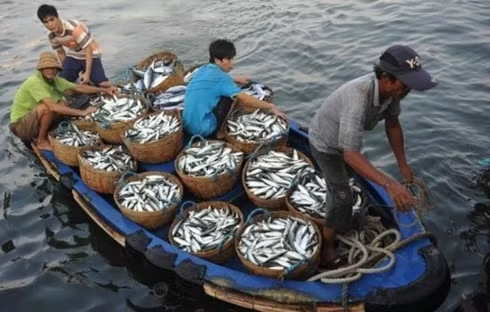
Cooperation in East Sea fisheries management, environmental protection.

States responsible for cooperation in marine environmental protection

According to CSIS, the East Sea is one of the world’s five most productive fishing zones, accounting for about 12 percent of all fish caught in 2015. More than half of the world’s fishing vessels operate in these waters. All claimants bordering the East Sea should be involved in the creation and management of East Sea fisheries zones, regardless of the location of their territorial and maritime claims.

Gregory Poling, Director of the Maritime Transparency Initiative of the CSIS, said that unlike hydrocarbons, for which exploitation rights are based only upon a state’s entitlement to the continental shelf, the obligation to jointly steward living marine resources makes fisheries management and environmental protection “low hanging fruit” for cooperation in the East Sea. 

With political will, it is entirely possible for nations bordering the East Sea to cooperatively protect these ecosystems and manage fish stocks without prejudice to their overlapping territorial and maritime claims. 

Mr. Poling said, "In fact we are clear that for this work all claimants will have to agree that nothing in the framework will amount to a compromise on the eventual sovereignty claim but the UN Convention on the Law of the Sea is filled with requirements for states to cooperate in fisheries management and environmental protection."

Article 123 of the United Nations Convention on the Law of the Sea (UNCLOS) mandates that states bordering semi-enclosed seas like the East Sea are obligated to cooperate in areas that include the protection of the marine environment and management of fish stocks. 

This is reflective of the deeply interconnected ecologies of semi-enclosed seas, in which currents cycle marine life (and pollution) through the region without regard for national jurisdiction. Moreover, Article 192 of UNCLOS provides a general obligation for states to “protect and preserve the marine environment.”

Protect marine environment through multilateral cooperation

The international legal obligation to cooperate on fisheries management and the environment is matched by practical necessity. Communities all around the East Sea are highly dependent on fish stocks for both food security and local livelihoods. Yet the region has seen catch rates plummet in recent years thanks to a combination of overfishing and willful environmental destruction. The entire East Sea is teetering on the edge of a fisheries collapse, and the only way to avoid it is through multilateral cooperation in disputed waters. 

Mr Poling said, "In the case of outstanding maritime disputes, states have responsibilities to find pragmatic solutions, mechanisms to work through disputes. We have two options. We can either think of creative ways to manage the resources of the ocean or we can spend the next 20 years arguing about sovereignty disputes but the fish is all gonna die in the next 10 years. So it will be lot easier to resole the disputes when there’s no fish left to worry about. But I don’t think that what’s anybody want."

To that end, the Blueprint for Fisheries Management and Environmental Cooperation in the East Sea suggests claimants should agree to establish a Fishery and Environmental Management Area in the East Sea; split enforcement responsibilities between occupiers and flag states; agree not to use subsidies to encourage fishing within the already overfished East Sea; coordinate efforts to reintroduce giant clams and other threatened species such as sea turtles to depopulated reefs in the East Sea; avoid activities that damage the marine environment or alter the seabed; cooperate on marine research, which is necessary to assess the health of the maritime environment and effectively implement conservation efforts.
VOVWorld

Other News

National Assembly Chairman urges renovation in leadership, working style

National Assembly Chairman urges renovation in leadership, working style

The NA's Committee for Cultural and Social Affairs has moved fast to reshuffle its organisation after the 14th National Party Congress and the election of deputies to the 16th NA, updating its work agenda to match new directives set out in the resolutions of the 14th National Party Congress and the first Congress of the NA Party Organisation for the 2025–2030 term.

Vietnam treasures ties with Croatia: PM

Vietnam treasures ties with Croatia: PM

Vietnam and Croatia should strive to double bilateral trade turnover from the current level of 161 million USD; study the establishment of a Joint Committee on Economic Cooperation to create a long-term, stable, and effective framework for collaboration, said Prime Minister Le Minh Hung.

President Ho Chi Minh's enduring legacy highlighted at Venezuela commemoration

President Ho Chi Minh's enduring legacy highlighted at Venezuela commemoration

Vice President of the United Socialist Party of Venezuela (PSUV) Jesús Faria expressed deep admiration for President Ho Chi Minh and Vietnam’s indomitable struggle for national independence. He described President Ho Chi Minh as an immortal symbol of 20th-century national liberation movements, whose legacy continues to inspire leftist parties, progressive movements, and peoples across Latin America, including Venezuela.

Vietnam proposes key cooperation orientations at BRICS Foreign Ministers' Meeting

Vietnam proposes key cooperation orientations at BRICS Foreign Ministers' Meeting

Deputy Foreign Minister Nguyen Minh Hang shared Vietnam’s approach to building an independent and self-reliant economy linked to deep international integration, while proposing several key areas for enhanced cooperation between BRICS and partner countries at the Expanded BRICS Foreign Ministers' Meeting that opened on May 14 in India.

Vietnam asks parties to respect its sovereignty over Truong Sa

Vietnam asks parties to respect its sovereignty over Truong Sa

PSNews - The spokesperson stated that the dispatch of personnel by relevant parties to features belonging to Truong Sa without Vietnam’s permission constitutes a violation of Vietnam’s sovereignty under international law. She stressed that such actions run counter to the Declaration on the Conduct of Parties in the East Sea (DOC) as well as ongoing efforts by countries to negotiate a Code of Conduct in the East Sea (COC).

Hanoi to host ASEAN Future Forum 2026 in mid-June

Hanoi to host ASEAN Future Forum 2026 in mid-June

PSNews - Vietnam’s proposals placed the highest priority on ensuring a peaceful and stable environment conducive for continued sustainable development and improving the well-being and happiness of the ASEAN people. They were praised by member states and incorporated into the core contents of the ASEAN Leaders’ Statement on the response to the Middle East crisis.

Vietnam promotes cooperation with United Nations on crime prevention

Vietnam promotes cooperation with United Nations on crime prevention

Vietnam highly values the support of the United Nations Office on Drugs and Crime (UNODC) in strengthening national capacity in crime prevention and criminal justice, drug control, and addressing emerging challenges, particularly cybercrime, said Ambassador Vu Le Thai Hoang.

Party, State leader calls for consolidation of central steering committees on legal, judicial reform

Party, State leader calls for consolidation of central steering committees on legal, judicial reform

Consolidating the central steering committees for institutional and legal reform and for judicial reform is necessary in order to streamline organisational structures without reducing responsibilities, while ensuring clear accountability, measurable outputs and concrete results. Following the restructuring, the body will be renamed the central steering committee for institutional improvement and law enforcement, with the Party General Secretary and State President serving as its head.

Vietnam strives for substantive outcome at NPT review conference

Vietnam strives for substantive outcome at NPT review conference

At the meeting this week, Ambassador Viet briefed the UNGA President on developments during the first two weeks of the conference. He stressed that the current international geopolitical landscape poses numerous complex challenges, while reaffirming Vietnam’s determination, together with other member states, to promote substantive and balanced outcomes at the conference.

Top leader of Vietnam receives Vientiane official in Hanoi

Top leader of Vietnam receives Vientiane official in Hanoi

The host leader stressed that cooperation between localities, particularly between the capitals of Hanoi and Vientiane, plays an especially important role as a pioneering force in effectively implementing the foreign polices of the two Parties and States, while also serving as a bridge between politics and development, as well as between strategy and concrete action.