East Sea 2020 - From diplomatic note to the rule of law

The year 2020 has seen many countries become more outspoken about the East Sea (known internationally as the South China Sea) through diplomatic notes exchanged at the UN.
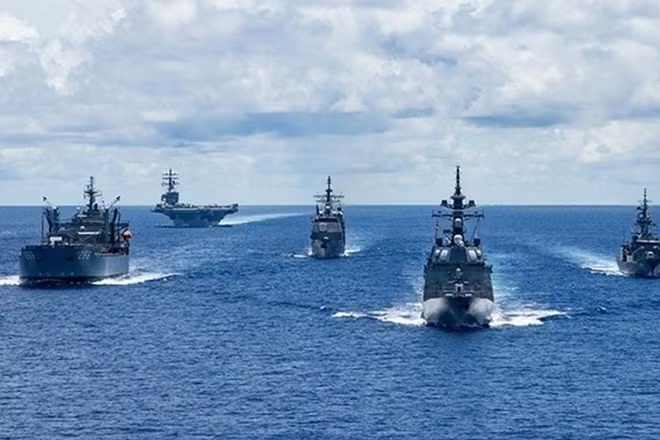
Warships of Australia, the US, and Japan conduct a drill in the Philippine Sea, near the East Sea in July, 2020. (Photo: US Navy)

Not only countries in the region, but many outside the region have spoken up as members of the 1982 UN Convention on the Law of the Sea (UNCLOS).

The East Sea is not simply a matter between ASEAN and China but a matter of international concern.

The world has witnessed a "war of diplomatic notes" related to the East Sea starting with Malaysia's submission to the UN Commission on the Limits of the Continental Shelf last December information on the limits of its continental shelf beyond 200 nautical miles from the baselines from which the breadth of the territorial sea is measured. Subsequently, many other countries sent notes and letters protesting China's actions in the East Sea.

Note diplomacy

In September, Britain, France, and Germany sent notes to the UN expressing their common view on the East Sea, emphasizing UNCLOS 1982 as establishing a legal framework for maritime activities worldwide. Jointly supporting freedom of navigation and overflight in the East Sea, the note is specific about the right of innocent passage through territorial waters.

The Philippines, Vietnam, Indonesia, the US, and Australia all sent notes opposing China's arguments. To date, there have been more than 20 diplomatic notes and statements from countries all over the world.

The notes condemned China's claims, saying the so-called "9-dashed line" is contrary to international law and UNCLOS. They affirmed that UNCLOS is an important legal document, which plays a fundamental role in solving maritime problems and that the 2016 Permanent Court of Arbitration (PCA) ruling is an important part of international law and UNCLOS that China should respect.

Towards East Sea security and safety

The use of notes shows that countries have focused on international law, especially UNCLOS as a basis to settle disputes rather than taking actions that may trigger confrontation or a military conflict.

The East Sea issue has been addressed frequently at regional and global forums: the ASEAN Regional Forum (ARF), the East Asia Summit (EAS), the ASEAN Defense Minister Meeting (ADMM), and the ASEAN Defense Minister Meeting Plus (ADMM +) to the G20 Summit and the Asia-Europe Cooperation Forum (ASEM).

All countries desire peace, stability, security, safety, freedom of navigation and overflight, non-militarization, and restraint from complications and tensions, and peaceful settlement of disputes in accordance with international law including UNCLOS. Countries support full and effective implementation of the 2002 Declaration of Conduct of Parties in the East Sea  (DOC) and early completion of an effective Code of Conduct in the East Sea (COC).

A safe, secure and prosperous East Sea is what countries are aiming for. Recent developments suggest that the world can hope for a more peaceful and stable East Sea in 2021.
VOV

Other News

National Assembly Chairman urges renovation in leadership, working style

National Assembly Chairman urges renovation in leadership, working style

The NA's Committee for Cultural and Social Affairs has moved fast to reshuffle its organisation after the 14th National Party Congress and the election of deputies to the 16th NA, updating its work agenda to match new directives set out in the resolutions of the 14th National Party Congress and the first Congress of the NA Party Organisation for the 2025–2030 term.

Vietnam treasures ties with Croatia: PM

Vietnam treasures ties with Croatia: PM

Vietnam and Croatia should strive to double bilateral trade turnover from the current level of 161 million USD; study the establishment of a Joint Committee on Economic Cooperation to create a long-term, stable, and effective framework for collaboration, said Prime Minister Le Minh Hung.

President Ho Chi Minh's enduring legacy highlighted at Venezuela commemoration

President Ho Chi Minh's enduring legacy highlighted at Venezuela commemoration

Vice President of the United Socialist Party of Venezuela (PSUV) Jesús Faria expressed deep admiration for President Ho Chi Minh and Vietnam’s indomitable struggle for national independence. He described President Ho Chi Minh as an immortal symbol of 20th-century national liberation movements, whose legacy continues to inspire leftist parties, progressive movements, and peoples across Latin America, including Venezuela.

Vietnam proposes key cooperation orientations at BRICS Foreign Ministers' Meeting

Vietnam proposes key cooperation orientations at BRICS Foreign Ministers' Meeting

Deputy Foreign Minister Nguyen Minh Hang shared Vietnam’s approach to building an independent and self-reliant economy linked to deep international integration, while proposing several key areas for enhanced cooperation between BRICS and partner countries at the Expanded BRICS Foreign Ministers' Meeting that opened on May 14 in India.

Vietnam asks parties to respect its sovereignty over Truong Sa

Vietnam asks parties to respect its sovereignty over Truong Sa

PSNews - The spokesperson stated that the dispatch of personnel by relevant parties to features belonging to Truong Sa without Vietnam’s permission constitutes a violation of Vietnam’s sovereignty under international law. She stressed that such actions run counter to the Declaration on the Conduct of Parties in the East Sea (DOC) as well as ongoing efforts by countries to negotiate a Code of Conduct in the East Sea (COC).

Hanoi to host ASEAN Future Forum 2026 in mid-June

Hanoi to host ASEAN Future Forum 2026 in mid-June

PSNews - Vietnam’s proposals placed the highest priority on ensuring a peaceful and stable environment conducive for continued sustainable development and improving the well-being and happiness of the ASEAN people. They were praised by member states and incorporated into the core contents of the ASEAN Leaders’ Statement on the response to the Middle East crisis.

Vietnam promotes cooperation with United Nations on crime prevention

Vietnam promotes cooperation with United Nations on crime prevention

Vietnam highly values the support of the United Nations Office on Drugs and Crime (UNODC) in strengthening national capacity in crime prevention and criminal justice, drug control, and addressing emerging challenges, particularly cybercrime, said Ambassador Vu Le Thai Hoang.

Party, State leader calls for consolidation of central steering committees on legal, judicial reform

Party, State leader calls for consolidation of central steering committees on legal, judicial reform

Consolidating the central steering committees for institutional and legal reform and for judicial reform is necessary in order to streamline organisational structures without reducing responsibilities, while ensuring clear accountability, measurable outputs and concrete results. Following the restructuring, the body will be renamed the central steering committee for institutional improvement and law enforcement, with the Party General Secretary and State President serving as its head.

Vietnam strives for substantive outcome at NPT review conference

Vietnam strives for substantive outcome at NPT review conference

At the meeting this week, Ambassador Viet briefed the UNGA President on developments during the first two weeks of the conference. He stressed that the current international geopolitical landscape poses numerous complex challenges, while reaffirming Vietnam’s determination, together with other member states, to promote substantive and balanced outcomes at the conference.

Top leader of Vietnam receives Vientiane official in Hanoi

Top leader of Vietnam receives Vientiane official in Hanoi

The host leader stressed that cooperation between localities, particularly between the capitals of Hanoi and Vientiane, plays an especially important role as a pioneering force in effectively implementing the foreign polices of the two Parties and States, while also serving as a bridge between politics and development, as well as between strategy and concrete action.