New Vietnamese leadership and aspirations for prosperous nation

With Vietnam recently completing a long-awaited transition of its leadership, there are expectations of realising its goal of becoming a globally-recognised power by the middle of the century.

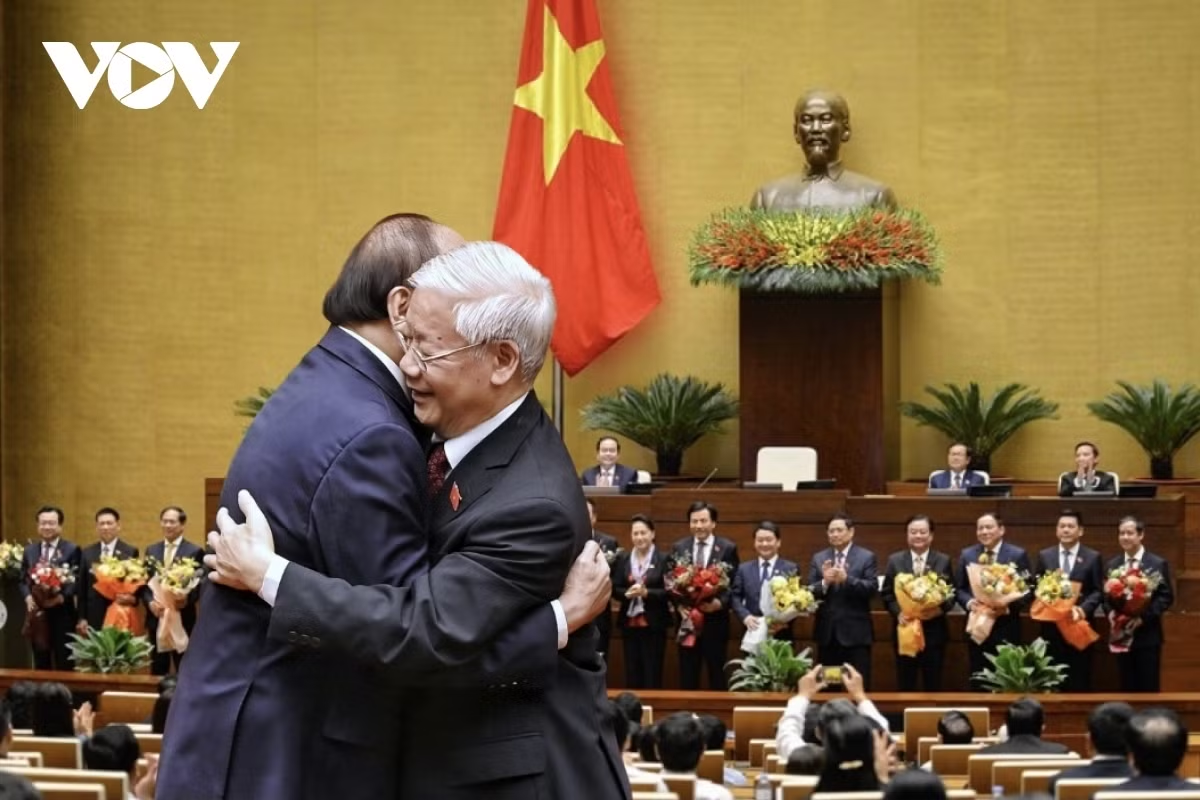
Party General Secretary nguyen Phu Trong transfers his State President post to newly elected President Nguyen Xuan Phuc, believing the successor will fulfil his duty thanks to experience he has acquired as Prime Minister.

Party General Secretary nguyen Phu Trong transfers his State President post to newly elected President Nguyen Xuan Phuc, believing the successor will fulfil his duty thanks to experience he has acquired as Prime Minister.

The freshly-concluded session of the National Assembly (NA) has been marked by a transition of the national leadership between the generations in the State apparatus. Indeed, the newly-elected political elite are made up of both old and young leaders, taking into account factors such as inheritance, stability, and development.

This latest change in leadership took place after the conclusion of the 13th National Party Congress and is anticipated to push forward Vietnamese development and elevate the country’s profile internationally.

Two and a half years on from taking the office of State President, Party General Secretary Nguyen Phu Trong officially transferred the post to newly-elected President Nguyen Xuan Phuc. Elsewhere, Hanoi Party Committee Secretary Vuong Dinh Hue became Chairman of the NA, and Head of the Party Central Committee’s Organisation Commission Pham Minh Chinh took the helm of the Government.

The completion of these four leading positions in the political regime have been viewed by both domestic and foreign observers as a “unique choice” that is designed to strengthen the capability of each position, especially after a period of personnel work not following normal rules.

In his role as Party chief, General Secretary Trong will help to build an elite contingent of cadres who will carry on the Party building and rectification campaign, along with the anti-corruption drive which has recorded plenty of encouraging results in recent times.

Newly-elected President Phuc will take advantage of his previous experience as PM to expand and strengthen the country’s relations with its partners. In addition, he has left his successor a great legacy: Vietnam is currently among the 40 largest economies in the world and the fourth largest economy in Southeast Asia, with GDP per capita reaching US$3,500.

As successor to the post, PM Chinh is expected to promote administrative reform efforts, whilst streamlining the apparatus and attracting resources for national development by making use of the practical experience he has acquired in previous positions. The new PM is well regarded as an official that possesses a strategic vision, is assertive, and is determined to carry out drastic reform measures.

Meanwhile, Chairman of the NA Vuong Dinh Hue represents an experienced leader in the fields of economics and finance who is expected to work alongside the NA to make important decisions to continue the country’s strong economic development in the near future.

Taking the oath to the NA, the newly elected leaders are fully aware of their responsibility to both inherit and build upon recent achievements, whilst continuing to implement innovations to create more effective changes for the country over the coming years.

PM Pham Minh Chinh stated five priorities for the Government in the following term, with the primary focus on realising the 13th National Party Congress’ Resolution, perfecting the socialist-oriented market economy mechanism, vigorously renewing the growth model, and ramping up economic restructuring.

Worthy of note is that the majority of the new leaders in the National Assembly and the Government have trained through experience and in disadvantaged areas. Half of the latest Government lineup are new, with the youngest member in his 40s.  

Vietnamese people and voters expect the legislative and executive bodies to be strong and to effectively implement directions set out at the 13th National Party Congress in order to build a rich, prosperous, democratic, fair, and civilised nation, whilst firmly protecting the Fatherland. The key goal is to transform Vietnam into a fully developed country by 2045 as a means of marking 100 years since independence.

The leadership transition took place at a time when the country has made great achievements over the past 35 years since carrying out the Doi Moi (Renewal) process, implementing an open foreign policy, and deeply integrating within the global economy. However, the current domestic and international context poses new challenges which require the new leadership to address.

During his inaugural address President Phuc likened the nation to a boat which is expected to deal with storms ahead in the ocean. He expressed his belief the new leadership will guide the nation through the stormy weather and land successfully. That is the expectation Vietnamese people and voters have on the leadership in order to make the “mighty Vietnam” dream come true in the coming decades.
VOV

Other News

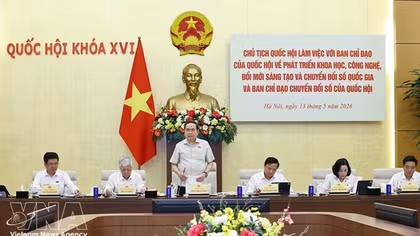
National Assembly Chairman urges renovation in leadership, working style

National Assembly Chairman urges renovation in leadership, working style

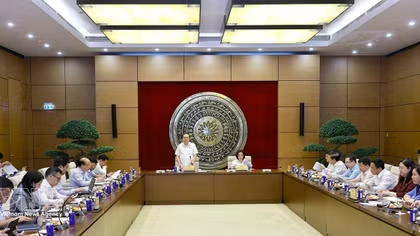
The NA's Committee for Cultural and Social Affairs has moved fast to reshuffle its organisation after the 14th National Party Congress and the election of deputies to the 16th NA, updating its work agenda to match new directives set out in the resolutions of the 14th National Party Congress and the first Congress of the NA Party Organisation for the 2025–2030 term.

Vietnam treasures ties with Croatia: PM

Vietnam treasures ties with Croatia: PM

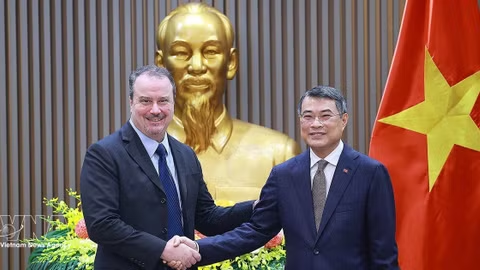
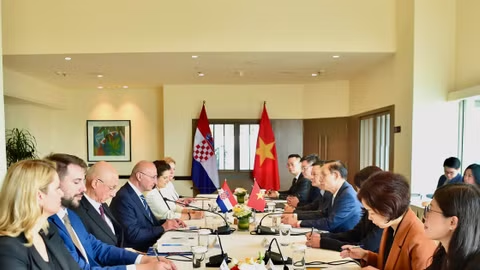
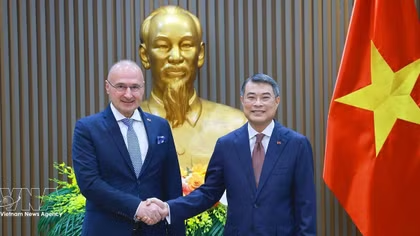
Vietnam and Croatia should strive to double bilateral trade turnover from the current level of 161 million USD; study the establishment of a Joint Committee on Economic Cooperation to create a long-term, stable, and effective framework for collaboration, said Prime Minister Le Minh Hung.

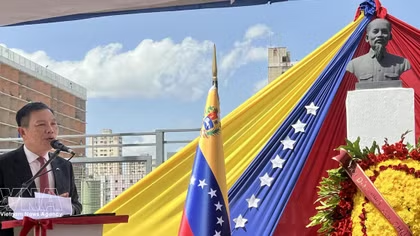
President Ho Chi Minh's enduring legacy highlighted at Venezuela commemoration

President Ho Chi Minh's enduring legacy highlighted at Venezuela commemoration

Vice President of the United Socialist Party of Venezuela (PSUV) Jesús Faria expressed deep admiration for President Ho Chi Minh and Vietnam’s indomitable struggle for national independence. He described President Ho Chi Minh as an immortal symbol of 20th-century national liberation movements, whose legacy continues to inspire leftist parties, progressive movements, and peoples across Latin America, including Venezuela.

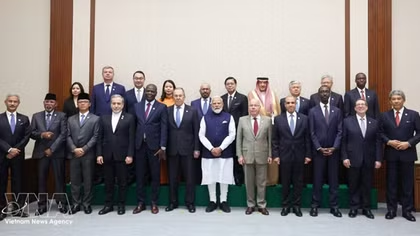
Vietnam proposes key cooperation orientations at BRICS Foreign Ministers' Meeting

Vietnam proposes key cooperation orientations at BRICS Foreign Ministers' Meeting

Deputy Foreign Minister Nguyen Minh Hang shared Vietnam’s approach to building an independent and self-reliant economy linked to deep international integration, while proposing several key areas for enhanced cooperation between BRICS and partner countries at the Expanded BRICS Foreign Ministers' Meeting that opened on May 14 in India.

Vietnam asks parties to respect its sovereignty over Truong Sa

Vietnam asks parties to respect its sovereignty over Truong Sa

PSNews - The spokesperson stated that the dispatch of personnel by relevant parties to features belonging to Truong Sa without Vietnam’s permission constitutes a violation of Vietnam’s sovereignty under international law. She stressed that such actions run counter to the Declaration on the Conduct of Parties in the East Sea (DOC) as well as ongoing efforts by countries to negotiate a Code of Conduct in the East Sea (COC).

Hanoi to host ASEAN Future Forum 2026 in mid-June

Hanoi to host ASEAN Future Forum 2026 in mid-June

PSNews - Vietnam’s proposals placed the highest priority on ensuring a peaceful and stable environment conducive for continued sustainable development and improving the well-being and happiness of the ASEAN people. They were praised by member states and incorporated into the core contents of the ASEAN Leaders’ Statement on the response to the Middle East crisis.

Vietnam promotes cooperation with United Nations on crime prevention

Vietnam promotes cooperation with United Nations on crime prevention

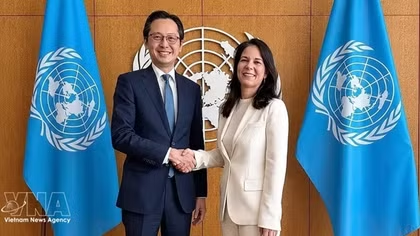
Vietnam highly values the support of the United Nations Office on Drugs and Crime (UNODC) in strengthening national capacity in crime prevention and criminal justice, drug control, and addressing emerging challenges, particularly cybercrime, said Ambassador Vu Le Thai Hoang.

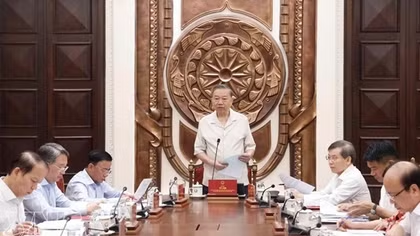
Party, State leader calls for consolidation of central steering committees on legal, judicial reform

Party, State leader calls for consolidation of central steering committees on legal, judicial reform

Consolidating the central steering committees for institutional and legal reform and for judicial reform is necessary in order to streamline organisational structures without reducing responsibilities, while ensuring clear accountability, measurable outputs and concrete results. Following the restructuring, the body will be renamed the central steering committee for institutional improvement and law enforcement, with the Party General Secretary and State President serving as its head.

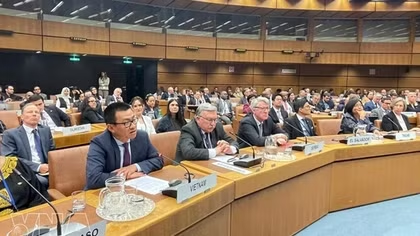
Vietnam strives for substantive outcome at NPT review conference

Vietnam strives for substantive outcome at NPT review conference

At the meeting this week, Ambassador Viet briefed the UNGA President on developments during the first two weeks of the conference. He stressed that the current international geopolitical landscape poses numerous complex challenges, while reaffirming Vietnam’s determination, together with other member states, to promote substantive and balanced outcomes at the conference.

Top leader of Vietnam receives Vientiane official in Hanoi

Top leader of Vietnam receives Vientiane official in Hanoi

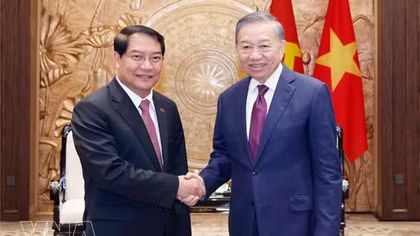
The host leader stressed that cooperation between localities, particularly between the capitals of Hanoi and Vientiane, plays an especially important role as a pioneering force in effectively implementing the foreign polices of the two Parties and States, while also serving as a bridge between politics and development, as well as between strategy and concrete action.