- Vietnam-RoK relationship thriving in all spheres: ambassador
- Vietnam, UN enjoy “very good” relationship: UN resident coordinator
- Party leader affirms continuously consolidated VN-Russia relationship
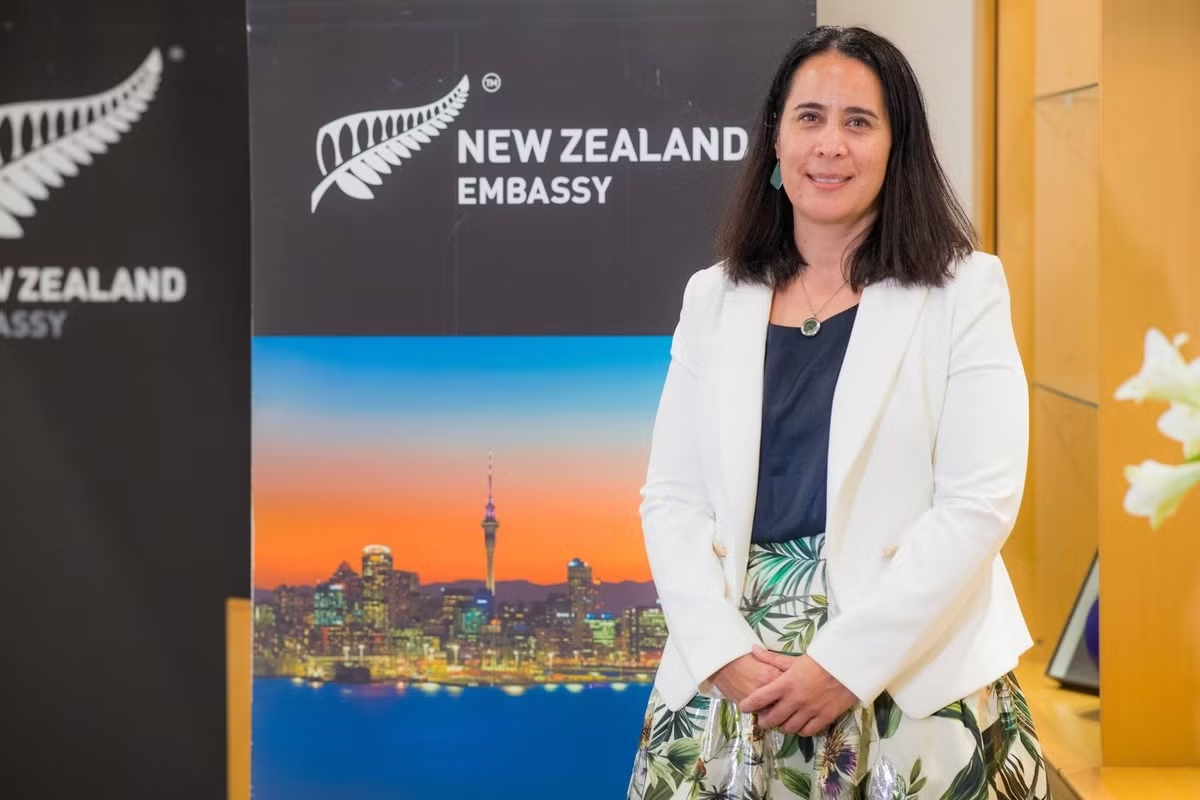
New Zealand Ambassador to Vietnam Tredene Cherie Dobson (Photo: New Zealand Embassy )
Following is the full text of the interview of the newly-accredited Ambassador with Vietnam News Agency reporters on the occasion of the 46th anniversary of the two countries’ diplomatic ties (June 19).
Q: On the occasion of the 46th anniversary of the diplomatic ties between the two nations, could you please evaluate the Vietnam - New Zealand relations in recent years?
A: The relationship between Vietnam and New Zealand is in great shape. In 2020, our Prime Ministers launched our Strategic Partnership, which marked a significant milestone in our bilateral relationship. In almost every area, the relationship continues to go from strength to strength.
Despite all of the difficulties posed by the pandemic, I am proud to say that our two countries have successfully maintained regular high level virtual political exchanges, defence and security cooperation, strong growth in bilateral trade, and expanded education links. The Foreign Ministers and Trade Ministers virtual talks in May and June this year are prime examples of how we have maintained high level dialogues during the pandemic.
Despite the challenges thrown at us by COVID-19, I am delighted that our trade relationship has continued to grow. Vietnam is New Zealand’s 14th largest trading partner and two-way merchandise trade topped 1.95 billion NZD by March 2021. New Zealand’s exports to Vietnam have seen good growth in a number of sectors, particularly food and beverage with over 25 percent growth. This shows the confidence that Vietnamese consumers have in New Zealand’s high-quality products. And in a sign of just how complementary our two-way trade is – Vietnam has grown its machinery exports to New Zealand by more than 28 percent over the last year.
I also want to acknowledge the recent strong momentum in defence and security cooperation between two countries. The effective implementation of the New Zealand-Vietnam Three Year Defence Cooperation Action Plan 2018-2021 and the Peacekeeping Operations Training and Cooperation Implementing Arrangement, as well as high-level defence visits in both directions, is a signal of the strengthening defence relations. We are also enjoying a high level of law enforcement cooperation as we work hard to build upon the 2019 arrangement between the Ministry of Public Security of Vietnam and the New Zealand Police.
Both countries are committed to working together to counter transnational organised crime by actively exchanging information and through training programmes, including on anti- money laundering.
New Zealand has also invested approximately 26.7 million NZD in the past three years through our dedicated bilateral development programme. As a friend of Vietnam, New Zealand provides development assistance in areas where New Zealand has a high level of capability matched with a high level of priority for Vietnam such as agriculture, disaster risk management, knowledge and skills development, and renewable energy.
Furthermore, every year the New Zealand Government provides 30 post graduate scholarships; 25 English Language Training for Officials awards; and 11 Short Term Training Scholarships to Vietnamese students. These awards target Vietnam’s up and coming professionals in agriculture, disaster risk management, renewable energy, and the public and private sectors. I’m also very proud of our alumni - since the 1990s, more than 355 young Vietnamese students and 550 Vietnamese officials have studied at New Zealand universities. The reason our education collaboration is doing so well is that our institutions are ranked in the top 3 percent globally, and are well known for fostering critical thinking and creativity – two skills critical to a future oriented market place.
Q: What are the fields that New Zealand will give priority to promote ties with Vietnam?
A: As both our countries look to achieve strong economic growth as part of the COVID19 recovery, the ambitious trade goals we have set will be an important focus. We are fortunate to have some very high-quality free trade agreements (FTAs) that link our two countries so we will be working hard to ensure that our exporters in both countries are able to leverage those agreements. In terms of specific sectors, I see a lot of potential in the green economy – and that includes everything from agri-tech to IT services. New Zealand and Vietnam are both very innovative economies and we need to take greater advantage of that.
Agriculture is another great example of where both countries have been able to benefit from the relationship. We have an Agricultural Cooperation Arrangement which supports bilateral trade but also is helping to reduce agricultural greenhouse gas emissions and promoting food safety and rural development.
In terms of our agricultural trade, we are fortunate to have very complementary products. New Zealand’s kiwi fruit and apples have consolidated their position in the Vietnamese market. New Zealand’s cherries are also becoming increasingly popular, especially during Tet. New Zealanders also enjoy nuts and tropical fruits from Vietnam, including Vietnam’s iconic dragon fruit and rambutans. We actually have a tremendous development programme that is drawing on New Zealand’s expertise in fruit production to develop three new dragon fruit varieties in Vietnam. Our local partners are now in the process of commercialising those new varieties with the support of New Zealand’s research institute as well as getting the license trademark for the new varieties. These high-quality fruits are specifically designed with strong disease resistance, increased storage life, and new colour and flavour profiles, promising to satisfy growers and customers in Vietnam and worldwide.
The pandemic has of course presented challenges for students traveling to New Zealand. Previously, nearly 3,000 Vietnamese students were studying in New Zealand, and we hope that we can re-establish these numbers when borders are safe to open again. There has been a silver-lining though as education providers have become a little bit more creative - New Zealand education institutions have been developing flexible in-country options, such as Joint Programmes and foundation study centres, and there are ongoing exchanges about on-line learning and curriculum development.
Technology is a relatively new area in our bilateral relationship, but it has a lot of potential. Technology is now New Zealand’s third largest export sector. We have some world-leading companies that are working with Vietnamese partners in diverse areas such as cutting-edge health software, detailed meteorological forecasting, and clean technology in renewable energy and climate-resilient agriculture.
Q: As a new Ambassador to Vietnam, could you share with us your plans to boost the Vietnam - New Zealand ties in your tenure?
A: With the successful launch of the New Zealand - Vietnam Strategic Partnership in July last year, our two Prime Ministers laid out the challenge of how we can deepen and broaden our relationship. Currently here at the Embassy we are working very hard with our Vietnamese partners to describe our ambitions for the Strategic Partnership in a detailed action plan. This will guide both countries and help ensure the relationship continues on the great trajectory it is now on.
As a small but innovative country, New Zealand has decades of experimentation in key areas of public policy and many of the solutions we have developed have been world leading. Much of what we have learned and developed can be applied elsewhere. Through the Government to Government Know-How programme, I want to share New Zealand’s specialist knowledge and intellectual property in areas like agriculture, food safety, health, education and fisheries on a commercial basis.
As mentioned, I want to ensure that we are taking advantage of regional economic integration through the ASEAN-Australia-New Zealand FTA as well as CPTPP and the newly minted RCEP Agreement.
New Zealand and Vietnam have also historically worked extremely well together in regional and multilateral forums, and I look forward to continuing that tradition, with New Zealand as this year’s Chair of APEC. We will be looking to work closely with Vietnam and other APEC members to ensure that we can build back more resilient, sustainable and inclusive economies in our region.