As Vietnam advances toward a new stage of development, the envisioned model of socialist communes and wards places people at the centre of governance, with public trust, citizen satisfaction and quality of life emerging as key indicators of success alongside economic growth and infrastructure development.
At the heart of the model is the principle that all policies must be designed for the people, rooted in the people’s aspirations and dedicated to serving their interests. Citizens will play an active role in governance through access to information, participation in decision-making, oversight of public affairs and equitable access to development outcomes. In this context, democracy and happiness of the people are not only development goals but also the most accurate benchmarks for evaluating the effectiveness of local governance and the capacity of grassroots authorities to serve their communities.
Aspiration for a “people-centred and people-oriented” model
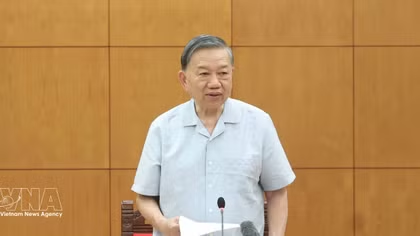
The policy of building the model of socialist communes and wards reflects the Communist Party of Vietnam (CPV)’s strategic vision for national governance in the new era of development. In his policy-oriented remarks, Party General Secretary and State President To Lam emphasised that the model is intended to provide practical experience on what socialist communes and wards should look like, how people’s lives will improve, how children can access education, how healthcare services can better serve citizens, and how communities can become safer, more civilised, and more livable.
The top leader’s remarks offer a simple yet strategic perspective that socialism must be translated into development models that people can experience directly in their daily lives through good schools, transparent governance, quality healthcare, and safe living environments.
This is also the guiding principle underpinning the entire process of building the model. The strategic vision put forward by Party General Secretary and State President To Lam has reshaped the way the future quality of life is perceived. While the values of socialism were once often assessed through macroeconomic indicators such as GDP size or growth rates, the focus is now placed more directly on a fundamental question: Are people actually receiving better services? And do they truly experience social justice?
Assoc. Prof. and Dr. Doan Minh Huan, President of the Ho Chi Minh National Academy of Politics (HCMA), has stressed that socialist communes and wards must translate the principle of “the people as masters” into substantive socialist democracy at the grassroots level. Local administrations should not merely function as management institutions but must become service-oriented institutions that guarantee people’s rights to participate, supervise, and benefit from decisions directly affecting their communities.
Many scientists have offered a profound methodological perspective: the focus should shift from merely ‘soliciting public opinions’ to ‘co-creating with the people.’ Under the traditional approach, citizens were involved only at the consultation stage, after policies had already been designed. In the socialist commune and ward model, however, people are engaged from the outset, participating in identifying problems and formulating solutions. This shift not only makes policies more closely aligned with real-life needs but also strengthens public trust – an invaluable asset of a people's government.
Lieutenant Colonel and Dr. Pham Van Long, lecturer at the Faculty of Marxist-Leninist Philosophy under the College of Political Officers of the Ministry of National Defence, affirmed that the fundamental objective of the socialist commune and ward model is to establish a modern, effective, and efficient grassroots governance institution that serves the people and ensures that all activities are conducted in their interests.
Substantive democracy, he noted, is the core criterion of the model. He said it should not be confined to democratic procedures and regulations on paper but must be reflected in citizens’ genuine ability to participate in the governance of their local communities. Substantive democracy, Long stressed, represents the unity between the people’s right to mastery and the responsibility of local authorities to serve the people.
Happiness seen a measure of development progress
In the new era, people’s happiness is being elevated into a scientific, concrete, and verifiable set of criteria within the socialist commune and ward model. Party General Secretary and State President Lam has affirmed that the highest goal is to “respect, ensure, and protect human rights, citizens’ rights, the happiness and satisfaction of the people, as both the measure and objective of development.
Building criteria for the socialist communes and ward model must therefore place the quality of life and happiness of the people at the centre. Policy makers agree that this is not merely a matter of prioritisation but a return to the humanistic essence of socialism. Every project and policy, from transport planning and environmental protection to education and healthcare, should be assessed based on its impact on people’s happiness, especially that of future generations and vulnerable groups.
According to Long, using citizens’ happiness as a benchmark reflects a modern governance mindset. It means moving beyond assessments based primarily on administrative and economic indicators toward evaluations based on people’s satisfaction and well-being. This approach continues to demonstrate the principle that “the people are the root.” It directly reflects the nature of the socialist system by safeguarding the people’s right to mastery, harnessing the strength of the entire people, ensuring oversight of power at the grassroots level, and directing all activities of commune and ward administrations toward the ultimate goal of serving the people and improving their quality of life and happiness.
Prof. and Dr. Nguyen Quoc Suu from the HCMA observed that building socialist communes and wards is, ultimately, about transforming socialism from an ideal into tangible living standards and development quality. In his view, happiness is the true quality of development. Economic growth should not come at the expense of the environment, nor should community cohesion be sacrificed for mechanical modernisation.
“A genuine socialist commune or ward is a place where people feel safe, respected, and empowered to improve their lives,” Suu stressed.
Offering a more detailed perspective, Assoc. Prof. and Dr. Nguyen Binh Minh from the Institute for Digital Technology and Economy under Hanoi University of Science and Technology stated that the model must ensure that no group is left behind in access to public services, healthcare, education, social welfare, or digital opportunities. Older people, persons with disabilities, poor households, children, temporary residents, and informal labourers should receive priority attention. He also proposed that support profiles for all vulnerable groups should be reviewed annually and that the gap in satisfaction levels between vulnerable groups and the community average should not exceed 10 percentage points.
Many researchers agree that social trust is strengthened when citizens feel heard and can equally benefit from high-quality public services. Efforts to promote decentralisation, delegation of authority, digital transformation, and high-quality human resources development should all serve to demonstrate a simple truth: substantive democracy is neither an abstract concept nor an extraordinary entitlement; it is reflected in people’s ability to participate in the formulation of policies and in overseeing their implementation. Happiness should not be measured solely by material wealth, but by people’s satisfaction when the elderly, women, and children fully benefit from social welfare policies, when workers’ incomes rise, and when unemployment rates decline.
This, in turn, provides the strongest foundation for the stability of the entire political system, they said.
When every commune and ward becomes a livable community where people’s right to mastery is respected and happiness is placed at the centre of development, the country will have laid the most solid foundations for its path toward socialism./.