📝 OP-ED: Transition to new development stage: Action is decisive factor

The fourth strategic shift outlined at the third meeting of the 14th Party Central Committee is therefore about building national resilience. The objective is not to eliminate every possible risk, but to strengthen the country's ability to adapt and recover when disruptions occur.

Hanoi (VNA) – No country has achieved lasting development without facing difficulties and challenges. The real question is whether it can identify risks early enough to prepare for them. Against that backdrop, the third meeting of the 14th Party Central Committee set out a fourth strategic shift: moving from responding to individual risks to proactively preventing them, strengthening national resilience, and safeguarding the country. This is not only a matter of national defence and security, but also a development mindset suited to an increasingly uncertain world.
download-5.png
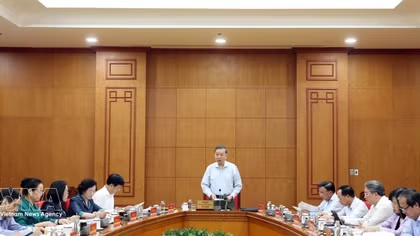
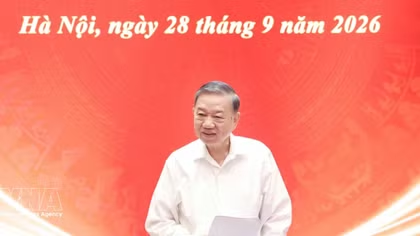
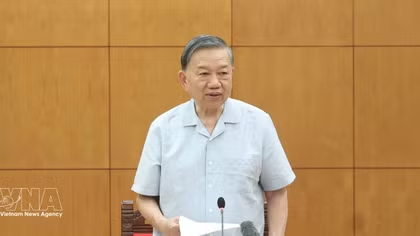
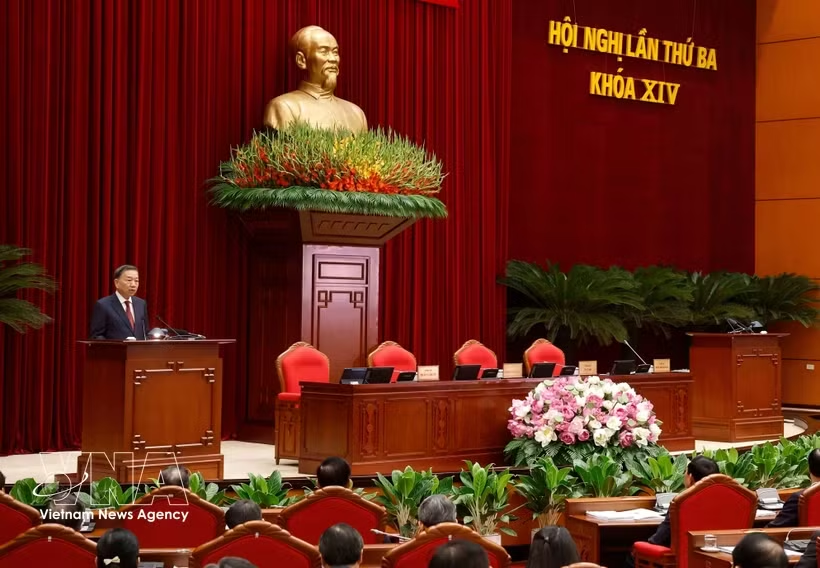
Party General Secretary and State President To Lam speaks at the closing ceremony of the third meeting of the 14th Party Central Committee. (Photo: VNA)

As a Vietnamese saying goes, "Don't wait for the storm before repairing the roof". It is more than advice on preparing for natural disasters; it is also a lesson in national governance. In practice, there have been times when problems were addressed only after they emerged, bottlenecks were tackled only after they had slowed progress, and solutions were sought only after risks had materialised. While such an approach may resolve immediate challenges, it often comes at a far greater cost than preventing problems before they arise.

Recent global events have made this lesson even clearer. The COVID-19 pandemic disrupted economies and societies worldwide and claimed millions of lives. Geopolitical conflicts, strategic competition among major powers, supply chain disruptions, extreme weather events, and cyberattacks have continued to test the resilience of countries across the globe. According to the United Nations, the global economy contracted by 4.3% in 2020, one of the steepest declines in decades. Natural disasters alone caused more than 500 billion USD in losses worldwide during 2024 and 2025. In Vietnam, Typhoon Yagi and other extreme weather events in 2024 inflicted damage exceeding 88.7 trillion VND (3.37 billion USD).

These figures underline an important reality: rapid growth alone is not enough. A country must also be able to withstand unexpected shocks.

With that in mind, the 14th National Party Congress not only set a target of double-digit economic growth but also of maintaining political stability, safeguarding national defence, security and foreign affairs, and building an independent and self-reliant economy while pursuing deep international integration.

Protecting the country today therefore means more than defending independence and sovereignty. It also means safeguarding economic security, energy security, food security, water security, data security, cybersecurity, and a peaceful environment needed for development. Protecting these foundations is, in essence, protecting the country's long-term growth prospects.

The fourth strategic shift outlined at the third meeting of the 14th Party Central Committee is therefore about building national resilience. The objective is not to eliminate every possible risk, but to strengthen the country's ability to adapt and recover when disruptions occur. This requires a corresponding shift in governance - from reacting to problems to anticipating and preventing them. It also means ensuring the security, safety and uninterrupted operation of the political system, the economy, society, technology, and critical infrastructure. Security provides the foundation for development, while sustainable development, in turn, reinforces security. Risks must therefore be detected early, warnings issued promptly, and problems addressed before they escalate. Small issues should never be allowed to grow into major crises.
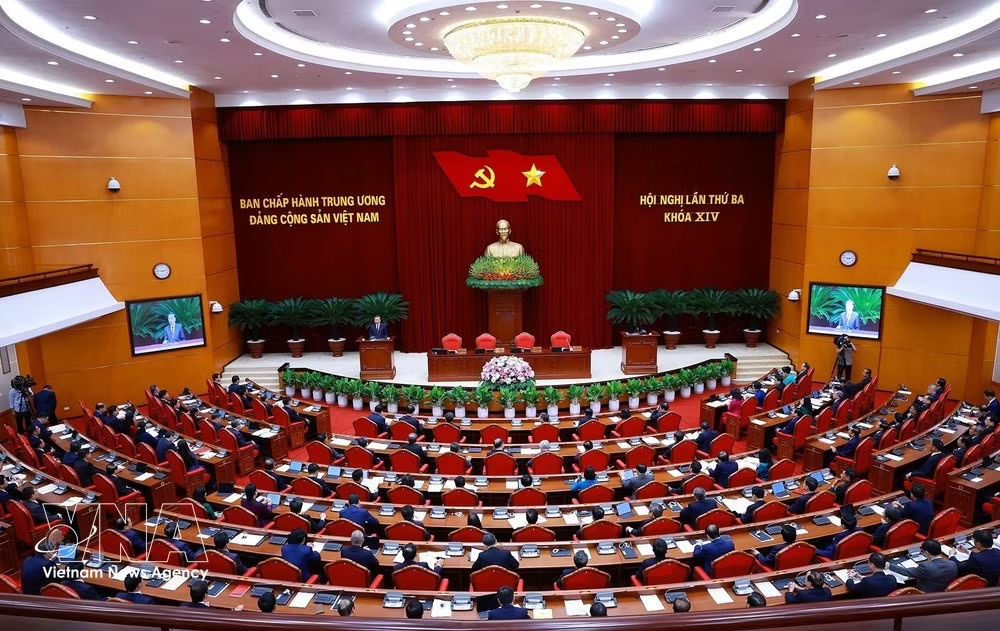
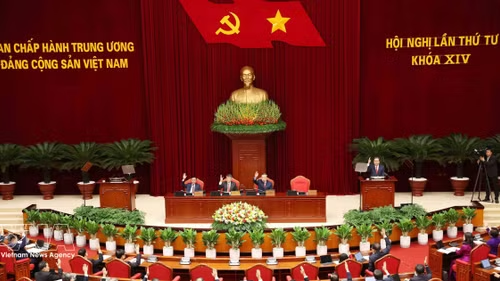
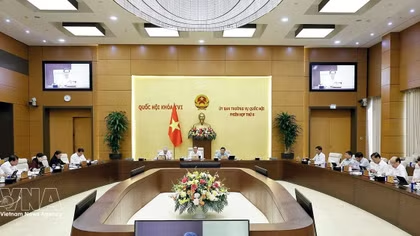
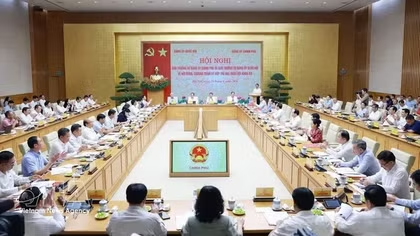
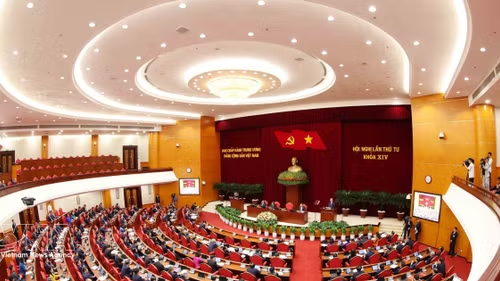
At the closing ceremony of the third meeting of the 14th Party Central Committee. (Photo: VNA)

This approach is already being translated into practice. More than a year after Vietnam introduced its two-tier local administration model, many shortcomings have been identified and adjusted during implementation rather than being allowed to accumulate into larger obstacles.

In the coming days, the Politburo will convene a national conference to study, disseminate and implement the resolution adopted at the third meeting of the 14th Party Central Committee. Senior Party and State leaders will personally present its core contents, demonstrating that the resolution is intended not merely as a policy document but as a programme of immediate action.

Experiences over many years has shown that the greatest gap often lies between resolutions and their implementation. Party General Secretary and State President To Lam has acknowledged this directly, saying: "The biggest bottleneck remains implementation." People expect reforms that they can see and feel in their daily lives. Businesses are looking for a more transparent investment environment, lower costs, and simpler administrative procedures.

At this stage, what matters most is action. Words must be matched by deeds, and results must be measurable. That is also the principle set out by the third meeting: clearly defined responsibilities, tasks, authority, timelines and expected outcomes. Only when a policy is translated into concrete actions and tangible results will the resolution truly come to life.

As Party General Secretary and State President To Lam emphasised: "The value and vitality of policy decisions must be measured by practical outcomes: bottlenecks removed, new capacities created, institutions operating smoothly, resources unlocked, productivity and competitiveness improved, the country made safer, and people enjoying more tangible benefits. From that understanding, unity in policy must immediately become unity in action, turning the Party Central Committee's decisions into concrete results."

Only four years remain until 2030, while the vision for 2045 is drawing closer. Every sound policy implemented in a timely manner will generate new momentum for development. Every delay in execution, however, risks missing valuable opportunities.

The four strategic shifts will have meaning only if they are transformed into action. That is the strongest message emerging from the third meeting: creating the conditions needed to turn national aspirations into tangible achievements./.
VNA
en.vietnamplus.vn

Other News

Vietnam leaves lasting imprint at AMM-59: Deputy FM

Vietnam leaves lasting imprint at AMM-59: Deputy FM

The Vietnamese delegation led by Foreign Minister Le Hoai Trung embodied the foreign policy line of the 14th National Party Congress by acting proactively, responsibly and with leadership inside ASEAN.

Vietnam urges relevant parties to fully implement DOC in East Sea

Vietnam urges relevant parties to fully implement DOC in East Sea

PSNews - Vietnam has called on parties concerned to exercise restraint, act in accordance with international law, and fully implement the Declaration on the Conduct of Parties in the East Sea (DOC), Spokeswoman of the Ministry of Foreign Affairs Pham Thu Hang said at the ministry’s regular press briefing on July 23.

Vietnam, US pledge to deepen Comprehensive Strategic Partnership

Vietnam, US pledge to deepen Comprehensive Strategic Partnership

At the meeting, Trung welcomed Rubio's participation and active contributions to the ASEAN meetings, saying they reflected the US' commitment to maintaining engagement in the region, supporting ASEAN centrality, and contributing to peace, stability and prosperity in Southeast Asia.

AMM-59: Vietnam proposes substantive, sustainable ASEAN-EU ties

AMM-59: Vietnam proposes substantive, sustainable ASEAN-EU ties

Looking ahead, Vietnam proposed the two sides prioritise stronger regional resilience by scaling up energy cooperation, pooling financial resources and cracking down on illegal, unreported and unregulated fishing, all aimed at building a resilient and sustainable blue economy.

ASEAN Regional Forum adopts Manila Plan of Action for 2026–2036

ASEAN Regional Forum adopts Manila Plan of Action for 2026–2036

Vietnamese Minister of Foreign Affairs Le Hoai Trung affirmed that ASEAN would continue working with China to fully and effectively implement the Declaration on the Conduct of Parties in the East Sea (DOC) and to conclude at an early date a substantive and effective Code of Conduct in the East Sea (COC) that is consistent with international law, particularly the 1982 United Nations Convention on the Law of the Sea (UNCLOS).

Caring for revolution contributors reflects Vietnam's deep humanitarian value: PM

Caring for revolution contributors reflects Vietnam's deep humanitarian value: PM

The PM urged all-level authorities, sectors, localities, and the public to fully implement relevant Party resolutions and directives as well as preferential policies for revolution contributors, push ahead with the 500-day campaign, expand gratitude movements, accelerate housing support for children of Agent Orange/dioxin victims and strengthen patriotic education.

Vietnam proposes three priorities to advance Mekong–RoK cooperation

Vietnam proposes three priorities to advance Mekong–RoK cooperation

In its capacity as co-chair in 2025, Vietnam worked closely with the RoK and the Mekong countries to maintain high-level exchanges, enhance the effectiveness of the Mekong–RoK Business Forum, organise the Mekong–RoK Forum for the first time to share project outcomes and implementation experience, and promote innovative solutions in water resource management through the third Mekong–RoK Water Forum.

Vietnam reaffirms support for UNRWA, readiness to assist Gaza recovery efforts

Vietnam reaffirms support for UNRWA, readiness to assist Gaza recovery efforts

During a meeting with the UNRWA official in Manila, the Philippines on July 22, Deputy Foreign Minister Dang Hoang Giang affirmed Vietnam’s consistent support for UNRWA’s role and operations, praising its efforts to maintain humanitarian, educational and healthcare assistance for Palestinians amid the complex situation.

Vietnam attends ASEAN foreign ministers' meetings with partners

Vietnam attends ASEAN foreign ministers' meetings with partners

The Vietnamese delegation proposed making energy security and transition a pillar of ASEAN-Canada relations, and urged Canada to support the implementation of the ASEAN Power Grid and expand cooperation in renewable energy, hydrogen, energy storage and nuclear power for civilian purposes.

Vietnamese naval vessel begins friendship visit to China

Vietnamese naval vessel begins friendship visit to China

On behalf of the Vietnamese delegation, Minh said he was confident that the activities will further strengthen mutual understanding and trust between the two militaries and navies, while contributing to the implementation of the common perceptions reached by the two countries' senior leaders on advancing more substantive defence and security cooperation.

Promoting Human Rights through Dialogue and Cooperation

Promoting Human Rights through Dialogue and Cooperation

Vietnam consistently upholds the UN Charter and international law, advocating for a balanced approach to human rights issues through dialogue, cooperation, and mutual respect. The country firmly opposes the politicization of human rights and interference in the internal affairs of sovereign states.

📝 OP-ED: Foreign affairs expand Vietnam's development space

📝 OP-ED: Foreign affairs expand Vietnam's development space

Recent diplomatic activities demonstrated that the foreign policy set out at the 14th National Party Congress is being translated into concrete action, reaffirming diplomacy as a “vital and regular” task alongside national defence and security.