Paris Peace Accords: Gateway to peace and lesson for national defence

The Paris Agreement on Ending the War and Restoring Peace in Vietnam (Paris Peace Accords), which was signed in Paris on January 27, 1973, was the success of one of the toughest and longest negotiations in world diplomacy.

Paris Peace Accords: Gateway to peace and lesson for national defence -0

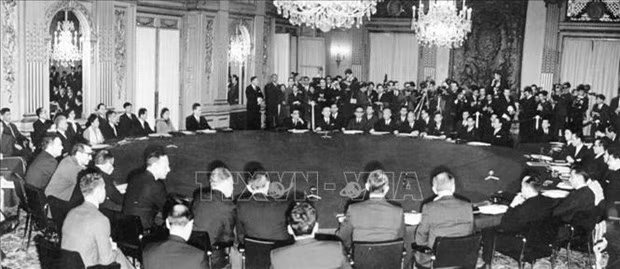
A four-party conference on peace in Vietnam officially convenes the first session in Paris on January 25, 1969 (Photo: VNA)

The Paris Agreement on Ending the War and Restoring Peace in Vietnam (Paris Peace Accords), which was signed in Paris on January 27, 1973, was the success of one of the toughest and longest negotiations in world diplomacy.

Recalling stories about the negotiations, diplomat Pham Ngac, 90, the youngest member of the Vietnamese team then, said that they took nearly five years from May 13, 1968 to January 27, 1973 with 202 open sessions, 36 private and secret sessions, 500 press conferences, and 1,000 interviews and talks.

Particularly, some talks lasted until 3am, right after that, the Vietnamese team had to take a flight home to make reports, carrying with them the minute of the freshly-ended meetings, he said.

However, despite difficulties, all members of the team always maintained a strong mind to complete their assigned tasks, the veteran diplomat said.

In the mind of Ngac, at 12:30 (Paris time) on January 22, 1973, the Paris Peace Accords were initialed by Special Advisor of the Government of the Democratic Republic of Vietnam Le Duc Tho and US Advisor Henry Kissinger. The deal was officially signed on January 27, 1973.

This is an internationally legal document affirming the great success of the war against the US of the Vietnamese people, with important provisions, including the US and other countries’ commitment to respecting independence, sovereignty, unity and territorial integrity of Vietnam.

Ngac said that a large number of international friends gathered at the meeting venue to congratulate the Vietnamese delegation, considering the success as a common victory of justice.

Commenting on the historical significance of the agreement, Prof. Dr. Nguyen Xuan Thang, Politburo member, Director of the Ho Chi Minh National Academy of Politics and Chairman of the Central Theory Council, said that it served as a strategic foundation for the Vietnamese people and army to launch the General Uprising in Spring 1975, liberating the south and reunifying the nation.

It also created favourable conditions and environment for Vietnam to establish diplomatic relations with other countries and take advantage of the support from international friends for its struggle for peace, justice and national reunification, said Thang.

He underlined that the agreement left a lesson on the close coordination between diplomatic activities and socio-economic and socio-cultural development in association with ensuring national security and defence, as well as another on combining Party and State diplomacy with people diplomacy, creating synergy for the protection of the nation early and from afar.
VNA

Other News

Top leader demands concrete output under Resolution 57

Top leader demands concrete output under Resolution 57

Top leader To Lam stressed that while the 14th National Party Congress’s Resolution serves as the strategic blueprint for the country's next growth stage, Resolution 57 is one of the key engines for turning that blueprint into reality.

Politburo sets six priorities for implementing Resolution No. 57

Politburo sets six priorities for implementing Resolution No. 57

After 18 months of implementing Resolution No. 57, ministries, sectors and localities have adopted innovative and effective approaches that have generated positive momentum, while winning broad support from businesses, the scientific community and the public for policies on science, technology, innovation and digital transformation.

Foreign affairs should better serve national development: Top leader

Foreign affairs should better serve national development: Top leader

Party General Secretary and State President To Lam underscored that Vietnam’s development goals for 2030, with a vision to 2045, require foreign affairs and international integration to become more proactive, with stronger forecasting capacity, timely and accurate policy advice, and swift action.

Conference reviews one-year implementation of three-tier administration model

Conference reviews one-year implementation of three-tier administration model

The event was held in a hybrid format, with the main venue at the Dien Hong Hall of the National Assembly building and online connection to 3,651 venues across ministries, central agencies, socio-political organisations, and headquarters of provincial, municipal, commune, ward and special-zone administrations nationwide.

Top leader calls for modern artillery-missile force capable of meeting new challenges

Top leader calls for modern artillery-missile force capable of meeting new challenges

He urged the Artillery-Missile Command to develop a force that is strong in political, ideological and organisational foundations, with absolute loyalty to the Party, the nation and the people, thorough understanding of the Party's military and defence guidelines and directives on safeguarding the Fatherland and building a revolutionary, regular, elite and modern army.

NA Chairman calls on Hanoi to turn master plan vision into tangible development projects

NA Chairman calls on Hanoi to turn master plan vision into tangible development projects

Chairman Man described the publication of the master plan as more than the unveiling of a development blueprint. It sends a strong message of action and demonstrates the city's determination to translate the resolutions of the 14th National Party Congress and the 18th Hanoi Party Congress into reality, in line with Party General Secretary and State President To Lam’s directive that “Hanoi must do what it commits to do, do it quickly, correctly, effectively and thoroughly.”

Deputy PM receives special advisor to Japan-Vietnam parliamentary friendship alliance

Deputy PM receives special advisor to Japan-Vietnam parliamentary friendship alliance

Deputy Prime Minister Le Tien Chau highly valued Special Advisor to the Japan-Vietnam Parliamentary Friendship Alliance Takebe's more than three decades of contributions to promoting Vietnam-Japan friendship and cooperation, particularly in people-to-people exchanges, local-level cooperation, education and human resource development, with the Vietnam-Japan University (VJU) project standing out as a flagship initiative.

Viet Nam stand ready to support Venezuela after earthquake

Viet Nam stand ready to support Venezuela after earthquake

PSNews - During the press briefing of Viet Nam’s Ministry of Foreign Affairs held on June 25, spokeswoman Pham Thu Hang provided updates on measures to protect Vietnamese citizens affected by the earthquake in Venezuela and a fire at Moscow’s Sadovod market, while reiterating support for victims of Agent Orange/dioxin.

Vietnam, Cambodia foster defence cooperation

Vietnam, Cambodia foster defence cooperation

Vietnam is ready to share training expertise, dispatch delegations to Cambodia for exchanges, and welcome Cambodian delegations to Vietnam for study visits and experience sharing.

Top leader calls on youth to think bigger, learn faster, make more contributions

Top leader calls on youth to think bigger, learn faster, make more contributions

Addressing the opening session of the 13th Ho Chi Minh Communist Youth Union National Congress for the 2026–2031 term in Hanoi on June 25, the Party and State leader told 788 delegates representing more than 5.1 million HCYU members and nearly 22 million young people nationwide that the country is entering a new stage of development in which young people are not only inheritors of the revolutionary cause but also direct architects of the future.

Minister Luong Tam Quang: Clear determination of personal responsibility helps contribute to boosting science and technology

Minister Luong Tam Quang: Clear determination of personal responsibility helps contribute to boosting science and technology

Prime Minister Le Minh Hung chaired a thematic meeting, on the afternoon of June 23, to review the implementation of Resolution No. 57-NQ/TW following its third session in 2026. Permanent Deputy Prime Minister Pham Gia Tuc, Deputy Prime Minister Ho Quoc Dung and Minister of Public Security General Luong Tam Quang moderated the discussions on solutions to accelerate the development of science, technology and innovation.

Top leader askes for building modern army based on science, technology

Top leader askes for building modern army based on science, technology

In the first six months of 2026, the Central Military Commission and the Ministry of National Defence have provided sound strategic advice to the Party and State on military and defence matters, maintained the strategic initiative, and prevented any passive or unexpected situations. Efforts to build a politically strong army have continued alongside comprehensive Party and political work and strict implementation of the Party's resolutions and regulations.

13th National Congress of Ho Chi Minh Communist Youth Union opens in Hanoi

13th National Congress of Ho Chi Minh Communist Youth Union opens in Hanoi

The congress, which will last until June 25, is not only an occasion to review the achievements of the past term but also a significant milestone in defining the vision, objectives, and tasks of the youth union in the next phase, reinforcing the pioneering role of the younger generation as Vietnam approaches two major historic milestones: the 100th founding anniversary of the Communist Party of Vietnam (1930–2030) and the 100th founding anniversary of the Ho Chi Minh Communist Youth Union (1931–2031).