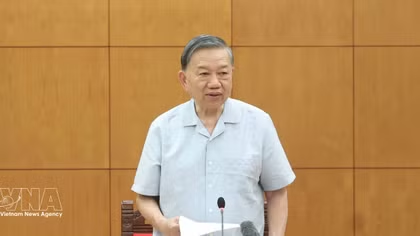
General Secretary of the Communist Party of Vietnam Central Committee To Lam has written an article highlighting the practice of thrift.
The Vietnam News Agency (VNA) respectfully introduces a translation of the article.
PRACTISING THRIFT
To Lam
General Secretary of the Communist Party of Vietnam Central Committee
Thrift practice and wastefulness combat are intrinsically linked and two pillars essential to achieving prosperity, whether at the level of family, nation or society. Practising thrift and flighting wastefulness are necessary in the daily life of each individual and society as a whole, serving as a “cornerstone” in building a civilised society and sustainable development. This must be a shared responsibility and should become a way of life, a daily cultural norm for each of us.
Vietnamese culture has long upheld thrift and simplicity as core values. The practice of thrift has been distilled into proverbs and folk sayings passed down orally from one generation to the next, such as: “Good at spending brings fullness, good at managing ensures warmth,” “The poor with thrift has a better ending than the rich with wastefulness,” “Do not leave land uncultivated/Every inch is worth its weight in gold,” “In good harvests, do not neglect maize and sweet potatoes/ In hardship, who do you think would be with you?” and “Spend within limits, use with measure,” as well as “Thrift ensures financial readiness/ Avoid troubling others in times of need…”
President Ho Chi Minh, the great teacher of the Vietnamese revolution, set a shining example of thrift practice. Immediately after leading the August Revolution to victory, facing the simultaneous threats of famine, illiteracy, and foreign invasion, at the first meeting of the provisional government of the Democratic Republic of Vietnam on September 3, 1945, he outlined six urgent tasks. He highlighted the launch of a national movement to increase production and practise thrift to fight hunger and rebuild the country. Uncle Ho repeatedly explained the meaning of thrift so that it would be understood and applied properly: “What is thrift? It is being frugal, not extravagant, not wasteful, not careless... Thrift does not mean being stingy. When something is unnecessary, even a single coin should not be spent. But when it comes to worthwhile causes, for the people, for the Fatherland, no matter how much effort or money it requires, we must be willing. That is true thrift. Thrift demands a firm opposition to extravagance... Extravagance is a crime against the nation and the people.” For him, thrift was a vital art of the social life. He stressed the importance of saving labour: “One person should be able to do the work of two or three.” He also stressed time management: “Be punctual, don’t arrive late or leave early. Work quickly and thoroughly. Complete today’s tasks today, don’t put them off for tomorrow. Remember that the people pay us with their sweat and tears, wasting time is deceiving them.” He demanded the Government spend money and resources economically, save people's labour, save the lives and blood of soldiers and citizens: “We must cherish human resources as our most valuable asset. We must take great care of people’s health and use their labour wisely.” “Wealth can be regained and time will come again, but once a soldier’s blood is shed or life is lost, it cannot be recovered. Therefore, “it must preserve every drop of our people's blood to build our nation's future.” He also urged thrift in speech: “Say little, do much,” and “Begin with action.”
Throughout the revolutionary periods, the Party and State have paid special attention to thrift practice, regarding it as a top national policy. During wartime, under the leadership of the Party and President Ho Chi Minh, with the pioneering of Uncle Ho, cadres and Party members, every citizen practised reasonable spending and thrift, tightened their belts, endured hardship, and sacrificed personal comforts to direct all resources to the front lines, contributing to national liberation. Since the Doi Moi (Renewal) period, the Party has issued various policies and directives regarding this work, including Directive No. 21-CT/TW issued on December 21, 2012 by the 11th Party Central Committee’s Secretariat on promoting thrift and preventing wastefulness; Directive No. 27-CT/TW dated December 25, 2023, from the 13th Party Central Committee’s Politburo on strengthening the Party’s leadership in this field; and Directive No. 42-CT/TW dated January 16, 2025, also from the 13th Party Central Committee’s Politburo, on enhancing the Party’s leadership in educating values of diligence, thrift, integrity, righteousness and impartiality; the Politburo's Directive No. 05-CT/TW dated May 15, 2016, on promoting the study and practice of Ho Chi Minh’s thought, morality and style, which clearly states the need to “organise widespread study, dissemination and communications…of Ho Chi Minh’s views and moral example on diligence, thrift, integrity, righteousness and impartiality”; and Regulation No. 37-QD/TW dated October 25, 2021, by the Party Central Committee, on things prohibited for Party members, including “organising lavish, wasteful weddings, funerals or other personal and family-related events." To institutionalise the Party's directives, in 1998, the 10th National Assembly's Standing Committee issued an ordinance on thrift practice and wastefulness prevention, which was elevated to the Law on Thrift Practice and Wastefulness Combat by the 11th National Assembly in 2005, and later revised and supplemented by the 13th National Assembly in 2013. The 2013 Constitution mandates that “State agencies, organisations, and individuals must practise thrift and fight wastefulness, and prevent and combat corruption in socio-economic activities and state management" (Article 56). Each year, and in multi-year periods, the Government issues comprehensive programmes on thrift practice and wastefulness combat.
With efforts to realise the Party's policies and State laws, meaningful progress has been made in thrift practice across the Party, people, and army. Organisations and individuals, especially cadres and Party members, have focused on cutting regular expenses and promoting the role of leaders in thrift practice. Some agencies and units have announced in writing that they will not receive congratulatory flowers during congresses or anniversary events as a way of thrift. Many year-end or review conferences are now conducted more briefly and efficiently, using online formats and avoiding printed materials to save time and money. Shared vehicles for senior officials on business trips has been adopted in numerous locations. Idle land and long-delayed planning projects have gradually been addressed. The management and use of office buildings are now conducted with the right purposes and within regulated limits and standards. Many businesses have tightened control over production costs, especially indirect expenses, to reduce product prices, while reducing production and business costs, strengthening consumption norm management, and enhancing the efficiency of production and business operations. Particularly, since late 2024, in line with the conclusions of the Party Central Committee, the Politburo and the Secretariat have led and directed the basic completion of the restructuring and streamlining of the organisational apparatus the Party, Government, National Assembly, and Vietnam Fatherland Front at both central and local levels. This has reduced the number of units, cut expenses, and created the conditions for immediate implementation of the policy on school fee exemptions. Preliminary estimates suggest that under the policy approved at the 11th plenum of the 13th Party Central Committee on provincial mergers, the dissolution of district-level administration, and commune-level consolidation, the State budget will save more than 20 trillion VND per year in regular expenses annually from 2025 to 2030. From 2030 onwards, annual savings are projected to exceed 30 trillion VND. This does not yet take into account the value of over 18,500 buildings that will no longer serve as government offices under the new two-tier local administration model.
Despite some progress, thrift practice still faces significant challenges and yields very low effectiveness. Existing policies and directives on thrift have not been fully realised; wastefulness and losses of state assets and budgetary resources continue on a broad scale, causing serious consequences. Thrift practice has yet to become a regular habit, and thrift remains absent from the daily consciousness of many cadres, Party members, civil servants, and the public. Wastefulness is not confined to state agencies but also appears in everyday social activities. A penchant for foreign-branded and luxury goods, extravagant gift giving, and a consumerist mindset among some citizens, especially the young, while average incomes nationwide have just surpassed the middle-income threshold and labour productivity remains low. Although there are exemplary cadres and Party members who uphold Party ideals and lead efforts in practising thrift, combating wastefulness, managing public assets responsibly and resisting the lure of power and luxury, there remain many, including a few leaders, who lack responsibility, indulge in material comforts, cause budgetary and asset losses, and use public funds for personal spending or interest group.
The root causes of these shortcomings include a lack of responsibility and resolve among some agencies, organisations, and individuals; incomplete or ambiguous policies, rules, and regulations with loopholes; and occasional, perfunctory implementation of thrift and anti-waste measures. Certain ministries, sectors, and localities have not proactively devised solutions to integrate thrift and anti-waste practices into their respective domains. The Law on Thrift Practice and Wastefulness Combat has not truly permeated daily life; its provisions remain too general, failing to establish effective mechanisms for enforcement. Programmes on thrift practice and wastefulness combat often remain symbolic and have not been embedded into the operations of agencies, units, localities, families, or individuals. Clear targets, indicators, and evaluation criteria are lacking. Although many cases of waste and violations have been identified, handling remains slow; commendations for those practising thrift or exposing waste are not issued promptly, undermining compliance. Inspection on thrift and anti-waste at all levels has yet to achieve significant impact.
At its 11th plenum of the 13th Party Central Committee, the Party strongly endorsed landmark decisions, including further streamlining the political system’s organisational structure, merging some provinces, dissolving district-level administrations, and consolidating communes. These reforms lay the groundwork for fundamentally improving thrift practice nationwide in this new era. To fulfil the highest standards set by the 11th Plenum, namely “high-quality, rapid, and sustainable development,” along with “proactivenss, self-reliance and autonomy in development,” to achieve the overarching goals of “stability, development, and improvement of people's lives” and meet the two centennial objectives, alongside creating a lean, strong, and efficient, valid and effective organisational apparatus, it is crucial to address the following:
First, recognise that practising thrift and combating wastefulness are fundamental solutions enabling the nation to overcome all storms amid a volatile international landscape that directly and substantially affects socio-economic development and social welfare. History has shown that thrift has been a decisive factor in generating immense strength for our entire Party, people, and army, even when the country was impoverished, people faced severe hardship, and “hunger” stalked the land; we still “tightened our belts,” devoted resources to the resistance, and won military victories against powerful colonial and imperial forces to liberate and reunify the nation. Facing new difficulties and challenges, with our resilient, indomitable spirit and unity across the political system and society, diligently embracing thrift and fighting wastefulness will generate vital internal resources to propel sustainable economic growth, ensuring the country advances steadily toward strategic objectives while better caring for people’s livelihoods. Therefore, every citizen, agency, unit, organisation, and business must develop concrete plans and implement collection and spending rationally. Cadres and party members, especially leaders, should set exemplary examples, mobilise their families and communities to participate actively, and across all sectors, occupations, and households, promote production and business, enhance productivity, quality, and efficiency, and rigorously practice thrift to minimise waste of time, money, assets, and human effort.
Second, strongly implement fundamental solutions to create substantial changes in practicing thrift and combating waste. The focus is on: (i) Focusing on perfecting institutions, creating a basis to thoroughly overcome wastefulness caused by institutions, removing barriers, difficulties, and obstacles that hinder development, clearing bottlenecks to create a foundation for development, especially issues related to bidding, budget, public investment, private economy, science and technology, innovation, digital transformation and the revolution in streamlining and streamlining the apparatus of the political system. It should early research, amend and supplement the Law on Thrift Practice and Wastefulness Combat, creating a comprehensive and solid political and legal basis for thrift practice in all sectors, all professions, all cadres, party members and people. (ii) Minimising administrative procedures and compliance costs, creating the greatest convenience for people and businesses; shifting from pre-inspection to post-inspection, eliminating the "ask-give" mechanism; decentralisation and delegation of authority to competent agencies and localities to resolve and take responsibility. In 2025, it should ensure that 100% of administrative procedures related to enterprises are carried out online in a smooth and effective manner; 100% of administrative procedures are not limited by provincial administrative boundaries. (iii) After arranging the organisation of the political system to be streamlined, lean and strong, in order to operate efficiently, valid and effectively, the very fundamental factor is to focus on building a team of cadres with good knowledge, skills and working attitude to achieve the highest efficiency in each area they are responsible for. In particular, management skills, task execution; passion, enthusiasm and responsibility in each job, each assigned task; standard culture in communications, behaviour, and awareness of saving… are requirements for cadres in the new organisational apparatus. (iv) Tightening discipline in financial and budget management and use; practising thrift, combating wastefulness, effectively using state financial resources in conjunction with mobilising social resources and streamlining the apparatus. Strengthening management and use of public assets, ensuring compliance with standards, norms, regimes and requirements of tasks, focusing on arranging and handling assets, especially houses and land in conjunction with streamlining the apparatus. Resolutely and thoroughly economising unnecessary expenditures to ensure resources for natural disaster and epidemic prevention and control, supplement development investment capital and economic development; striving to further increase the rate of breakthrough expenditures for science and technology development, innovation, national digital transformation, and support for private economic development. (v) Creating a legal corridor and resources for the private economy to develop, promote the spirit of entrepreneurship and innovation throughout society, creating conditions for all people to have the opportunity to contribute, increase labour productivity, and enrich themselves, their families and society.
Third, build a culture of thrift; make the thrift practice and wastefulness combat "self-conscious", "voluntary" and "daily norm akin to eating, drinking and dressing". Research, launch and maintain the annual "national thrift day" to promote and spread the movement throughout society to raise awareness of practicing thrift. Promote the campaign "studying and following the ideology, morality, and lifestyle of Ho Chi Minh"; promptly reward and commend exemplary cadres, soldiers, and people who have initiatives in work and economic development that bring practical results in practicing thrift; have strict disciplinary measures against collectives and individuals, especially heads of agencies and units in the political system, and party members who fail to fully comply with the Law on Thrift Practice and Wastefulness Combat. Continue to promote the fight against corruption, wastefulness, and negativity, considering this one of the fundamental solutions contributing to building a culture of thrift.
In his report to the 4th Congress of the Communist International, V.I. Lenin emphasised, “In any case, we must streamline the state apparatus, must economise as much as possible. We are economising in all things, even in schools. We must do this, because we know that if we cannot save heavy industry, if we cannot restore it, we will not be able to build up an industry at all. And without an industry, we will inevitably perish and we will no longer be an independent nation.” Beloved President Ho Chi Minh emphasised, “In the process of building socialism, thrift is a great policy, a great morality, a way of working and living that must never be neglected.” To bring the country firmly into a new and successful era, our entire Party, people and army must strive to practise thrift and fight wastefulness.