PM asks for stronger governance reforms to unlock Dong Thap's growth potential

Chairing a working session on May 27 with the provincial Party Committee’s Standing Board as part of his southern working trip, the PM requested the locality to strongly renew its mindset and governance methods, stressing that the locality must proactively propose policies and special mechanisms suited to local conditions and integrate them into its action programmes based on assigned key tasks.

1-6626.jpg
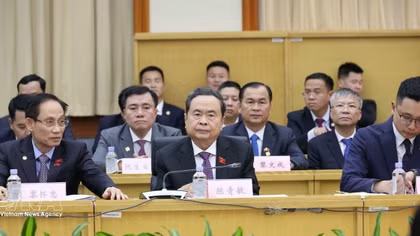
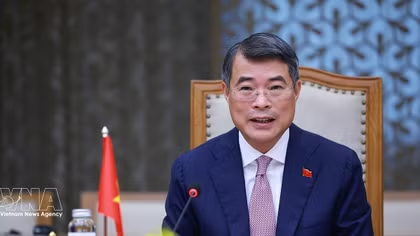
Prime Minister Le Minh Hung (right) at the working session with the Dong Thap provincial Party Committee’s Standing Board on May 27 (Photo: VNA)

Prime Minister Le Minh Hung has urged the Mekong Delta province of Dong Thap to effectively harness new potential and adopt stronger reforms in governance and growth planning to achieve rapid and sustainable development.

Chairing a working session on May 27 with the provincial Party Committee’s Standing Board as part of his southern working trip, the PM requested the locality to strongly renew its mindset and governance methods, stressing that the locality must proactively propose policies and special mechanisms suited to local conditions and integrate them into its action programmes based on assigned key tasks.

The PM reviewed the province’s socio-economic development, public investment disbursement, operation of the two-tier local administration model, and implementation of the Politburo’s Resolution 57 on science-technology development, innovation and digital transformation.

He applauded efforts and achievements of the provincial Party organisation, authorities and people, saying Dong Thap’s development direction was broadly in line with the goals set by the 14th National Party Congress. However, he also pointed to a number of bottlenecks that continue to constrain local growth.

According to the Government leader, economic restructuring remains sluggish as agriculture still accounts for a large share of the economy with relatively low added value. Public investment disbursement has yet to meet expectations, creating obstacles for major infrastructure projects. Transport connectivity among regions remains incomplete, limiting logistics development and the attraction of large-scale investment projects.

He also noted that high-tech and processing industries have yet to match the province’s potential, while the lack of leading enterprises and shortages in high-quality human resources continue to hinder development.

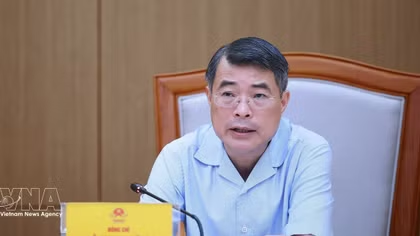
Prime Minister Le Minh Hung speaks at the working session with the Dong Thap provincial Party Committee’s Standing Board on May 27. (Photo: VNA)

The PM requested Dong Thap to urgently issue a plan to effectively implement its master plan and continue updating development orientations in line with practical conditions. He urged the province to remove bottlenecks facing infrastructure projects, efficiently handle surplus and unused state-owned land and properties, and assess investment efficiency before allocating capital.

Dong Thap must identify a new growth model built on science and technology, innovation and digital transformation, while making full use of its competitive advantages and available resources, he stressed.

The PM demanded stronger development of modern ecological agriculture linked with deep processing; promoting branding development and export expansion; and developing the coastal area into a multi-sector marine economic hub adaptable to climate change.

He underlined the need to accelerate the development of processing industries and turn industrial zones along the Tien and Hau rivers into major agro-aquatic processing centres.

At the same time, Dong Thap should step up the development of industrial parks, regional logistics infrastructure and large logistics centres to strengthen connectivity between the Mekong Delta and Ho Chi Minh City as well as international export markets, he said.

The Government leader also highlighted the necessity to promote border trade, improve the efficiency of international border gates, and develop eco-tourism and agricultural tourism products associated with local brands.

Regarding public investment, the PM instructed the province to speed up capital allocation and disbursement, especially for key national infrastructure projects, while proactively reallocating capital from slow-moving projects to those with stronger disbursement capacity.

The leader asked Dong Thap to ensure the smooth and effective operation of the two-tier local government model, including personnel restructuring, training for commune-level officials, and efficient management of redundant public assets and administrative headquarters.

For the implementation of Resolution No. 57, he called for greater mobilisation of resources and personnel for science – technology development and innovation; enhancing vocational training linked to business demand; and adopting policies to attract high-quality human resources and support innovation startups among young people.

The PM further urged the province to continue ensuring social welfare, expand social housing projects, improve public healthcare services and strengthen education infrastructure in border areas.

Attention must be also paid to Party building and creating a united, transparent, democratic and action-oriented administrative system with a professional and dedicated contingent of officials, he said./.
en.vietnamplus.vn

Other News

PM orders power plan overhaul to meet double-digit growth

PM orders power plan overhaul to meet double-digit growth

Securing adequate power supply is an urgent priority and a prerequisite to successfully achieve socio-economic development goals 2026, a foundational year for accelerating progress, with breakthroughs to follow in 2027 and the goals for the full term to be delivered, said Prime Minister Le Minh Hung.

Vietnam, China step up legislative cooperation, experience sharing

Vietnam, China step up legislative cooperation, experience sharing

Vietnamese National Assembly (NA) President Tran Thanh Man and Chairman of the Standing Committee of the National People’s Congress (NPC) of China Zhao Leji called for more balanced and sustainable trade, high-quality investment, modern and coordinated railway connectivity, and stronger cooperation in science and technology.

Top leader pledges support for firms, presses tech self-reliance

Top leader pledges support for firms, presses tech self-reliance

The country needs more firms that master technologies, build trusted brands and run production networks able to compete globally. Progress over the next five to 10 years must show up in productivity, job quality and market position, said top leader To Lam.

Vietnam, China to boost legislative, people-to-people exchanges

Vietnam, China to boost legislative, people-to-people exchanges

To further consolidate the three pillars of political, material and social foundations underpinning ties between the two Parties and countries, NA President Man proposed maintaining exchanges at all levels, strengthening national defence-security ties, and supporting each other’s development and international standing.

NA President visits Beijing legislative liaison station

NA President visits Beijing legislative liaison station

Praising the model of bringing legislative work closer to grassroots communities, voters and the public in Nanmofang and Beijing at large, National Assembly (NA) President Tran Thanh Man said Vietnam attaches importance to legislative work in building a socialist rule-of-law state of the people, by the people and for the people. That includes listening to experts, intellectuals, businesses, voters and the general public, especially those directly affected by policies and laws.

Vietnam pledges to advance rule of law at home, uphold law-based global order at UN

Vietnam pledges to advance rule of law at home, uphold law-based global order at UN

As it updates its legal framework, Vietnam has also put in place rules governing digital technologies, personal data protection, cybersecurity, artificial intelligence and digital transformation. The country upgraded its National Legal Database and expanded digital platforms to broaden access to legal information, education and aid.

NA President arrives in Beijing, beginning official visit to China

NA President arrives in Beijing, beginning official visit to China

Vietnam–China relations have continued to develop, particularly following reciprocal visits by General Secretary of the Communist Party of Vietnam Central Committee and President To Lam and General Secretary of the Communist Party of China Central Committee and President of China Xi Jinping.

14th Party Central Committee wraps up fourth meeting

14th Party Central Committee wraps up fourth meeting

The decisions issued at this meeting aim to strengthen leadership and implementation capacity and rally the strength of the entire nation, with the value of the plenum ultimately reflected in the issues addressed and improvements in people’s lives.

PM arrives in Vientiane, beginning official visit to Laos

PM arrives in Vientiane, beginning official visit to Laos

The visit provides an opportunity for the two Parties and Governments to reaffirm the special solidarity and faithful bond between Vietnam and Laos, a close relationship forged, tested and continuously nurtured throughout history. It also demonstrates the political resolve of the senior leaders of the two Parties and Governments to further develop the Vietnam–Laos special relationship in an increasingly substantive and effective manner.

JICA broadens support for Vietnam, from “brain circulation” to economic security

JICA broadens support for Vietnam, from “brain circulation” to economic security

PSNews — The Japan International Cooperation Agency (JICA) has identified four core pillars in its new support package assisting Vietnam's transition to a high-value growth model. Notably, the agency aims to foster "brain circulation" between Vietnam and Japan while expanding cooperation into economic security and sustainable development.

PM's Laos visit to help deepen bilateral relations

PM's Laos visit to help deepen bilateral relations

The two countries established diplomatic relations on September 5, 1962. On July 18, 1977, they signed the Treaty of Friendship and Cooperation, providing an important political and legal foundation for strengthening bilateral ties and supporting each country’s cause of national construction and defence.