The on-going 7th plenary meeting of the 12th Central Committee of the Communist Party of Vietnam is attracting special attention from Party members and the public, with high expectations for new breakthroughs in the building of the contingent of cadres, especially at the strategic level.

Dr Ngo Duc Chinh, a lecturer at the Transport University in Hanoi, said besides certain achievements, the personnel work should draw lessons from a series of trials over the recent time involving many high-ranking cadres.
In order to have a contingent of competent and clean cadres in the apparatus of the Party and public agencies, the lecturer said we should begin with the selection of cadres at the grassroots level which are Party cells and administrations of communes and wards. The work to clean up the apparatus should be done regularly to eliminate unqualified cadres.
According to Chinh, “Only when we strengthen the contingent of cadres from the grassroots level can the Party and State build an administration that is close to the people and works for the people, thus enhancing the effectiveness and efficiency of State management.”
Sharing Chinh’s view, architect Do Ngoc Giao at the Tay Ho Architecture Consultation Company in Hanoi’s Hai Ba Trung district said in order to find competent officials and assign them to the right positions, the Party needs to discover degraded cadres or political opportunists to exclude them from the Party and State apparatus and firmly fight the paying of bribes in exchange for position.
He noted that public opinions have questioned the fighting capacity of Party cells and the effectiveness of self-criticism and criticism.
“I hope that the Party Central Committee’s 7th meeting will create a breakthrough in personnel work so that the State apparatus will have officials who put common interest first,” he said.
The 7th plenary session of the 12th-tenure Party Central Committee is taking place in Hanoi from May 7-12.
Main issues on the agenda of the six-day sitting include the personnel work at all levels, especially at strategic level, salary reform for officials, public servants, the armed forces, and workers, and social insurance policy reform, among others.

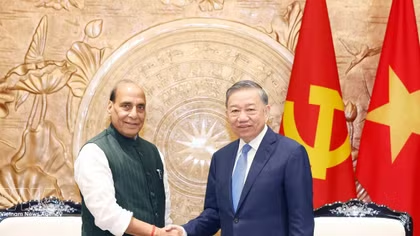
Vietnam highly evaluates India’s role and contributions to regional peace, stability and development, and always regards India as one of its most important partners, the top leader said.
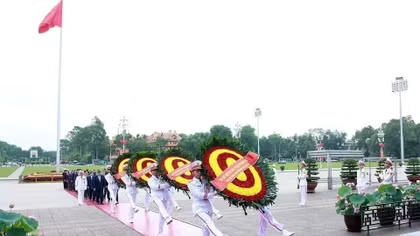
The Party and State leaders expressed their profound respect and boundless gratitude to President Ho Chi Minh, who founded and trained the Communist Party of Vietnam and made immense contributions to the Party and nation’s glorious revolutionary cause.
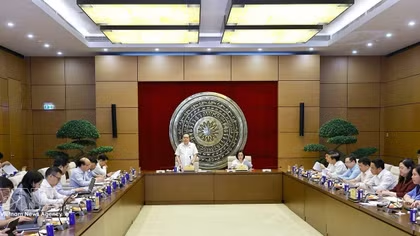
The NA's Committee for Cultural and Social Affairs has moved fast to reshuffle its organisation after the 14th National Party Congress and the election of deputies to the 16th NA, updating its work agenda to match new directives set out in the resolutions of the 14th National Party Congress and the first Congress of the NA Party Organisation for the 2025–2030 term.
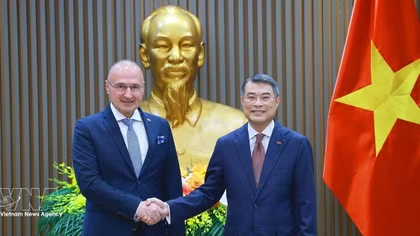
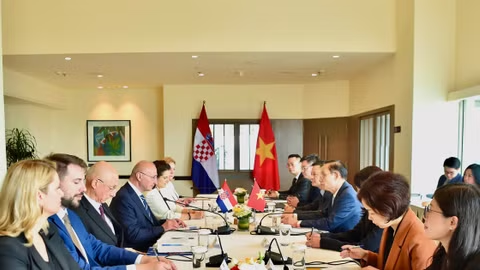
Vietnam and Croatia should strive to double bilateral trade turnover from the current level of 161 million USD; study the establishment of a Joint Committee on Economic Cooperation to create a long-term, stable, and effective framework for collaboration, said Prime Minister Le Minh Hung.
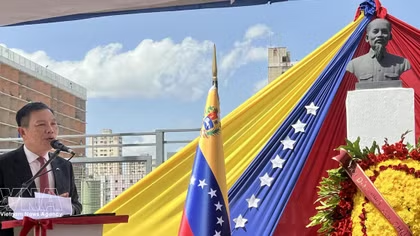
Vice President of the United Socialist Party of Venezuela (PSUV) Jesús Faria expressed deep admiration for President Ho Chi Minh and Vietnam’s indomitable struggle for national independence. He described President Ho Chi Minh as an immortal symbol of 20th-century national liberation movements, whose legacy continues to inspire leftist parties, progressive movements, and peoples across Latin America, including Venezuela.
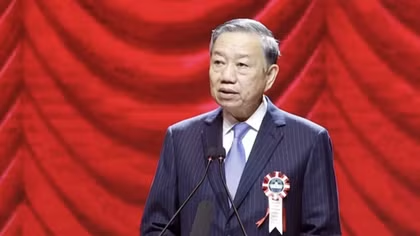
Vietnam National University, Hanoi must rise even further, becoming a leading academic pillar, a major hub of innovation, and a pioneering force in Vietnam’s higher education system; while also serving as a distinguished and reputable representative of Vietnamese intellect on the international stage.
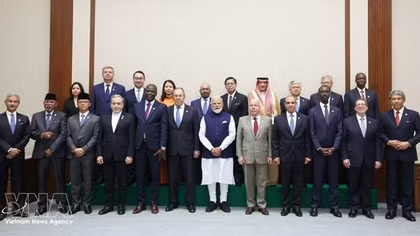
Deputy Foreign Minister Nguyen Minh Hang shared Vietnam’s approach to building an independent and self-reliant economy linked to deep international integration, while proposing several key areas for enhanced cooperation between BRICS and partner countries at the Expanded BRICS Foreign Ministers' Meeting that opened on May 14 in India.
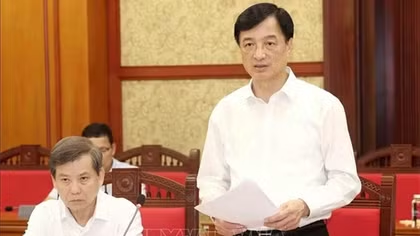
The Central Steering Committee for reviewing the one-year operation of the political system’s apparatus and the two-tier local administration model convened its first session in Hanoi on May 14.
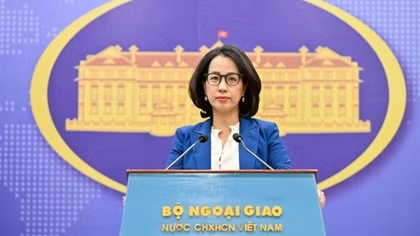
PSNews - The spokesperson stated that the dispatch of personnel by relevant parties to features belonging to Truong Sa without Vietnam’s permission constitutes a violation of Vietnam’s sovereignty under international law. She stressed that such actions run counter to the Declaration on the Conduct of Parties in the East Sea (DOC) as well as ongoing efforts by countries to negotiate a Code of Conduct in the East Sea (COC).
PSNews - Vietnam’s proposals placed the highest priority on ensuring a peaceful and stable environment conducive for continued sustainable development and improving the well-being and happiness of the ASEAN people. They were praised by member states and incorporated into the core contents of the ASEAN Leaders’ Statement on the response to the Middle East crisis.
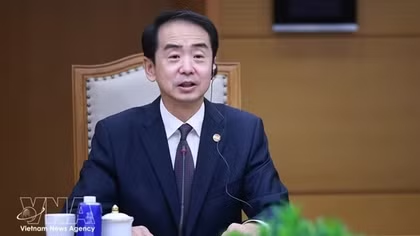
Both sides emphasised that advancing bilateral relations is a shared strategic choice, and pledged to steadfastly pursue the socialist path and jointly safeguard the socialist regimes and the leadership role of their Communist Parties as their most fundamental common strategic interest, Ambassador He Wei said.
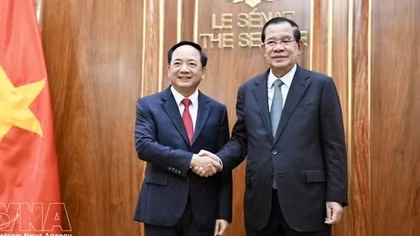
At the meetings, the senior Vietnamese Party official affirmed that Vietnam would continue to work closely with Cambodia to strengthen and deepen bilateral ties, while consistently supporting Cambodia’s peaceful, stable and prosperous development.
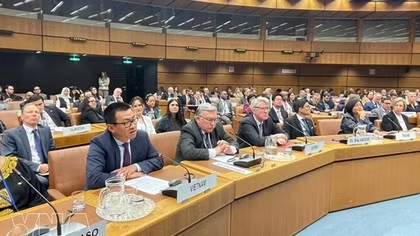
Vietnam highly values the support of the United Nations Office on Drugs and Crime (UNODC) in strengthening national capacity in crime prevention and criminal justice, drug control, and addressing emerging challenges, particularly cybercrime, said Ambassador Vu Le Thai Hoang.
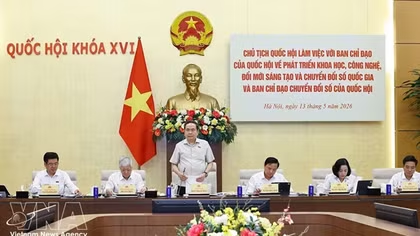
NA Chairman Tran Thanh Man underlined that digital transformation must go beyond investing in software or platforms and instead create substantive changes in working methods, advisory quality and operational efficiency.
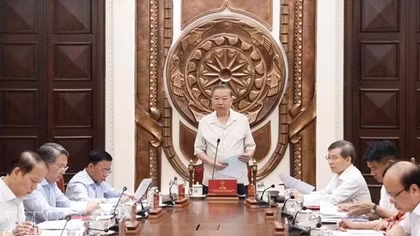
Consolidating the central steering committees for institutional and legal reform and for judicial reform is necessary in order to streamline organisational structures without reducing responsibilities, while ensuring clear accountability, measurable outputs and concrete results. Following the restructuring, the body will be renamed the central steering committee for institutional improvement and law enforcement, with the Party General Secretary and State President serving as its head.
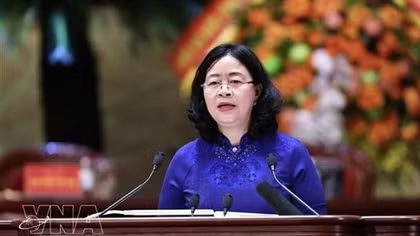
Bui Thi Minh Hoai was re-elected President of the the Vietnam Fatherland Front (VFF) Central Committee for the 2026-2031 tenure at the first conference of the 11th-term VFF Central Committee, held before the closing session of its 11th National Congress on May 13 morning in Hanoi.
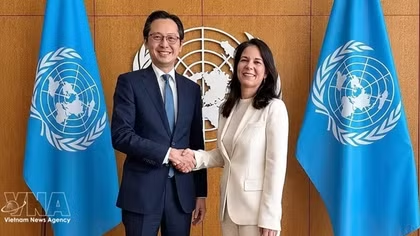
At the meeting this week, Ambassador Viet briefed the UNGA President on developments during the first two weeks of the conference. He stressed that the current international geopolitical landscape poses numerous complex challenges, while reaffirming Vietnam’s determination, together with other member states, to promote substantive and balanced outcomes at the conference.
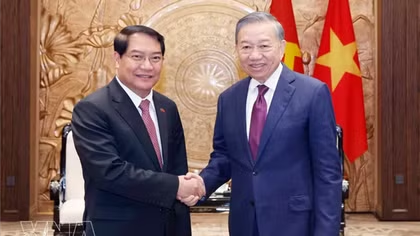
The host leader stressed that cooperation between localities, particularly between the capitals of Hanoi and Vientiane, plays an especially important role as a pioneering force in effectively implementing the foreign polices of the two Parties and States, while also serving as a bridge between politics and development, as well as between strategy and concrete action.
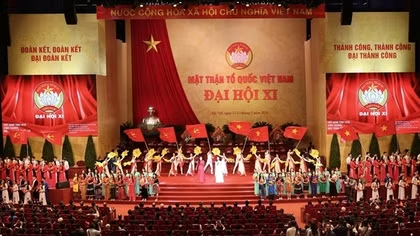
More than 1,300 delegates are attending the 11th National Congress of the Vietnam Fatherland Front (VFF) for the 2026–2031 tenure, including 1,138 official delegates.
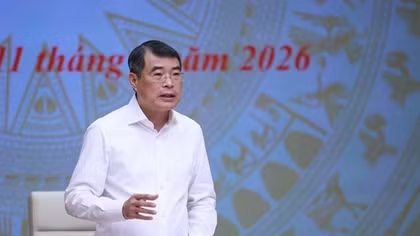
Prime Minister Le Minh Hung praised ministries and agencies for their proactive steps since the beginning of this year and especially from early April to follow the Politburo’s Resolution 57 and Conclusion 18, with clear, positive progress.