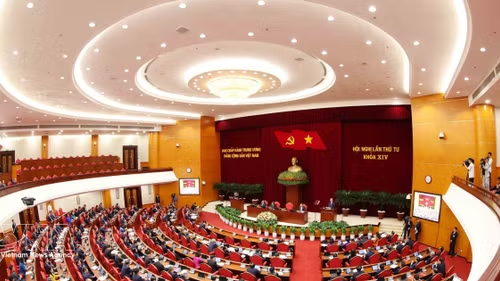
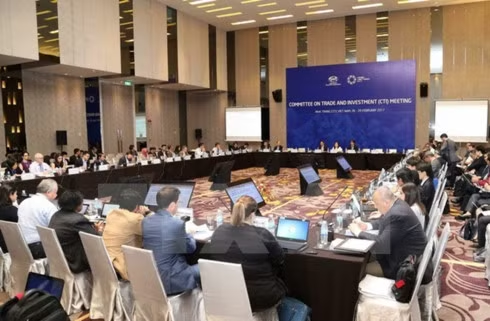
Up to 2,000 domestic and international delegates are expected to register for attendance at events within the framework of the second APEC Senior Officials Meeting (SOM 2) and related meetings scheduled to take place in Hanoi and Ninh Binh from May 9-21, heard a press briefing on May 5.
 |
To date, around 250 local reporters and 200 foreign peers have also signed up for coverage of these events, the organisers said.
SOM 2 will comprise 49 meetings, workshops and dialogues of committees and working groups of the Asia-Pacific Economic Cooperation (APEC) Forum, covering a range of spheres such as trade and investment liberalisation, business facilitation, human resource development, education, network economy, food safety, science, technology and creativity, mining, automobile industry and urbanisation.
At these events, APEC delegates are expected to continue speeding up the deployment of long-term cooperation programmes and plans in key areas and reach consensus on documents to be submitted to ministers for approval, laying a foundation for preparing contents and documents for the APEC Economic Leaders Meeting and APEC Ministerial Meeting in central Da Nang city in November 2017.
A multilateral dialogue on APEC towards 2020 and the future, a High-level Policy Dialogue on Human Resource Development in the Digital Age, a Pacific Economic Cooperation Council (PECC) meeting, a Senior Finance Officials Meeting (SFOM) and the 23rd Ministers Responsible for Trade (MRT) Meeting will also be held on this occasion.
Since its inception in 1989, APEC has proved itself as a leading economic cooperation and connectivity mechanism in the Asia-Pacific region, focusing on three pillars: trade and investment liberalisation, business facilitation and economic-technological cooperation.
APEC now groups 21 member economies, Australia, Brunei, Canada, Chile, China, Hong Kong (China), Indonesia, Japan, the Republic of Korea, Malaysia, Mexico, New Zealand, Papua New Guinea, Peru, the Philippines, Russia, Singapore, Chinese Taipei, Thailand, the US and Vietnam, which together account for 39 percent of the world’s population and contribute 59 percent of the global GDP and 48 percent of the global trade (by November 2016).
Vietnam officially joined APEC in November 1998, marking a milestone in the implementation of its foreign policy of openness, multilateralisation and diversification of relations and international economic integration.
Since then, Vietnam has made positive contributions to the APEC cooperation process. The country successfully hosted the APEC Year 2006, in which the 14th APEC Economic Leaders Meeting endorsed the Hanoi Action Plan to implement the Busan Roadmap towards the Bogor Goals, approved measures to enhance the efficiency of APEC cooperation and set out long-term prospects towards the formation of the Free Trade Area of the Asia-Pacific (FTAAP). In 2014, Vietnam also successfully organised the 6th APEC Human Resources Development Ministerial Meeting.
Vietnam has recommended and joined in many new initiatives alongside with proposing and carrying out more than 100 projects related to trade, investment, economic-technological cooperation, small- and medium-sized enterprises, response to emergency, healthcare, food security and counter-terrorism. The nation has assumed important positions in APEC cooperation mechanisms.
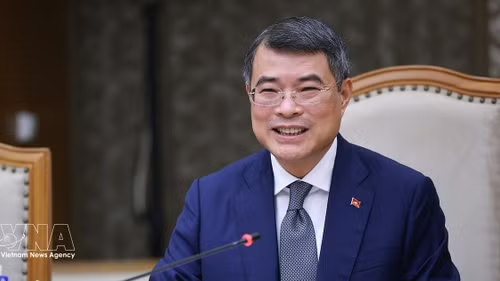
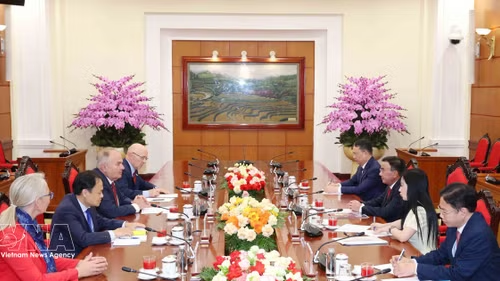
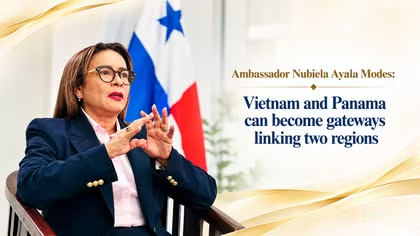
"Panama can serve as a strategic platform for Vietnamese companies seeking greater access to Latin America and the Caribbean, while Vietnam represents an important gateway for strengthening Panama’s engagement with Southeast Asia", Ambassador Nubiela Ayala Modes confirmed.
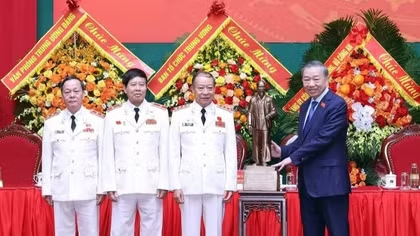
The Vietnam Association of Former People's Public Security Officers must truly serve as a common home that fosters comradeship and solidarity among former public security officers and those who have contributed to the cause of safeguarding security and social order, said top leader To Lam.
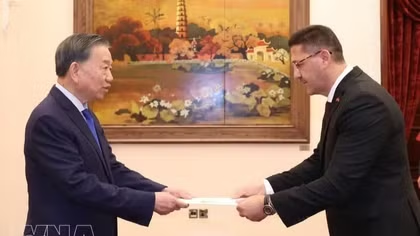
General Secretary and President To Lam receives newly accredited ambassadors
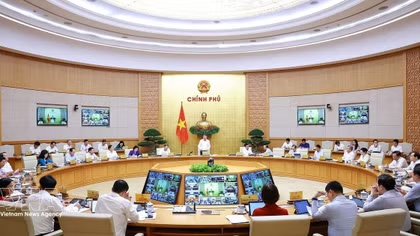
Localities nationwide hailed effective and flexible directions delivered by the Government so far this year, resulting in positive nine-month socio-economic growth, and reaffirmed their commitment to achieving targets set for the whole 2026 at an online Government-locality conference on October 3.
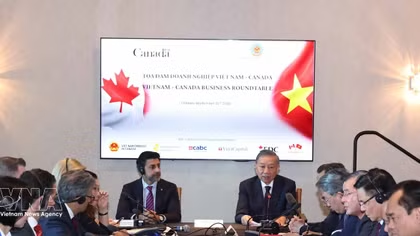
The elevation of bilateral ties to a Strategic Partnership shows that Vietnam and Canada increasingly view each other not simply as trading partners, but as long-term partners in addressing economic, technological and regional challenges.
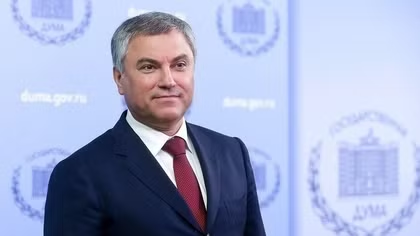
National Assembly President Tran Thanh Man on October 1 sent a congratulatory letter to Vyacheslav Volodin on his re-election as Chairman of the State Duma of the Federal Assembly of Russia.
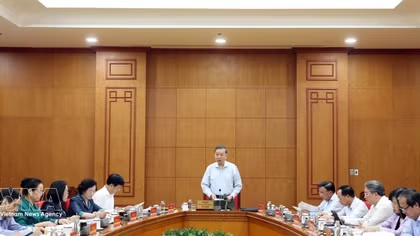
The top leader applauded the efforts of ministries, sectors, localities, social organisations, coaches, athletes, experts in developing physical education and sports in recent times, stressing that Resolution No. 08 has provided an important political foundation for sports development over the past 15 years, while Conclusion No. 70 set important orientations for the new period.
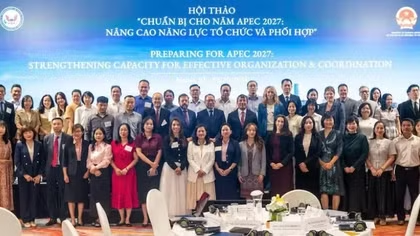
PSNews - Vietnam is recognised by its partners as an influential member of the Asia-Pacific Economic Cooperation (APEC) forum, with expectations that it will continue to demonstrate leadership when it hosts APEC for the third time in 2027, according to Standing Deputy Minister of Foreign Affairs Nguyen Minh Vu.
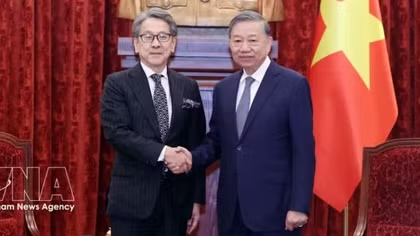
General Secretary and President Lam urged JBIC to continue promoting the substantive implementation of projects under the Asia Zero Emission Community (AZEC), and step up discussions on potential cooperation within the framework of the POWERR Asia (Partnership on Wide Energy and Resources Resilience Asia) initiative, including the development of strategic energy reserves.
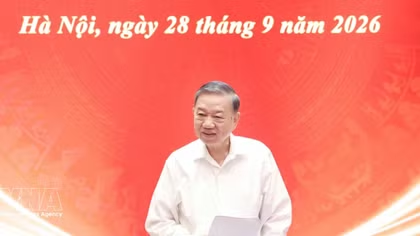
Overhauling the Party’s leadership methods is an objective, inevitable and urgent requirement to elevate the Party’s governing capacity and combat strength and keep the political system effective in the new development era.
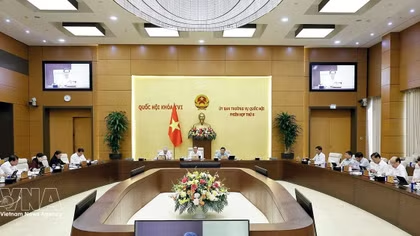
During the session, the NA Standing Committee will give opinions on a number of draft laws, namely the revised Land Law, the revised Housing Law, the revised Law on Real Estate Business, the Law on Legal Normative Documents, and the consolidated Law on the State Budget.
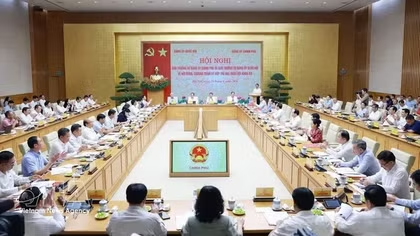
National Assembly President Tran Thanh Man coordination must go beyond finishing the agenda to improve the quality of NA decisions and Government enforcement; deal with policies rather than just paperwork, especially in the fight against corruption and other negative phenomena; and pin down final responsibility for each product, not just progress.
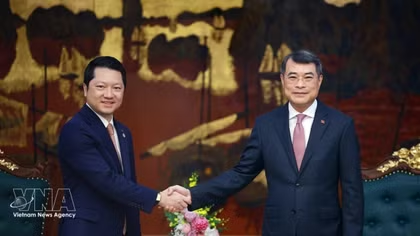
Prime Minister Le Minh Hung asked the two countries' inspection agencies to build on their achievements by regularly exchanging information and experience, maintaining delegation exchanges, and coordinating inspections in areas related to bilateral economic, trade and investment cooperation.
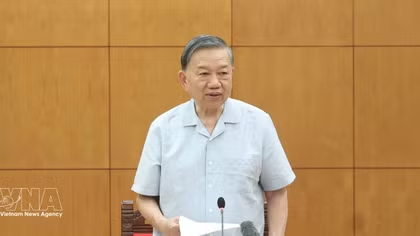
General Secretary and President To Lam demanded a sweeping review rather than piecemeal amendments to individual laws, so that people's rights are protected on a continuing basis.
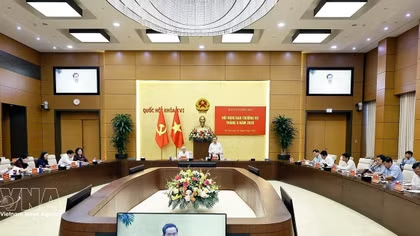
The meeting approved a plan to develop the project on reviewing the 2013 Constitution and studying and proposing comprehensive amendments to the Constitution.
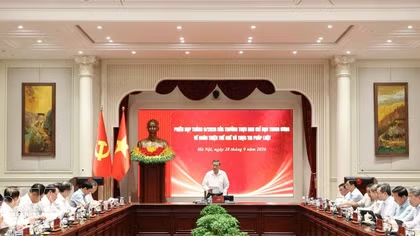
General Secretary of the Communist Party of Vietnam Central Committee and President To Lam on September 28 called for urgent and fundamental improvements in law enforcement, stressing that legislation and its enforcement must form a unified whole and ultimately serve development, protect legitimate rights and interests, and strengthen public trust.
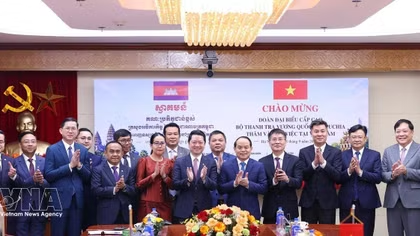
The Government Inspectorate of Vietnam broadly accepted the Cambodian ministry's proposals to maintain, renew and make more effective regular meetings between professional units and training establishments, and increase exchanges of senior, expert and specialised working-group delegations.
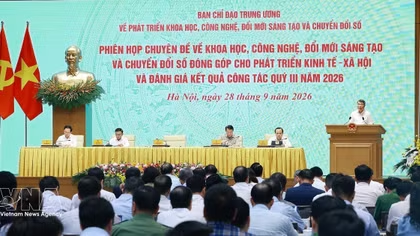
Prime Minister Le Minh Hung said Vietnam can no longer depend on capital and cheap labour. The only way to maintain strong double-digit growth, he said, is by boosting productivity through science, technology, innovation, and digital transformation.
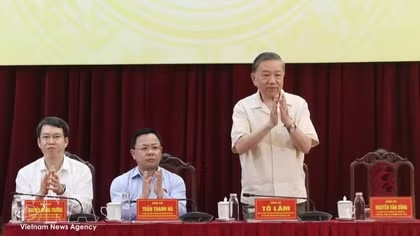
The General Secretary and President stressed that there must be no delay between resolutions and action, or between decisions and results in people’s lives, adding that laws must not only serve management but also facilitate development, while outdated regulations must not hinder growth.
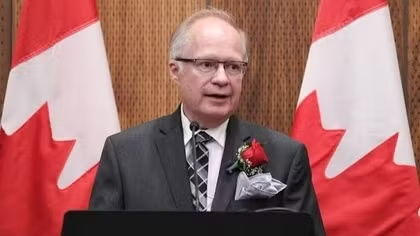
Regarding Vietnam’s role in multilateral affairs, Wilfert highlighted four areas where Vietnam could further contribute to multilateral cooperation, beginning with its contribution to regional peace and stability through ASEAN and the UN.