Stronger decentralisation for megacities must go with tighter power controls: Lawmakers

Most deputies welcomed the draft law’s reform-oriented approach and a number of breakthrough policies, including greater decentralisation in organisational arrangements, staffing management and policy implementation.

Hanoi (VNA) - Lawmakers on August 11 discussed in plenary the draft Law on Urban Development, welcoming the bill’s stronger decentralisation and delegation of powers while stressing that greater powers must be matched by tighter oversight.

They said this will provide a robust and flexible legal framework for developing modern, smart, green and sustainable Vietnamese cities with stronger international competitiveness.
download-8.png
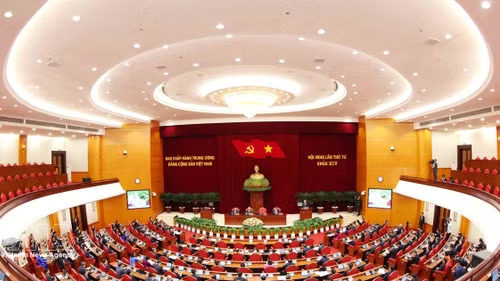
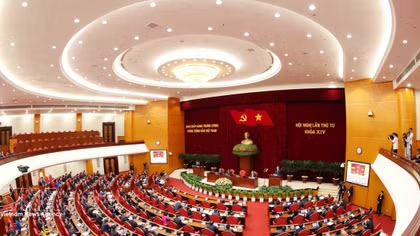
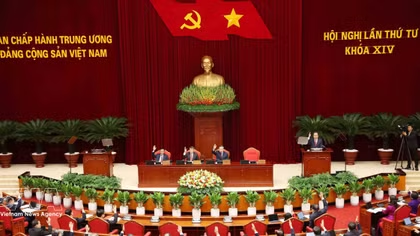
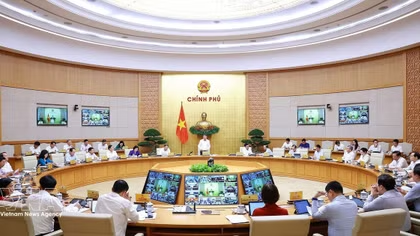
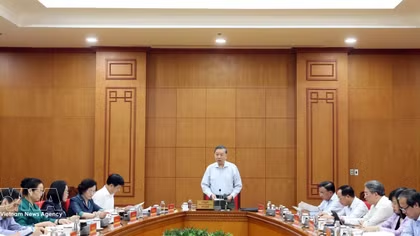
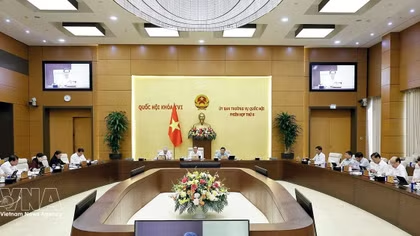
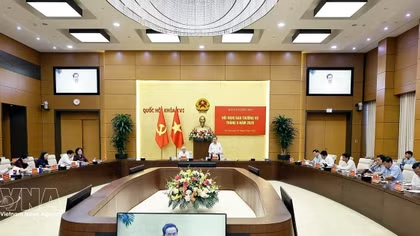
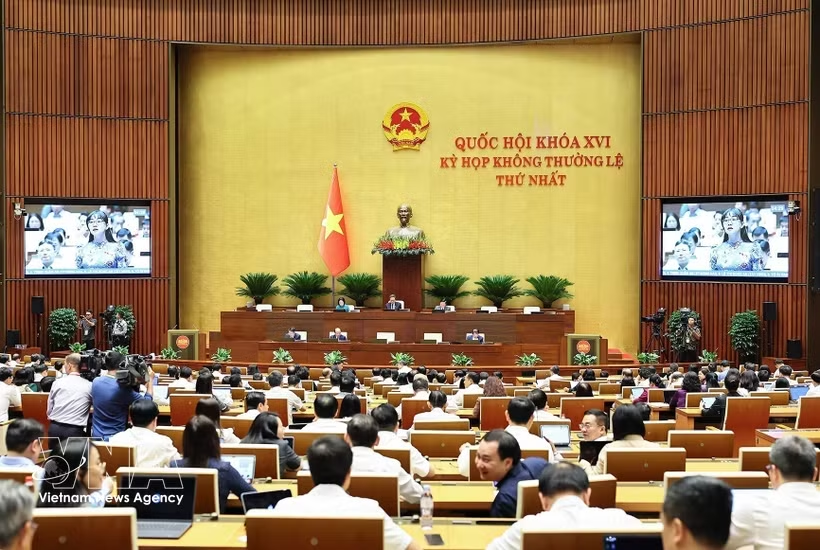
An overview of the discussion (Photo: VNA)

Greater powers to unlock development potential

Most deputies welcomed the draft law’s reform-oriented approach and a number of breakthrough policies, including greater decentralisation in organisational arrangements, staffing management and policy implementation.

Discussing greater autonomy for special urban administrations, deputy Nguyen Ngoc Son of Hai Phong city proposed that the law clearly regulate the solicitation and handling of opinions from the Government or Prime Minister on matters involving national and inter-regional planning and infrastructure before a city approves its plans.

He also called for clearer rules on the scope of regulations that a municipal People’s Committee can temporarily suspend. Where such measures differ from laws or resolutions of the National Assembly, they must follow mechanisms specifically authorised by the legislature, avoiding a “grey area” between technological experimentation and legal policy pilots.

Deputy Trinh Xuan An of Dong Nai also stressed that comprehensive decentralisation must go hand in hand with power controls and a stronger role for People’s Councils. He said the authority and responsibility of leaders must be tied to oversight, openness and transparency.

According to An, the draft law assigns more than 150 powers to People’s Councils, giving them considerable room to decide local policies. Decentralisation, he said, should not merely mean transferring powers from central authorities to municipal People’s Committees and their chairpersons. People’s Councils must fully exercise their role as elected institutions responsible for policymaking and overseeing local administrations.

An proposed three levels of oversight: before decisions are made, during implementation, and through post-implementation evaluation and accountability. He also called for stronger capacity among People’s Council committees and full-time deputies, alongside clearer boundaries between powers that may depart from general laws and the corresponding oversight mechanisms.

Stronger decentralisation, tighter oversight

Deputy Nguyen Dai Thang of Hung Yen urged the drafting body to clarify the financial responsibility of leaders and the oversight roles of the National Assembly, Government and People’s Councils. He also proposed specific criteria and conditions for other cities to apply the mechanisms under the law, preventing “ask-give” mechanisms or premature application.

Thang supported greater autonomy in staffing and recruitment policies, particularly in human resources management. He proposed stipulating that funding for such policies must come from local budgets, without using central budget funds or altering general policies applicable to civil servants and public employees.

Regarding controlled pilot mechanisms, Thang called for clearer rules governing their relationship with sector-specific laws, particularly those on land, monetary policy, planning and investment.

On stalled projects, Son proposed that when a stalled project resumes, authorities fully review land-related financial obligations and those arising from project adjustments, ensuring that the State suffers no revenue losses while avoiding the re-establishment of obligations already lawfully fulfilled.

Projects involving large or complex land values, public assets or financial obligations should also undergo inter-agency appraisal before decisions are made. Son suggested considering a deadline of December 31, 2026, arguing that extending the mechanism for up to 10 years could weaken its urgency and encourage a wait-and-see mentality./.
VNA
en.vietnamplus.vn

Other News

First working day of Party Central Committee's fourth plenum

First working day of Party Central Committee's fourth plenum

Delegates held group discussions on the CPV Central Committee resolution calling for stronger building and rectification towards a clean, strong and comprehensive Party and political system able to meet the country's development needs in the new era.

Key Party leader hosts Hungarian Workers' Party chief

Key Party leader hosts Hungarian Workers' Party chief

The Communist Party of Vietnam always values its solidarity and friendship with the Hungarian Workers' Party and communist and workers' parties worldwide, which helps build political trust and supports Vietnam's relations with other countries, said key Party leader Tran Cam Tu.

14th Party Central Committee convenes fourth plenum

14th Party Central Committee convenes fourth plenum

In his opening remarks, General Secretary and President To Lam said that the 14th National Party Congress set out major orientations and strategic goals, while the second and third plenums adopted important policies on Party building, personnel, development and national defence. The fourth plenum must focus on creating conditions for effective implementation while preparing the theoretical, organisational and human resources foundations for the country’s long-term development.

Panamanian President's Vietnam visit offers new opportunity to deepen bilateral ties

Panamanian President's Vietnam visit offers new opportunity to deepen bilateral ties

Vietnamese Ambassador to Mexico and Panama Nguyen Van Hai noted that the visit is particularly significant as the first high-level exchange between the two countries in nearly 15 years, following then-President Ricardo Martinelli’s visit to Vietnam in 2012, and came shortly after the 50th anniversary of diplomatic relations in 2025.

Vietnam and Panama can become gateways linking two regions

Vietnam and Panama can become gateways linking two regions

"Panama can serve as a strategic platform for Vietnamese companies seeking greater access to Latin America and the Caribbean, while Vietnam represents an important gateway for strengthening Panama’s engagement with Southeast Asia", Ambassador Nubiela Ayala Modes confirmed.

Localities committed to achieving 2026 growth targets

Localities committed to achieving 2026 growth targets

Localities nationwide hailed effective and flexible directions delivered by the Government so far this year, resulting in positive nine-month socio-economic growth, and reaffirmed their commitment to achieving targets set for the whole 2026 at an online Government-locality conference on October 3.

Creating new drivers for Vietnam-Canada cooperation

Creating new drivers for Vietnam-Canada cooperation

The elevation of bilateral ties to a Strategic Partnership shows that Vietnam and Canada increasingly view each other not simply as trading partners, but as long-term partners in addressing economic, technological and regional challenges.

Top leader asks for sports development to build national strength

Top leader asks for sports development to build national strength

The top leader applauded the efforts of ministries, sectors, localities, social organisations, coaches, athletes, experts in developing physical education and sports in recent times, stressing that Resolution No. 08 has provided an important political foundation for sports development over the past 15 years, while Conclusion No. 70 set important orientations for the new period.

Vietnam mobilises resources to affirm its leadership role in APEC 2027

Vietnam mobilises resources to affirm its leadership role in APEC 2027

PSNews - Vietnam is recognised by its partners as an influential member of the Asia-Pacific Economic Cooperation (APEC) forum, with expectations that it will continue to demonstrate leadership when it hosts APEC for the third time in 2027, according to Standing Deputy Minister of Foreign Affairs Nguyen Minh Vu.

Top Vietnamese leader receives Chairman of Japan Bank for International Cooperation

Top Vietnamese leader receives Chairman of Japan Bank for International Cooperation

General Secretary and President Lam urged JBIC to continue promoting the substantive implementation of projects under the Asia Zero Emission Community (AZEC), and step up discussions on potential cooperation within the framework of the POWERR Asia (Partnership on Wide Energy and Resources Resilience Asia) initiative, including the development of strategic energy reserves.

NA, Government's Party committees meet on legislature's second session agenda

NA, Government's Party committees meet on legislature's second session agenda

National Assembly President Tran Thanh Man coordination must go beyond finishing the agenda to improve the quality of NA decisions and Government enforcement; deal with policies rather than just paperwork, especially in the fight against corruption and other negative phenomena; and pin down final responsibility for each product, not just progress.

Prime Minister receives Cambodian Minister of Inspection

Prime Minister receives Cambodian Minister of Inspection

Prime Minister Le Minh Hung asked the two countries' inspection agencies to build on their achievements by regularly exchanging information and experience, maintaining delegation exchanges, and coordinating inspections in areas related to bilateral economic, trade and investment cooperation.