Party General Secretary and State President To Lam has requested continued refinement and greater effectiveness of the two-tier local administration model, stressing that building public trust and development momentum across society is key to turning the nation’s development aspirations into tangible strength for rapid and sustainable development in the years ahead.
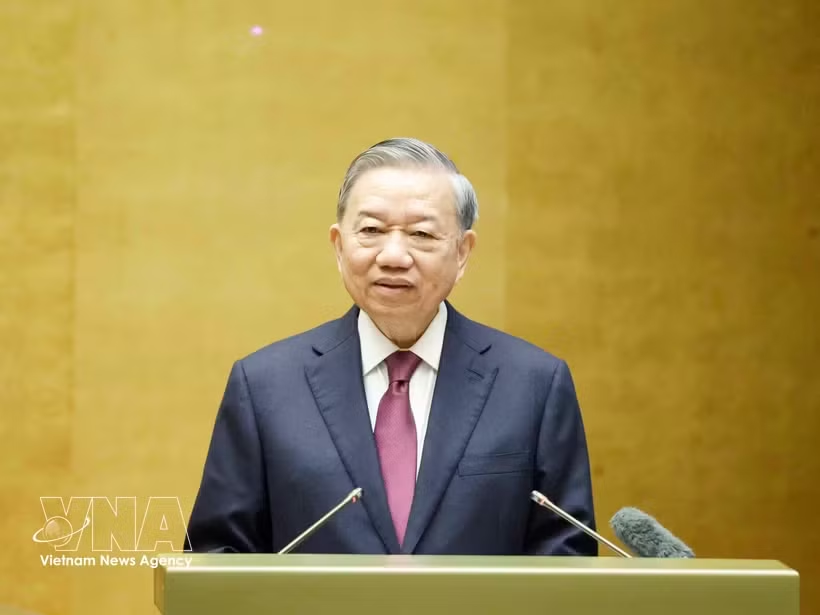
Addressing a national conference on April 13 to study, disseminate and implement the Resolution of the 14th Party Central Committee’s second plenum, the Party and State leader underscored the necessity for decisive, coordinated and effective actions to translate the Party’s resolutions into concrete results throughout the political system and society.
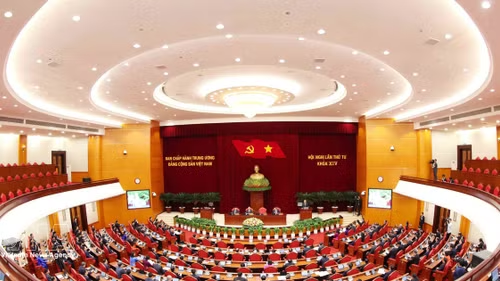
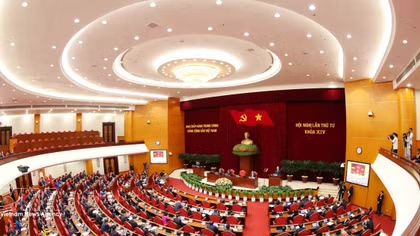
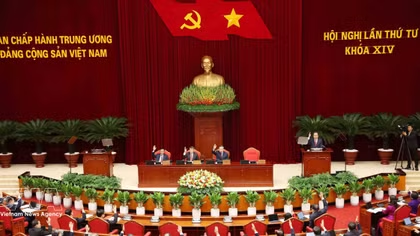
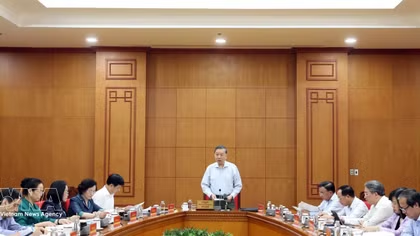
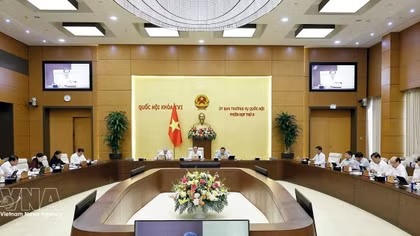
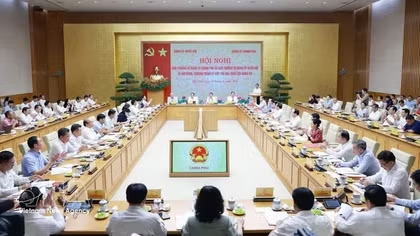
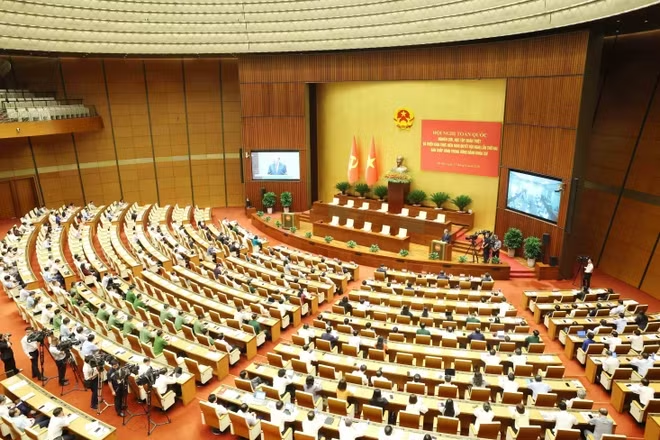
The hybrid-format conference connected the main venue at the National Assembly’s Dien Hong Hall with 36,323 online sites nationwide, drawing nearly 2.2 million participants. Delegates heard key reports on the implementation of the Party Statute, regulations on inspection, supervision and discipline, political and ideological work, anti-corruption efforts in the new period, and socio-economic development orientations for 2026–2030.
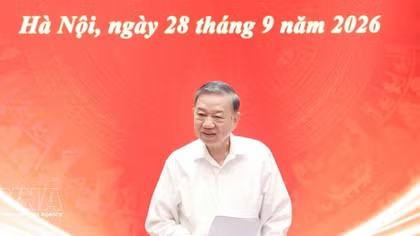
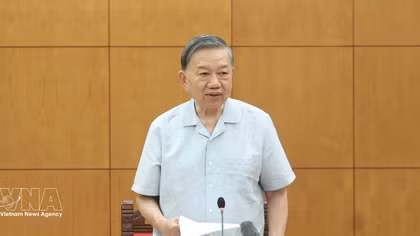
In his directive speech, the top leader stressed that Party regulations serve as the institutional backbone ensuring unified and consistent operation of the entire political system. All Party committees, organisations and members must fully understand and strictly comply with these rules, viewing them as a direct political responsibility. Implementation must be uniform, consistent and closely monitored, with strict handling of violations alongside encouragement of innovative and effective practices.
He called for a fundamental shift in development mindset, emphasising the efficient mobilisation and allocation of all resources to sustain growth. An economy that seeks high, sustainable growth and the capacity for breakthrough, he noted, cannot rely on a single source of capital or place the entire burden on the State.
The State needs to shift from being a direct investor to a role as a designer and enabler, creating an environment in which all resources in society can be mobilised and allocated in line with market signals within a transparent and stable institutional framework, he said.
On that basis, it is necessary to redefine the roles of capital sources within a new development structure, where capital flows do not exist in isolation but interact, reinforce and guide one another, he added.
According to the leader, State capital should be properly positioned as “seed” or catalytic capital, shaping development space, mitigating initial risks, and thereby guiding and activating non-state capital flows more effectively. Corporate capital, including private enterprises and foreign direct investment should be channelled into high value-added manufacturing, innovation-driven projects and knowledge-based value chains. Meanwhile, external borrowing must be used selectively, aligned with the country’s absorption capacity and long-term debt sustainability, prioritising key infrastructure and high-impact sectors.
He also highlighted the importance of developing financial markets, including capital, credit and bond markets, into effective medium- and long-term funding channels for the real economy, with a focus on productive sectors, innovation and essential infrastructure.
A strategic breakthrough, he noted, lies in unlocking the vast resources of the people, not only financial capital but also intellect, skills, labour, entrepreneurship and the aspiration for legitimate prosperity. Once effectively activated, these resources can be transformed into a powerful endogenous driver, contributing to stronger self-reliance of the national economy.
He also urged the elimination of fragmented, localised and short-term mindset in development planning. He said that national planning must adopt an integrated, multi-objective and long-term vision, ensuring balanced spatial development, efficient resource allocation and stronger regional connectivity.
Sectoral and local plans, he said, must align with the overall national development framework and strategic orientations, avoiding overlaps, conflicts of interest and resource waste.
Energy planning, in particular, should be prioritised, as stable, sustainable and affordable energy is essential for industrialisation, long-term growth and national resilience, he said, noting that energy must be positioned within the overall national development framework, in close alignment with industry, urban development, logistics, digital infrastructure, green transition, resilience, and national security, while ensuring autonomy.
Alongside planning, the top leader stressed the need to end inefficient, short-term and “form-driven” investment practices. All projects must be rigorously assessed within the broader planning framework to ensure quality, efficiency, long-term relevance and connectivity, he said, stressing that a century-long vision must be incorporated into the overall master planning.
A sound project must be assessed based on its real development impact and socio-economic efficiency, with the level of public benefit as the central criterion. Under no circumstances should capital size be used as a substitute for efficiency, the number of projects for growth quality, or superficial disbursement speed for long-term effectiveness. Every Vietnamese dong invested, whether from the State or society, must be carefully calculated in terms of efficiency, spillover effects, its ability to catalyse further investment, create jobs, generate added value, enhance competitiveness, and improve social welfare.
Building trust, development momentum across society
The top leader stressed the need to unlock productive forces and mobilise resources within the people, ensuring that every citizen, household, business household, and enterprise becomes an active driver of growth. Substantive growth must be formed both from the top down and the bottom up, across every link of the economy - from households and business households to production facilities and enterprises. When internal resources in the people are unlocked and effectively connected with State resources, infrastructure, markets, technology, training, credit, and development planning, the economy will have a solid domestic foundation for sustainable growth, he explained.
It is essential to create a development environment in which millions of people can clearly see real opportunities, where each family and business household has favourable conditions to invest, expand legitimate production and business activities, and maintain long-term engagement with the economy. Enterprises must be assured of a stable and transparent institutional framework, reasonable compliance costs, synchronised infrastructure, and broad market access. This, in turn, will generate strong endogenous momentum, fostering innovation, entrepreneurship, and sustainable development.
Every mechanism, policy, infrastructure project, and capital flow must aim to activate the capacity and aspirations for development in the people, thus transforming potential opportunities into tangible growth and turning public trust into a lasting driver of national development.
General Secretary and State President Lam also called for continued improvement of the effectiveness and efficiency of the two-tier local administration model. For this model to fully realise its value and strength, it must be viewed within the unified framework of national governance, guided by a consistent principle: the central level should be strong in strategic orientation, institutional development, and supervision, while local levels should be strong in implementation, with the commune level playing a decisive role in determining the operational quality of the entire system.
To realise this approach, commune-level authorities must strengthen their decision-making capacity. Stronger capacity in mobilising resources at the commune level will enable provincial authorities to be more proactive in coordinating and implementing strategic projects. At the same time, commune-level governance must be strengthened in supervision and feedback mechanisms.
For the commune level to become a driving force for upgrading provincial governance, all resolutions, policies, and projects must be translated into concrete actions. These decisions must directly aim to improve people’s living conditions, promote economic development, and enhance local competitiveness.
The top leader urged Party committees, Party organisations, officials and Party members at all levels from the central to grassroots to act with the highest sense of responsibility, demonstrating greater proactiveness, stronger determination, and more substantive action. Each level, sector, and locality must position itself within the broader national context, clearly identify its role and responsibility in the country’s overall development, and act in a consistent, disciplined, and effective manner.
He affirmed that, above all, it is crucial to build trust and development momentum throughout society. When people and businesses have confidence, the system operates smoothly, and resources are effectively mobilised, the aspirations for development will be transformed into real strength, helping drive the country toward rapid and sustainable growth in the coming period.
Receiving the top leader's instructions, Politburo member, Secretary of the Party Central Committee, and Chairman of the Party Central Committee’s Commission for Information, Education and Mass Mobilisation Trinh Van Quyet emphasised that these directions not only concretise the spirit of the 14th National Party Congress and the second plenum of the 14th Party Central Committee, but also serve as a guideline for Party committees, organisations, and all officials and Party members to implement them in a more synchronised, unified, effective, and substantive manner.
Following the conference, Party committees, organisations, agencies, and units will continue to disseminate and thoroughly grasp the contents of the Party Central Committee’s resolutions, regulations, and conclusions in line with the guidance of the Party Central Committee’s Commission for Information and Education, and Mass Mobilisation. This will be closely linked with the development of action programmes and concrete implementation plans tailored to the functions and tasks of each locality, agency, and unit, while strengthening inspection and supervision to ensure serious, synchronised, innovative, and effective implementation, with periodic reports submitted to the Politburo.