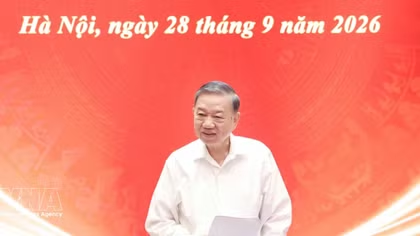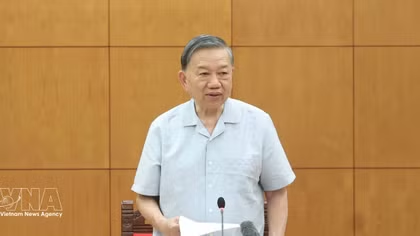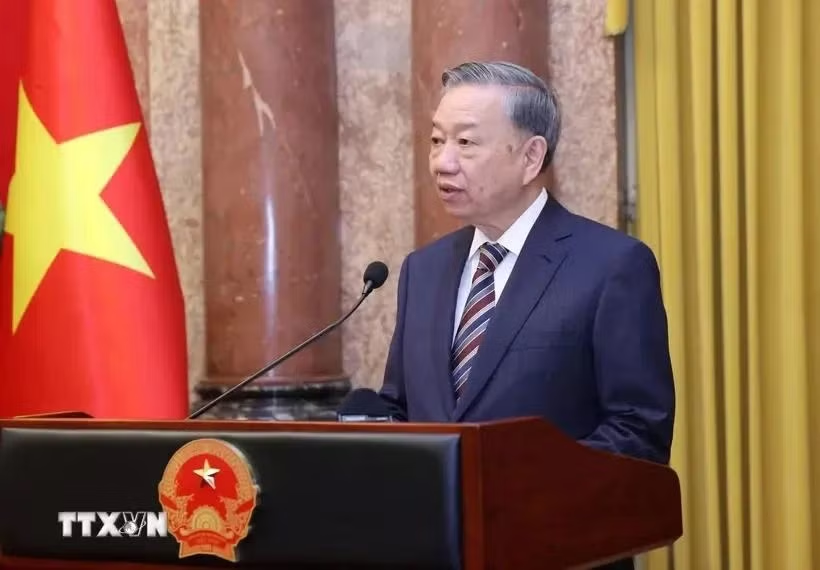
General Secretary of the Communist Party of Vietnam Central Committee and State President To Lam has written an article on continuing to strongly innovate the Party's leadership and ruling methods.
The Vietnam News Agency runs the full translation of the article:
CONTINUING TO STRONGLY INNOVATE THE PARTY'S LEADERSHIP AND RULING METHODS - AN URGENT NEED OF THE NEW REVOLUTIONARY PERIOD
TO LAM
General Secretary of the Communist Party of Vietnam Central Committee and State President
1. For over 94 years of leading the revolution, our Party has continuously studied, developed, supplemented, and perfected its leadership methods, and enhanced its leadership and ruling capacity. This is the key factor ensuring the Party is always pure and strong to steer the revolutionary ship through all challenges to victories. The country is now at a new historical moment and in a new era – the one of the nation's rise, when the requirement for the bold innovation of leadership methods and the improvement of leadership and ruling capacity to drive the nation forward is increasingly pressing.
The term of "ruling party" was first introduced by V.I. Lenin in 1922. From 1925 to 1927, in his book “Duong Kach Menh” (Revolutionary Path), President Ho Chi Minh also touched upon “ruling party”. He considered the Communist Party of Vietnam (CPV)'s leadership over the State and society a principle demonstrating the Party's ruling role. The Party holds this great responsibility because its purpose is nothing other than "leading the working class in the struggle to eliminate imperialist capitalism, and to achieve a communist society," "apart from the interests of the nation and the Fatherland, the Party has no other interests," "the Party is not an organisation for personal power or wealth. It must fulfill the duty of national liberation, making the Fatherland prosperous and the people happy." In his testament, President Ho Chi Minh wrote: "Our Party is a ruling Party." Regarding leadership methods, in the work “Sua doi loi lam viec” (Rectifying work style), President Ho Chi Minh dedicated a section to this issue. He posed the question: "What is the true leadership?” and gave the answer "The true leadership is: 1) to make the right decisions on all matters... 2) to organise proper execution... 3) to organise supervision..." And, to achieve all the three correctly, he said, it must be based on the people.
Based on Marxism-Leninism and Ho Chi Minh ideology, the 7th National Party Congress had, for the first time, mentioned "renewing the Party’s leadership content and methods," emphasising the need to "specifically define the relationship and work style between the Party, the State, and mass organisations at all levels, especially the central level." The 1991 Platform for national construction during the transition to socialism defined the Party's leadership methods as: "The Party leads the society through platforms, strategies, policy orientations, and work guidelines; through communications, persuasion, mobilisation, inspection, and the exemplary actions of Party members. The Party nominates outstanding members with full capabilities and qualities to government agencies and mass organisations. The Party does not take over the work of other organisations in the political system." "The Party leads the political system and is also a part of it. The Party maintains close ties with the people, is subject to the people's supervision, and operates within the framework of the Constitution and the law." The mid-term national Party conference in the 7th-tenure affirmed that "the Party’s leadership is based on the principle of democratic centralism, collective leadership, and individual responsibility; through Party organisations, not just through Party members; by collective decisions, and by monitoring, providing guidance, inspecting implementation, encouraging good points, and correcting deviations to enhance the role and effectiveness of the State, without taking over the State's management." The 8th, 9th, 10th, 11th, and 12th National Party Congresses continued supplementing and developing views on the Party's leadership methods; while the 13th National Congress emphasised "continuing to strongly innovate the Party's leadership methods in the new conditions." Based on the review of 15 years of implementing Resolution No. 15-NQ/TW of the 10th Party Central Committee, the 6th plenum of the 13th Party Central Committee issued Resolution No. 28-NQ/TW on November 17, 2022 on continuing to innovate the Party's leadership and ruling methods over the political system in the new period. The Party's leadership and ruling role over the State and the society is affirmed in the Constitution of the Socialist Republic of Vietnam; the mechanism of "the Party leadership, the State management, and the people’s mastery” has also been affirmed early and implemented through strict regulations in the Party Statute, the Constitution, and laws, as well as the rules and regulations of other organisations within the political system, and mass organisations.
Under the Party’s leadership and with a democratic and scientific ruling method that is constantly innovated to suit the requirements and tasks of each period, the Vietnamese revolutionary cause in general and the cause of Doi Moi in particular have created many miracles and attained great accomplishments. From a country that had no name on the world map and was heavily devastated by war, Vietnam has become a symbol of peace, stability, hospitality, and a destination for international investors and tourists. From a backward economy, Vietnam has risen up to be among the world top 40 leading economies, top 20 countries in terms of trade scale and an important link in 16 free trade agreements (FTAs) connecting 60 key economies in the region and the world. From a country under siege and embargo, Vietnam has established diplomatic relations with 193 member countries of the United Nations, and entered into strategic partnerships and comprehensive partnerships with 30 countries, including all major countries, and is an active member of more than 70 regional and international organisations. Making the happiness and prosperity of the people as the goal, Vietnam is regarded by the United Nations and international friends as a success story, a bright spot in poverty alleviation and in constantly improving the material and spiritual life of the people.
At the same time, stable political institutions have been formed with the mechanism of "Party leadership, State management, people's mastery". The Party's organisational system has gradually taken shape after many times of reshuffling, and continues to be innovated and rearranged. The political system, the core of which is the socialist rule-of-law State of the people, by the people and for the people, has been built and perfected, affirming its role in managing and operating all activities of social life. The Vietnam Fatherland Front is truly an organisation that represents and protects the people's legitimate and legal rights and interests; gathers and promotes the strength of the great national unity, exercises democracy, strengthens social consensus; conducts supervision and social criticism; and participates in Party and State building. Socio-political organisations represent the legitimate and legal rights and interests of all classes and strata of people; unite, gather, encourage, and mobilise people to actively implement the Party's policies and guidelines. Such institutions increasingly prove their suitability and superiority, winning the trust and support of the vast majority of officials, party members, and people of all strata, and held in high regards by international friends.
However, many shortcomings and limitations remain in the renovation of Party leadership. One of which is the issuance of many documents, some of which are too general, overextended and overlapped, while supplementation, revision or replacement is slow. Some major policies and orientations of the Party have yet to be timely and fully institutionalised, or institutionalised with a low level of feasibility. The overall model of the political system has not yet been completed; the functions, tasks, authority and working relationships of organisations, individuals, and holders of top positions remain unclear; while decentralisation and delegation of power are not strong enough. Shortcomings remain in the organisational models of the Party and the political system, making it difficult to distinguish the boundary between leadership and management, easily leading to taking over the work of others or loosening the leadership role of the Party. Administrative reform and renewal of working style and norms in the Party are still slow, while meetings continue to be held too frequently.
2. To continue to strongly reform the leadership methodology and improve the leadership capacity and the ruling capacity to ensure that the Party is the great helmsman leading our nation to strongly move forward, some key tasks include:
First, ensuring the consistent perception of and strictly implementing the Party's leadership and ruling methodology, and absolutely not allowing taking over others' tasks, or loosening the Party's leadership. The Party leads through the political system in which the Party is the core; leads by ideology, guidelines and policies, along with the setting of good examples and regular self-criticism and criticism by cadres and Party members; by institutionalising the Party's viewpoints, guidelines and policies into the State’s laws; by mobilising and persuading the people to implement the Party's guidelines and policies, introducing outstanding representatives to the State apparatus, and by implementing the inspection and supervision work. The Party rules by law, leads the promulgation of the Constitution and laws, and operates within the framework of the Constitution and laws. Party cadres and members comply with and uphold the "rule of law". The ruling Party leads the state; the power of the ruling party is political power that devises policies and guidelines, while the state power is the power to govern society on the basis of law. The Party’s leadership is to ensure that the real power belongs to the people, and the State is truly of the people, by the people and for the people. The Party comprehensively leads the country and is responsible for all successes and shortcomings during the cause of Fatherland construction and safeguarding.
Second, focusing on streamlining the apparatus and organisation of Party agencies so that they truly become the intellectual core, the "general staff", and the vanguards leading state agencies. Building truly lean advisory bodies for Party committees, and the advisory staff with political qualities, good professional capacity and qualifications, professional expertise, a high sense of responsibility, and proficiency in their work. Researching and promoting the merger of some advisory and support agencies of the Party; soon making comprehensive assessment of the concurrent holding of positions in the Party and the political system to make appropriate decisions. Ensuring that the Party's leadership tasks do not overlap with management tasks; distinguishing and clearly defining specific tasks of leaders at all levels in Party organisations, and avoiding the situation of taking over responsibilities of others, overlapping tasks, or formality. Strongly reforming the working style and norms in a scientific and professional fashion, with the motto "right role, right lesson".
Third, strongly reforming the promulgation, dissemination and implementation of the Party’s resolutions; building grassroots Party organisations and Party members into truly "cells" of the Party. Resolutions of Party committees and Party organisations at all levels must be concise, easy to understand, easy to remember, easy to absorb and easy to be implemented; correctly and accurately identify the requirements, tasks, paths and methods of development of the country, the nation, each locality, each ministry and each sector; be visionary, scientific, pragmatic, practical, and feasible; inspire excitement, confidence, expectation and motivation to urge actions by cadres, Party members, economic sectors, enterprises and people to implement the Party's resolutions. The dissemination and implementation of the resolutions must create self-awareness and self-absorption, especially of new viewpoints, policies and solutions. Focus must be put on building good Party cells and good Party members; improving the quality of Party cells’ activities, and putting the Party's policies and guidelines into practice.
Fourth, continuing to reform the inspection and supervision work; promoting the application of information technology and digital transformation to Party activities. The Party inspects and supervises so that work is performed better and resolutions are implemented effectively; the Party and State apparatuses operate effectively and efficiently, in accordance with policies and guidelines, and with the right people and right jobs; to detect new factors, good and creative ways of doing things in a timely manner; to correct and adjust deviations or prevent wrongdoings and violations of the Party’s regulations and the State’s laws. Promoting the inspection and supervision role of Party committees and inspection commissions at all levels. Issuing regulations on the decentralisation of inspection and supervision authority in conjunction with detecting and strictly handling all acts of taking advantage of inspection and supervision to commit corruption and negative phenomena. Focusing on digital transformation in the Party’s activities; building databases of grassroots Party organisations, Party members and Party documents, connecting databases from the central to grassroots levels, and synchronously connecting them with the national resident database and other databases to effectively serve the protection of internal politics and the building of a clean and strong Party.
V.I. Lenin said: “When the situation has changed and we have to solve tasks of a different kind, we should not look back and use yesterday's methods”. The reality of Doi Moi is always moving and developing, requiring constant reforms in the Party's leadership and ruling methods on the basis of firmly upholding the Party's principles; imbued with the teachings of Party General Secretary Le Duan:“We must lead closely and with principles, never wavering in the face of difficulties and challenges of the revolution”.