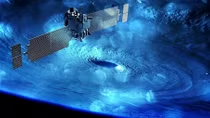
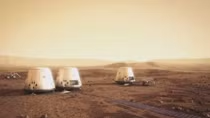
On planet Earth, water molecules stick to tiny grains of sea salt or dust blown into the air to form white clouds. However, when it comes to Mars, the presence of mid-atmospheric clouds has long remained a mystery to scientists.
With the help of CGI, physicist Brian Cox has shown that the Red Planet, which looks like a rocky desert now, might have looked like a true paradise with waterfall cascades, rivers and enjoyed conditions, making life possible.
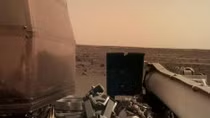
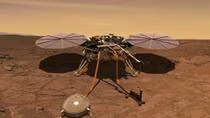
Nasa’s InSight Mars lander has detected signals of what could have been a marsquake. The signals were recorded on 6 April and if confirmed would be the first detection of seismic activity on Mars.
asa’s InSight Mars lander has detected signals of what could have been a marsquake. The signals were recorded on 6 April and if confirmed would be the first detection of seismic activity on Mars.
asa’s InSight Mars lander has detected signals of what could have been a marsquake. The signals were recorded on 6 April and if confirmed would be the first detection of seismic activity on Mars.
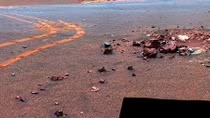
Only a handful of days after NASA gave up on the Mars rover Opportunity, sister rover Curiosity did something strange by suddenly placing herself into standby mode, alarming technicians on Earth.
There are two sites that have recently entered the scientific spotlight, bearing the beautiful Latin names Oxia Planum and Mawrth Vallis. They are both associated with hard evidence of the Red Planet’s ancient water reserves, which, if ultimately proved, will directly point to the type of life that possibly thrived there.
Nasa’s first lander to Mars since 2012 is set to launch on Saturday morning from Vandenberg air force base in California. The InSight spacecraft aims to listen for quakes and unravel the mystery of how rocky planets such as Earth form. If all goes as planned it should land on Mars on 26 November.
Last week, the Australian National University invited volunteers to help astronomers track down the fabled Ninth Planet, first hypothesized in 2014, and have so far identified four possible candidates for Planet Nine. Radio Sputnik talked to Dr. Brad Tucker from the Australian National University on the significance of the research.
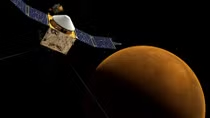
The Mars Atmosphere and Volatile Evolution (MAVEN) spacecraft of the US National Aeronautics and Space Administration (NASA) has performed a speed-boosting maneuver to avoid a collision with Mars' moon Phobos, NASA said in a statement.
An evolutionary biologist has suggested that human colonists on Mars could go through rapid evolution, eventually becoming an entirely new human species.
NASA has announced the discovery of a colossal mass of underground ice on Mars that could hold as much water as Lake Superior, the second-largest lake on Earth. The body was found in a region of the red planet called “the Utopia” in an area some 2,050 miles in diameter, roughly the size of New Mexico, and running about 560 feet below the surface.