New Research Reveals How Cotton Candy Clouds Are Conceived on Mars

On planet Earth, water molecules stick to tiny grains of sea salt or dust blown into the air to form white clouds. However, when it comes to Mars, the presence of mid-atmospheric clouds has long remained a mystery to scientists.

New research published 17 June in the journal Nature Geoscience suggests that the thin Martian clouds that have long baffled scientists may be formed due to specks of dust from destroyed meteors.

The intriguing discovery may hold the key to explaining how wispy, cotton candy-like clouds grow in the middle atmosphere of the Red Planet.
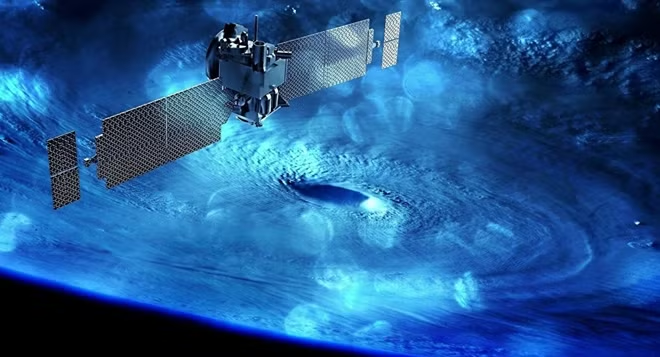
Photo: CC0.
Photo: CC0. 

A graduate student at the University of Colorado Boulder and lead author on the new paper, Victoria Hartwick, said: “Clouds don't just form on their own.”
“They need something that they can condense onto.”

According to the scientists, on Earth, water molecules adhere to tiny grains of sea salt or dust blown into the air to form clouds. However, the presence of mid-atmospheric clouds on Mars, which has no sea salt, left experts perplexed, although earlier studies had hinted that meteoritic smoke, the residue of destroyed meteorites, may have had a hand in building clouds near Earth's poles.

Building on that theory, Hartwick and her team set themselves the task of determining if this meteoritic smoke could similarly create the clouds apparent in the middle atmosphere of Mars, below other known types of clouds.

“Our model couldn't form clouds at these altitudes before [we included meteorite impacts]," Hartwick said. 
“But now, they're all there, and they seem to be in all the right places.”

Hartwick and her colleagues combined data taken from NASA's Mars Atmosphere and Volatile Evolution (MAVEN) satellite with computer simulations that replicated the flows of the planet's atmosphere.

The simulations successfully showed that including meteoritic smoke created clouds and conditions similar to those on the Red Planet.
Each day 2 to 3 tonnes of mostly small meteorites impact the Martian atmosphere. As they are destroyed in their passage through the atmosphere, they release dust into the air.

“More and more climate models are finding that the ancient climate of Mars, when rivers were flowing across its surface and light might have originated, was warmed by high-altitude clouds,” said study co-author Brian Toon. “It is likely that this discovery will become a major part of that idea for warming Mars,” he concluded.

Science has already unlocked many mysteries pertaining to ancient Mars, which was reportedly somewhat of a paradise with waterfall cascades and rivers. While how exactly the planet lost its water remains an open question, the current new research could be instrumental in revealing information not only about the weather conditions on present-day Mars but also about the planet's past climate.
Sputnik News

Other News

Vietnam targets at least 10 large strategic technology firms by 2030

Vietnam targets at least 10 large strategic technology firms by 2030

Deputy Prime Minister Ho Quoc Dung has signed a decision approving a plan to develop large domestic strategic technology enterprises in the 2026–2030 period, aimed at advancing digital infrastructure, digital human resources, digital data, strategic technologies and cybersecurity.

Protecting users crucial in building digital trust: Experts

Protecting users crucial in building digital trust: Experts

In Vietnam, digital transformation in the finance and banking sector is accelerating cashless payments, expanding access to financial services, improving market transparency and supporting economic growth and macroeconomic management.

Fostering skilled workforce for innovation era: experts

Fostering skilled workforce for innovation era: experts

Experts said close coordination among State management agencies, research institutes, universities, and businesses will improve training quality and serve the dual goals of quality education and practical research application.

Startup forum bridges Silicon Valley and local innovation ecosystem

Startup forum bridges Silicon Valley and local innovation ecosystem

The University of Economics Ho Chi Minh City (UEH), Saigon Asset Management (SAM), and Plug and Play Tech Centre co-hosted the “From Vietnam to Silicon Valley” forum, exploring AI innovation, venture capital, and pathways to integrate Vietnam’s startup ecosystem with Silicon Valley and global markets.

Experts call for stronger action against fake news online

Experts call for stronger action against fake news online

Experts have warned that fake news, misinformation and harmful online content are increasingly shaping public perceptions, particularly among young people, and stressed the need for stronger legal safeguards, technology tools and wider dissemination of credible information to tackle the problem effectively.

Protecting digital future in post-quantum, AI era

Protecting digital future in post-quantum, AI era

Participants highlighted the importance of building a proactive, synchronised and sustainable national cybersecurity ecosystem through closer cooperation among regulators, technology firms, research institutions and cybersecurity experts.

Vietnam attends SAHA 2026 defence, aerospace exhibition in Türkiye

Vietnam attends SAHA 2026 defence, aerospace exhibition in Türkiye

Vietnam’s participation in SAHA 2026 International Defence & Aerospace Exhibition in Istanbul reflects the country’s consistent policy of enhancing international defence integration and promoting defence industry cooperation towards self-reliance, self-strengthening, modernisation and dual-use development.

SK Group partners to build AI ecosystem in Vietnam

SK Group partners to build AI ecosystem in Vietnam

SK Innovation and SK Telecom signed MoUs with Nghe An province and the National Innovation Centre of Vietnam to advance AI ecosystem development and support the country’s long-term growth strategy.

Vietnam Research Excellence Fellowship for 2026-2030 approved

Vietnam Research Excellence Fellowship for 2026-2030 approved

Under the Vietnam Research Excellence Fellowship (VREF) for the 2026–2030 period, PhD students are identified as a core research force directly contributing to breakthroughs in sci-tech and innovation. Investing in top-tier doctoral candidates is more than workforce development, but a high-stakes strategic bet to forge a cohort of world-class scientists and technologists who can power Vietnam’s long-term economic ambitions.