Vietnamese scientists develop nanovitexin from mung bean husks to support diabetes treatment

The breakthrough is expected to support diabetes prevention and treatment while opening up broader biomedical applications.
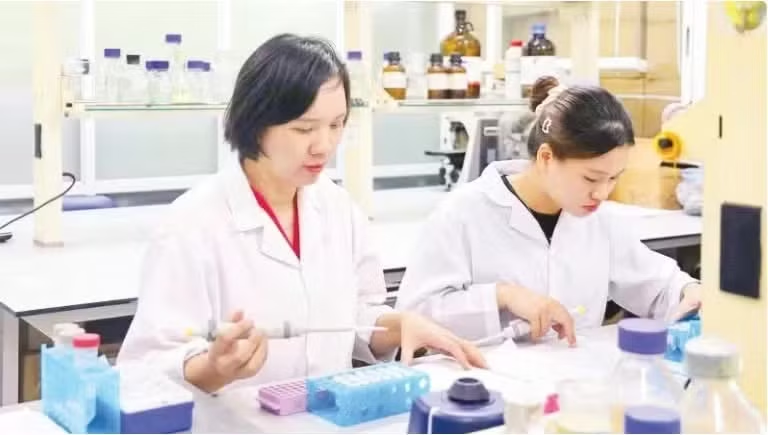
Scientists from the Vietnam Academy of Science and Technology (VAST) have successfully developed nanovitexin from mung bean husks, creating a material with significantly enhanced properties compared to conventionally extracted vitexin.

The breakthrough is expected to support diabetes prevention and treatment while opening up broader biomedical applications.

vitexin.jpg
Research on extracting the bioactive compound vitexin from mung bean husks has contributed to improving the effectiveness of diabetes treatment. (Photo: nhandan.vn)

According to the International Diabetes Federation, more than 11% of the world’s adult population was living with diabetes in 2025. Often referred to as a “silent killer,” the disease can cause serious complications affecting the cardiovascular system, liver, eyes and other organs.

While a range of anti-diabetic medicines is available, many remain costly and may cause undesirable side effects. As a result, scientists have increasingly turned their attention to natural bioactive compounds derived from plants as potential alternatives or complementary therapies.

Vitexin, a natural compound found in mung bean husks and several other plants, has been shown to possess various pharmacological properties, including anti-diabetic effects. However, its poor water solubility limits absorption in the body, with only about 4.9–5.8% absorbed in the small intestine, significantly reducing its effectiveness when administered orally.

To overcome these limitations, researchers from the VAST’s Institute of Biology and Institute of Materials Science applied nanotechnology to formulate vitexin into nano-sized particles, improving both its solubility and absorption. The project focused on developing a technological process for producing nanovitexin as a raw material for health supplements supporting diabetes prevention and treatment.

Dr. Ngo Thi Hoai Thu of the Institute of Biology, who led the research, said nano drug-delivery systems can significantly improve the bioavailability of poorly soluble compounds, enhance their stability under environmental conditions and increase their pharmacological effectiveness.

With a particle size of only 50–70 nanometres, nanovitexin demonstrates superior cellular uptake compared to conventional vitexin. It also shows strong antioxidant activity, helping protect cells from oxidative stress-related damage.

Researchers said nanovitexin offers particular promise in blood glucose management through its ability to inhibit starch-degrading enzymes. It may also help reduce gastrointestinal side effects commonly associated with conventional anti-diabetic drugs.

Beyond diabetes applications, the material could be used in products supporting liver detoxification and neuroprotection, while helping extend drug activity and reduce dosing frequency.

According to the project evaluation council, one of the team’s key achievements was the successful development of a technological process for producing nanovitexin from vitexin extracted from mung bean husks for biomedical applications. The resulting products are of high quality and show strong potential for technology transfer and commercialisation, paving the way for the development of new health-support products derived from natural materials.
en.vietnamplus.vn

Other News

Protecting users crucial in building digital trust: Experts

Protecting users crucial in building digital trust: Experts

In Vietnam, digital transformation in the finance and banking sector is accelerating cashless payments, expanding access to financial services, improving market transparency and supporting economic growth and macroeconomic management.

Fostering skilled workforce for innovation era: experts

Fostering skilled workforce for innovation era: experts

Experts said close coordination among State management agencies, research institutes, universities, and businesses will improve training quality and serve the dual goals of quality education and practical research application.

Startup forum bridges Silicon Valley and local innovation ecosystem

Startup forum bridges Silicon Valley and local innovation ecosystem

The University of Economics Ho Chi Minh City (UEH), Saigon Asset Management (SAM), and Plug and Play Tech Centre co-hosted the “From Vietnam to Silicon Valley” forum, exploring AI innovation, venture capital, and pathways to integrate Vietnam’s startup ecosystem with Silicon Valley and global markets.

Experts call for stronger action against fake news online

Experts call for stronger action against fake news online

Experts have warned that fake news, misinformation and harmful online content are increasingly shaping public perceptions, particularly among young people, and stressed the need for stronger legal safeguards, technology tools and wider dissemination of credible information to tackle the problem effectively.

Protecting digital future in post-quantum, AI era

Protecting digital future in post-quantum, AI era

Participants highlighted the importance of building a proactive, synchronised and sustainable national cybersecurity ecosystem through closer cooperation among regulators, technology firms, research institutions and cybersecurity experts.

Vietnam attends SAHA 2026 defence, aerospace exhibition in Türkiye

Vietnam attends SAHA 2026 defence, aerospace exhibition in Türkiye

Vietnam’s participation in SAHA 2026 International Defence & Aerospace Exhibition in Istanbul reflects the country’s consistent policy of enhancing international defence integration and promoting defence industry cooperation towards self-reliance, self-strengthening, modernisation and dual-use development.

SK Group partners to build AI ecosystem in Vietnam

SK Group partners to build AI ecosystem in Vietnam

SK Innovation and SK Telecom signed MoUs with Nghe An province and the National Innovation Centre of Vietnam to advance AI ecosystem development and support the country’s long-term growth strategy.

Vietnam Research Excellence Fellowship for 2026-2030 approved

Vietnam Research Excellence Fellowship for 2026-2030 approved

Under the Vietnam Research Excellence Fellowship (VREF) for the 2026–2030 period, PhD students are identified as a core research force directly contributing to breakthroughs in sci-tech and innovation. Investing in top-tier doctoral candidates is more than workforce development, but a high-stakes strategic bet to forge a cohort of world-class scientists and technologists who can power Vietnam’s long-term economic ambitions.

Strategic tech must address practical challenges: PM

Strategic tech must address practical challenges: PM

Prime Minister Pham Minh Chinh on March 28 said strategic technologies must tackle Vietnam’s practical challenges, while chairing a meeting of the Government’s Steering Committee for science and technology, innovation, digital transformation, and Project 06.

Ho Chi Minh City sets sights on becoming semiconductor hub

Ho Chi Minh City sets sights on becoming semiconductor hub

Ho Chi Minh City is stepping up efforts to attract investment from global leading groups and companies in the fields of electronic components, semiconductors and chip manufacturing as it seeks to position itself as a leading semiconductor industry hub in both the region and the world. 

Ho Chi Minh City launches upgraded technology exchange platform

Ho Chi Minh City launches upgraded technology exchange platform

The upgraded platform represents a comprehensive shift from a simple information-sharing model to a managed online technology trading system, enabling monitoring and measurement of real transaction outcomes. It is built on three pillars, namely new tradable technology products, a modern digital platform, and an improved operational model.