Ho Chi Minh City to complete 1st recruitment drive for top science, technology experts in Q3

To strengthen its competitiveness in attracting global talent, the city has introduced a comprehensive package of incentives, including housing assistance, transportation support, streamlined immigration and work permit procedures, improved research facilities, and favourable working conditions.

Ho Chi Minh City plans to complete the first phase of its recruitment drive for chief architects and leading experts in science, technology, innovation and digital transformation in the third quarter of 2026, under a directive issued by Vice Chairman of the municipal People's Committee Nguyen Manh Cuong on July 20.

Specifically, the municipal Department of Science and Technology will coordinate with the Department of Home Affairs and relevant agencies to guide units in identifying their recruitment needs, receive applications, and organise the first recruitment round. The city has also required all recruitment demands to be publicly announced to ensure a transparent, objective and regulation-compliant selection process.

The move is part of the city’s implementation of Government Decree No. 231/2025/ND-CP on the recruitment and employment of chief architects in science, technology, innovation and national digital transformation, as well as Decree No. 249/2025/ND-CP, which establishes mechanisms and policies to attract experts in these strategic fields.

Municipal departments, agencies and local administrations are tasked with proactively reviewing their development priorities and identifying demand for highly qualified personnel. They are encouraged to actively identify, recruit and attract chief architects, scientists and technology experts capable of leading key projects.

The city will place particular emphasis on strengthening connections with overseas Vietnamese professionals and international experts with advanced expertise, encouraging them to participate in major scientific, technological and digital transformation initiatives. Priority will be given to high-quality talent in strategic and core technologies, as well as emerging sectors expected to create new drivers of economic growth.
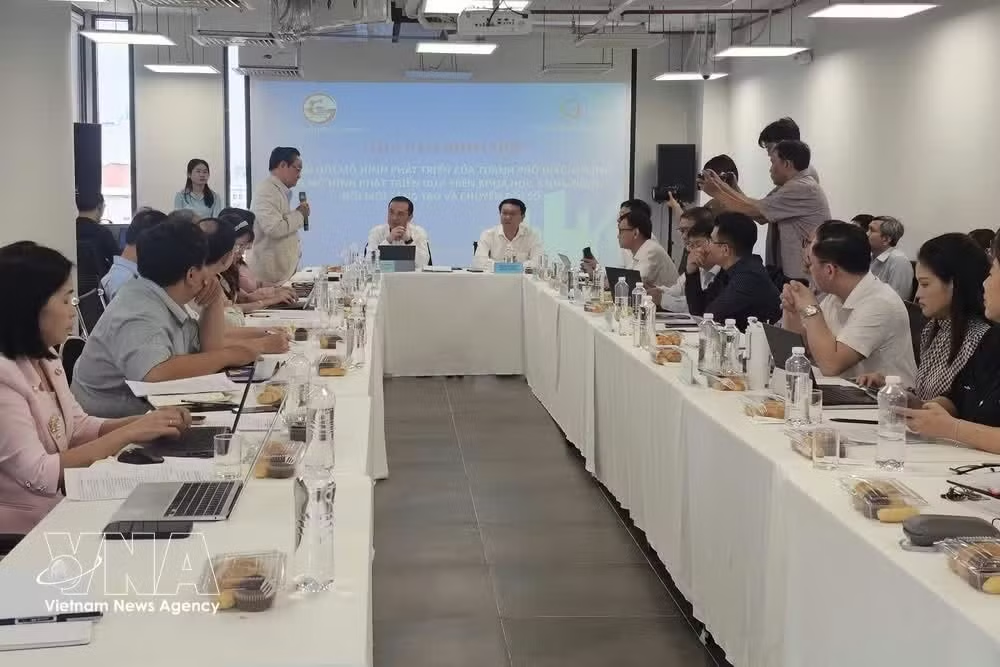
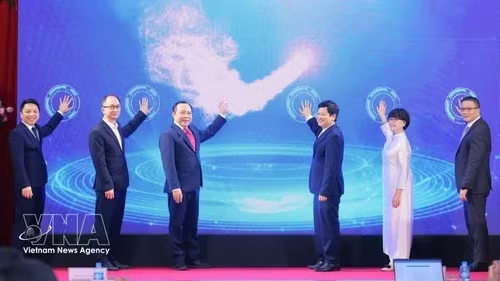
Ho Chi Minh City's Department of Science and Technology on February 5 holds a symposium on transforming the city's development model towards one driven by science, technology, innovation and digital transformation. (Photo: VNA)

The latest recruitment campaign follows a broader talent attraction plan unveiled by the municipal People's Committee in early June. Under the plan, Ho Chi Minh City seeks to recruit leading experts, scientists, chief architects and individuals with exceptional talent to take charge of major science and technology programmes, innovation initiatives, urban infrastructure projects, and the formulation of socio-economic development strategies and policies.

To strengthen its competitiveness in attracting global talent, the city has introduced a comprehensive package of incentives, including housing assistance, transportation support, streamlined immigration and work permit procedures, improved research facilities, and favourable working conditions.

Experts, scientists and other exceptional talents will receive an initial financial package immediately after their employment contracts take effect. Monthly remuneration will be determined according to professional qualifications and the position held, with salary levels designed to remain competitive in the high-skilled labour market.

In parallel, the city is stepping up investment in scientific infrastructure by upgrading specialised laboratories and establishing preferential mechanisms that allow chief architects, scientists, experts and other outstanding talents to access laboratories, databases and public libraries free of charge to support their research and professional activities./.

en.vietnamplus.vn

Other News

Protecting national security amid digital transformation, cyberspace

Protecting national security amid digital transformation, cyberspace

Cybersecurity, information security and data security risks must be identified and addressed early and from afar, with appropriate defensive measures ready to neutralise threats and protect national interests in cyberspace, said Lieutenant General Le Xuan Minh, Director of the Ministry of Public Security’s Department of Cybersecurity and Hi-tech Crime Prevention (A05).

Mekong Delta launches first robotics, AI research institute

Mekong Delta launches first robotics, AI research institute

Dr. Nguyen Van Quang, Rector of Nam Can Tho University, said the university is developing a value chain covering training, research, technology development, testing, technology transfer and commercialisation. The model is designed to link research more closely with practical needs, ensuring that technologies generate products and products create value for society.

Vietnam positioned to harness AI wave, World Bank report says

Vietnam positioned to harness AI wave, World Bank report says

The WB report identifies Vietnam as one of the few economies outside the European Union (EU) to have adopted a comprehensive AI regulatory framework as early as 2025. Vietnam applies a risk-tiered approach similar to that of the EU AI Act, imposing different obligations depending on whether an AI system poses “unacceptable,” “high,” “low” or “minimal” risks. The approach is viewed as a strategic step towards ensuring safe and transparent AI governance.

AI offers both opportunities, challenges for Vietnam's growth

AI offers both opportunities, challenges for Vietnam's growth

Dr. Ho Duc Thang, a full-time member of the National Assembly’s Committee for Cultural and Educational, said productivity is the key to sustaining double-digit economic growth, and AI has greater potential to improve productivity than any previous technology.

Top leader unveils people-centred vision for new development model

Top leader unveils people-centred vision for new development model

Vietnam's growth model, long fueled by low-cost labour, resource extraction, contract manufacturing, expanded investment, and capital accumulation, has run out of road. The country now needs a sweeping reform agenda to shift from extensive growth to a model driven by productivity, knowledge, science and technology, innovation, and digital transformation.

First national semiconductor chip prototyping support centre makes debut

First national semiconductor chip prototyping support centre makes debut

Vietnam's semiconductor ecosystem now comprises around 60 chip design companies, some 7,000 chip design engineers and 166 universities offering semiconductor-related training programmes. Initial registrations from 12 organisations indicate demand for the prototyping of approximately 30,000 chips.

Vietnam targets at least 10 large strategic technology firms by 2030

Vietnam targets at least 10 large strategic technology firms by 2030

Deputy Prime Minister Ho Quoc Dung has signed a decision approving a plan to develop large domestic strategic technology enterprises in the 2026–2030 period, aimed at advancing digital infrastructure, digital human resources, digital data, strategic technologies and cybersecurity.