Hanoi approves controlled pilot of two technology projects

The two projects involve an intelligent autonomous transportation system developed by Phenikaa-X JSC and a technology for producing mixed rare-earth oxides with a purity of over 95% on a semi-industrial scale developed by the Mining Technology and Construction Consultancy JSC.

Hanoi (VNA) – Hanoi has decided to allow the controlled pilot of two technology projects, with the municipal People’s Committee announcing the decisions at a ceremony held at Hoa Lac Hi-Tech Park on September 10.
download-7.png
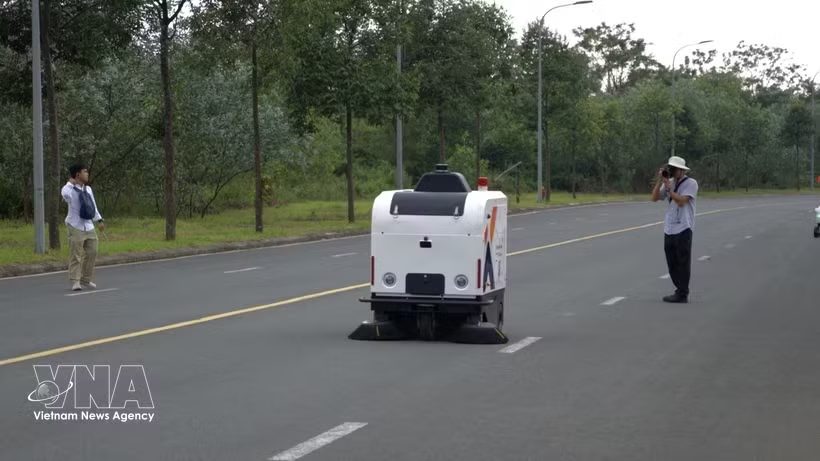
Demonstration of an autonomous electric street sweeper. (Photo: VNA)

The two projects involve an intelligent autonomous transportation system developed by Phenikaa-X JSC and a technology for producing mixed rare-earth oxides with a purity of over 95% on a semi-industrial scale developed by the Mining Technology and Construction Consultancy JSC.

Speaking at the event, Vice Chairman of the Hanoi People’s Committee Truong Viet Dung said the significance of the two projects went beyond the specific technologies being piloted, as Hanoi is also testing a new approach to technology governance.

Instead of waiting for technologies to become fully mature before developing regulations, the city is creating a limited space where new technologies can be tested under controlled conditions, risks can be managed, data can be collected, and policies can be refined based on practical experience.

He stressed that a sandbox is not a mechanism for granting special favors to new technologies, but a tool for the State and businesses to work together to bring innovative products into practical use more quickly while ensuring safety and accountability.
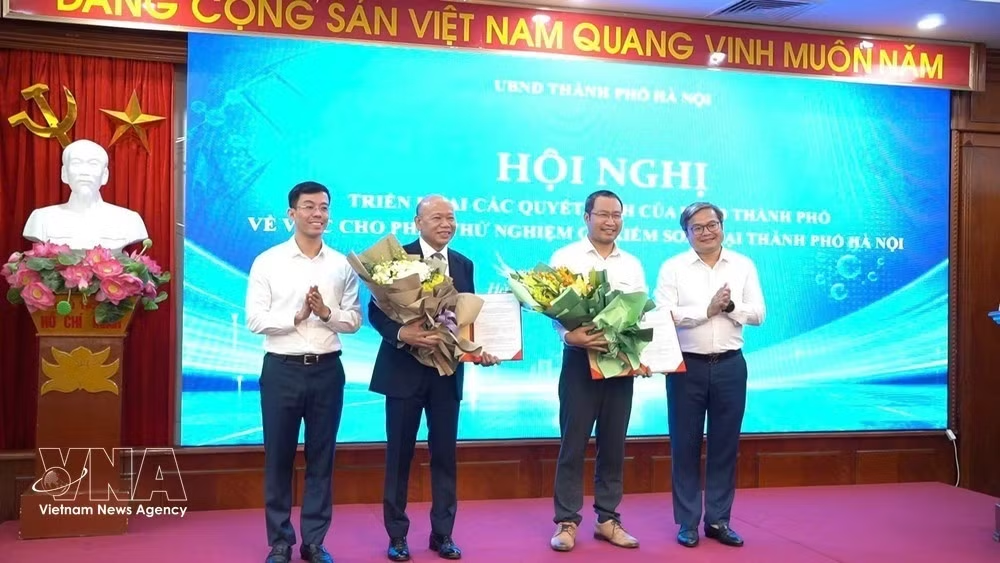
Vice Chairman of the Hanoi People's Committee Truong Viet Dung (first, right) presents decisions to representatives of the two businesses. (Photo: VNA)

For the transport project, the pilot is expected to run for 24 months. The city requires the pilot to go beyond assessing whether autonomous buses, robotaxis and other types of robots can operate successfully. The pilot must clarify their safety, stability, ability to handle different situations, and compatibility with existing infrastructure. The results must also provide a basis for determining the conditions required for commercialisation and the wider deployment of the technology.

Meanwhile, the pilot for the other project will last 18 months. Le Van Tuan, Chairman of the Board of Directors of the Mining Technology and Construction Consultancy JSC, said the project is the result of about a decade of research by Vietnamese scientists.

The trial will assess the company’s ability to master the technology, the stability of the production line, product quality and the efficiency of raw material, chemical and energy use. Waste, environmental impacts and radiation safety will also be strictly monitored./.
VNA
en.vietnamplus.vn

Other News

Singapore's experience suggests solutions to Vietnam's human resources challenge in AI era

Singapore's experience suggests solutions to Vietnam's human resources challenge in AI era

As Vietnam accelerates digital transformation and high-tech development, Singapore’s experience and the engagement of global technology companies demonstrate that human resources preparation must stay ahead of the curve. The ability to filter knowledge, collaborate, innovate and effectively use AI will increasingly become essential to helping workers adapt to a changing labour market and strengthening the competitiveness of Vietnam’s economy in the new era.

Protecting national security amid digital transformation, cyberspace

Protecting national security amid digital transformation, cyberspace

Cybersecurity, information security and data security risks must be identified and addressed early and from afar, with appropriate defensive measures ready to neutralise threats and protect national interests in cyberspace, said Lieutenant General Le Xuan Minh, Director of the Ministry of Public Security’s Department of Cybersecurity and Hi-tech Crime Prevention (A05).

Mekong Delta launches first robotics, AI research institute

Mekong Delta launches first robotics, AI research institute

Dr. Nguyen Van Quang, Rector of Nam Can Tho University, said the university is developing a value chain covering training, research, technology development, testing, technology transfer and commercialisation. The model is designed to link research more closely with practical needs, ensuring that technologies generate products and products create value for society.

Vietnam positioned to harness AI wave, World Bank report says

Vietnam positioned to harness AI wave, World Bank report says

The WB report identifies Vietnam as one of the few economies outside the European Union (EU) to have adopted a comprehensive AI regulatory framework as early as 2025. Vietnam applies a risk-tiered approach similar to that of the EU AI Act, imposing different obligations depending on whether an AI system poses “unacceptable,” “high,” “low” or “minimal” risks. The approach is viewed as a strategic step towards ensuring safe and transparent AI governance.

AI offers both opportunities, challenges for Vietnam's growth

AI offers both opportunities, challenges for Vietnam's growth

Dr. Ho Duc Thang, a full-time member of the National Assembly’s Committee for Cultural and Educational, said productivity is the key to sustaining double-digit economic growth, and AI has greater potential to improve productivity than any previous technology.

Top leader unveils people-centred vision for new development model

Top leader unveils people-centred vision for new development model

Vietnam's growth model, long fueled by low-cost labour, resource extraction, contract manufacturing, expanded investment, and capital accumulation, has run out of road. The country now needs a sweeping reform agenda to shift from extensive growth to a model driven by productivity, knowledge, science and technology, innovation, and digital transformation.

First national semiconductor chip prototyping support centre makes debut

First national semiconductor chip prototyping support centre makes debut

Vietnam's semiconductor ecosystem now comprises around 60 chip design companies, some 7,000 chip design engineers and 166 universities offering semiconductor-related training programmes. Initial registrations from 12 organisations indicate demand for the prototyping of approximately 30,000 chips.