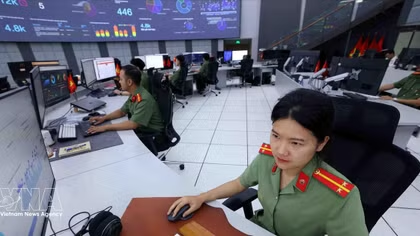
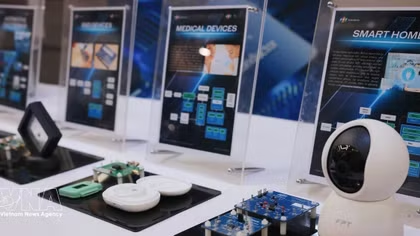
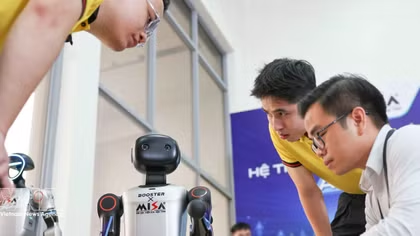
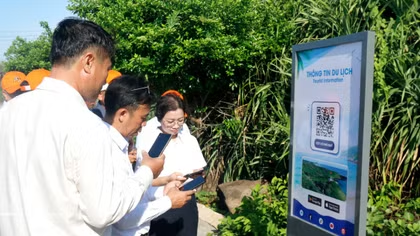
The growing application of new technologies, especially artificial intelligence (AI), is creating fresh opportunities for boosting productivity and economic development, underscoring the need for controlled testing mechanisms to assess risks, refine policies and bring promising technologies into practice.
Emerging potential
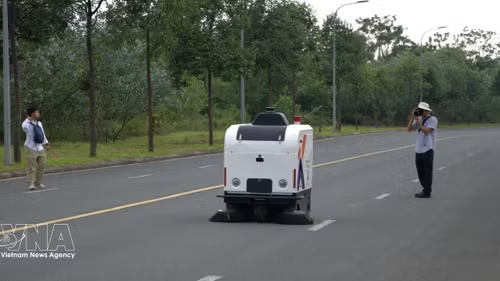
In Hanoi, the prospect of driverless cars autonomously transporting passengers and goods is no longer remote. The capital has recently approved a controlled pilot project for a smart autonomous transport system featuring autonomous buses, robot taxis, cleaning robots and delivery robots.
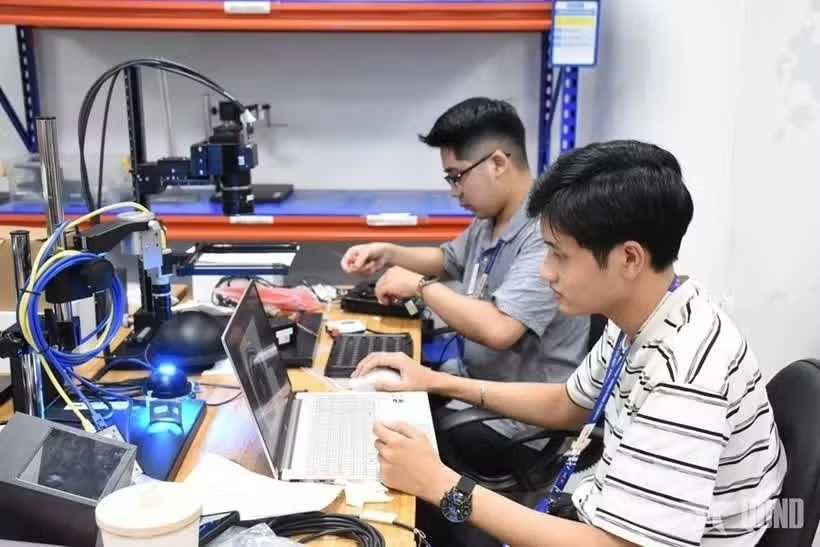
The pilot is confined to Hoa Lac Hi-Tech Park, with specific testing criteria. During the 12-month pilot period, autonomous buses are expected to serve around 40,000-50,000 passenger trips, while robot taxis are projected to carry some 20,000-35,000 passengers. According to the municipal People’s Committee, the pilot aims to assess the safety, reliability, and readiness of autonomous vehicles under real traffic conditions.
Meanwhile, Dien Bien province is also piloting new technologies to support socio-economic development. Its rugged terrain and winding roads pose major logistics challenges, while remote areas face difficulties in accessing healthcare, transporting goods, and supplying production materials. Against this backdrop, unmanned aerial vehicles (UAVs) being tested and deployed as part of the locality’s efforts to apply science and technology to developing a low-altitude economy are expected to help address these constraints and unlock new development potential.
The pilot flights are expected to focus on three key areas: smart agriculture, including seeding, crop spraying, crop monitoring and transport of agricultural supplies; low-altitude logistics, such as the delivery of medicines, medical supplies, specimens and essential goods to remote areas; and resource management and public services, including terrain surveys, forest management, resource monitoring and early disaster warnings.
These initiatives show that technology pilots are emerging not only in developed urban areas but also in localities facing economic and geographical difficulties. Although still at the pilot and evaluation stage, they highlight the potential of new technologies for local economic development. In agriculture, UAVs could shorten spraying time, improve the efficiency of seeding and fertiliser application in hard-to-reach areas, and reduce transport costs. In transport, autonomous vehicles could pave the way for more modern systems.
However, many other technologies with potential practical applications have yet to be fully researched or effectively deployed. This calls for additional testing mechanisms to help bring useful technological solutions into practice and serve people's needs.
Creating momentum for technology development
Nguyen Van Thuat, Deputy Director of the Digital Economy and Society Department under the Ministry of Science and Technology, stressed the need for Vietnam to create new development spaces based on science, technology and innovation alongside traditional growth drivers, thereby fostering new economic sectors with higher productivity and added value.
For emerging fields, institutional barriers can be more challenging than technological ones, he said, adding that waiting for a fully developed legal framework before deployment could mean missing development opportunities, while large-scale application without adequate risk assessment could fail to ensure social interests.
Controlled testing offers a way to address this dilemma, allowing regulators to evaluate technologies within defined scopes, timeframes and conditions while gradually refining policies, he added.
Commercialisation is also crucial to bringing technological products from research to the market. Assoc. Prof. Ta Hai Tung, Deputy Director of Hanoi University of Science and Technology, said hi-tech parks should serve not only as centres for testing, research and training but also as links among the State, universities and businesses.
He noted that cooperation between universities and businesses remains limited, partly because most Vietnamese enterprises are small or medium-sized with limited resources. While businesses are increasingly seeking to master technologies, establishing dedicated research centres remains costly. Universities already have research teams, enabling businesses to commission research or technology transfer at lower costs, while State seed funding could help connect the two sides and build a sustainable ecosystem.
Experience also shows that people remain a decisive factor in technology testing, research and development. Although the Political Bureau’s Resolution No. 57-NQ/TW allows pilot schemes for new practical issues and accepts risks and delays in science, technology and innovation, concerns over risks and responsibility persist.
According to experts, apart from developing a high-quality workforce, stronger measures are needed to protect individuals and organisations willing to pursue breakthroughs, take action and assume responsibility.