Hanoi (VNA) - Thanks to sweeping changes in strategic thinking and major breakthroughs, efforts to safeguard national sovereignty in cyberspace and ensure cybersecurity and data security have made significant progress, creating a solid foundation for the development of digital government, digital society and digital economy.
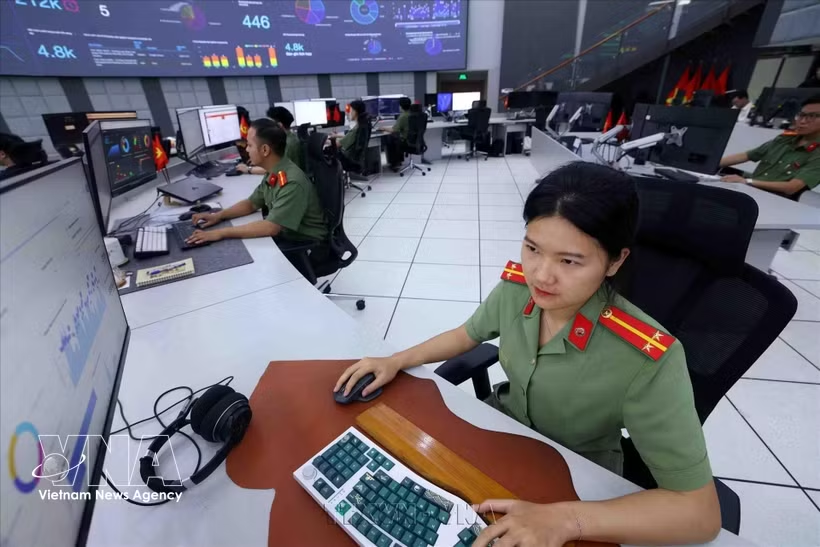
Impact of digital transformation, cyberspace
Lieutenant General Le Xuan Minh, Director of the Ministry of Public Security’s Department of Cybersecurity and Hi-tech Crime Prevention (A05), said that as digital transformation advances comprehensively and extensively, the concept of national security is undergoing fundamental changes in both scope and substance.
In practice, cyberspace has become foundational infrastructure for the development of digital government, digital society, and digital economy. Data has become a strategic resource, digital infrastructure the lifeblood of the modern economy, and technology a source of new forms of power, increasing risks and challenges to national security.
He said that data sovereignty is facing growing challenges as cross-border dependence increases. Digital transformation, data centres and interconnected systems are also heightening cybersecurity and data security risks, while cyberattacks are becoming increasingly sophisticated, professional and systematic, aided by artificial intelligence (AI).
Cyberspace has become a “grey zone” in strategic competition, where countries, particularly major powers, are stepping up dangerous activities below the threshold of war. Recent conflicts have highlighted a new form of warfare when cyber and information warfare often pave the way for military operations on the ground. Cyber reconnaissance, attacks, espionage and ideological sabotage have become tactical tools for gaining the upper hand, he noted.
A new form of attacks targeting the cognitive domain has also emerged, involving cognitive warfare and manipulation of digital trust. Perceptions of people and society as a whole are increasingly influenced by content-distribution and AI algorithms used by social media platforms and cross-border AI services. Such platforms have also become operating grounds for hostile forces, while cyber espionage is growing increasingly dangerous.
According to Minh, breakthrough technologies are reshaping approaches to protecting national sovereignty and security in cyberspace, particularly quantum computing, AI, unmanned aerial vehicles (UAVs), next-generation mobile services such as 5G and 6G, and satellite Internet.
National security in cyberspace is consequently facing risks related to technological dependence and national self-reliance. Failure to master core products and services could create new risks of falling behind and losing sovereignty over cyberspace, cybersecurity and data security, especially as Vietnam develops AI products based on foreign technological foundations.
Three strategic breakthroughs
Lieutenant General Minh said the Party, State and Ministry of Public Security have identified these challenges at an early stage. Under the comprehensive direction of the Central Public Security Party Committee and the Ministry of Public Security, efforts to safeguard national security in cyberspace have focused on three strategic breakthroughs.
The first is to improve institutions, policies and laws on cybersecurity and national security in cyberspace. The second is technological self-reliance through research, application and development of cybersecurity products and services. The third is developing high-quality human resources in cybersecurity and data security.
These three breakthroughs have helped generate positive changes and tangible results in safeguarding sovereignty in cyberspace, cybersecurity and data security.
Early, remote risk detection and response
Politburo Resolution No. 57-NQ/TW identifies the protection of national sovereignty in cyberspace, cybersecurity and data security as a consistent and inseparable requirement throughout the development of science and technology, innovation and national digital transformation.
Directive No. 57-CT/TW of the Party Central Committee’s Secretariat emphasises a strategic shift from “passive defence” to “proactive and active defence” and the building of a comprehensive, proactive cybersecurity posture.
Cybersecurity, information security and data security risks must be identified and addressed early and from afar, with appropriate defensive measures ready to neutralise threats and protect national interests in cyberspace, Minh stressed.
To strengthen national security protection in cyberspace and create a firm foundation for the digital society and digital economy, the A05 Director said Vietnam should continue improving its cybersecurity legal framework, particularly regulations governing cyberspace infrastructure, core services, critical digital infrastructure, high-tech security, cross-border data flows, data security and algorithmic security.
He said that Vietnam should build a cyber and information warfare prevention posture as part of a comprehensive cybersecurity and people-based security system, combining legal and technological capabilities and community strengths as well as extending protection from widespread civilian systems to critical national infrastructure.
It is also necessary to strengthen cyberspace management in tandem with cybersecurity protection, ensuring that the two form a seamless and comprehensive system. Priority should be given to building national digital sovereignty, strengthening self-reliance in technology and services, and ensuring the stable operation of Vietnam’s Internet system under all circumstances, including emergencies.
At the same time, Vietnam needs to rapidly develop the capacity to manage and protect security in emerging strategic domains, including the cognitive and low-altitude domains, while developing sovereign cybersecurity technologies. Focus should be placed on protecting critical infrastructure and core national databases, safeguarding personal data, and creating a safe and healthy cyberspace where people can fully benefit from the country’s socio-economic development./.