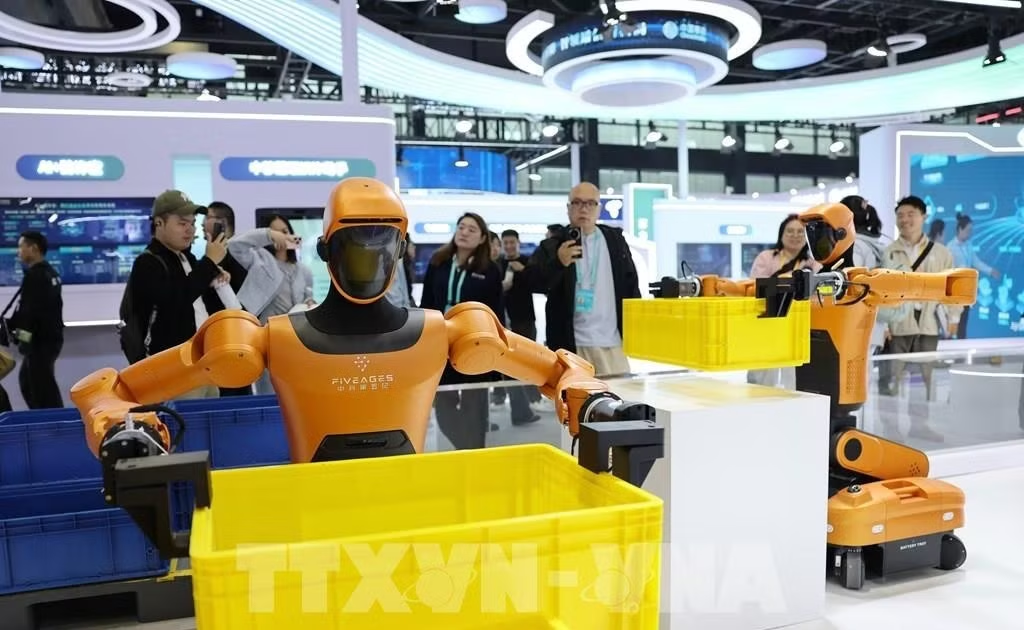
Vietnam eyes deeper participation in ASEAN robotics ecosystem

Vietnam, with its strengths in export-oriented manufacturing and foreign investment attraction, is well positioned to participate more deeply in the region's robotics value chains.

Vietnam eyes deeper participation in ASEAN robotics ecosystem

Hanoi (VNA) – As artificial intelligence (AI), automation, and robotics profoundly transform global manufacturing, ASEAN has an opportunity to develop an internationally competitive robotics industry ecosystem. Vietnam, with its strengths in export-oriented manufacturing and attracting foreign investment, is well positioned to participate more deeply in the region's robotics value chains.

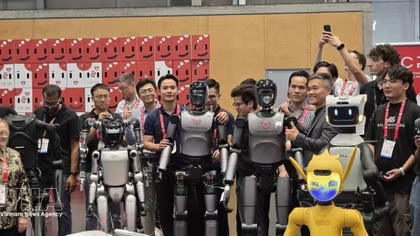
Rapid advances in AI, sensor technology, intelligent control systems and computing capabilities are expanding the applications of robots beyond industrial production lines into logistics, healthcare, agriculture, construction, energy and services. In particular, physical AI and embodied AI enable robots to perceive their surroundings, process information, make decisions, and interact with the physical world, ushering in a new phase of development for the industry.

According to the International Federation of Robotics (IFR)'s World Robotics 2026 report, approximately 5 million industrial robots were operating worldwide in 2025, up 9% year on year and double the figure recorded seven years earlier. More than 600,000 new industrial robots were installed during the year, representing an increase of 11%. The professional service robot market also continued to expand, particularly in transportation and logistics.

Against this backdrop, a key strategic direction for ASEAN is to shift from a model in which each member state develops its own robotics industry independently towards building a regional ecosystem based on connectivity and complementarity. Under this approach, countries could work together to develop technical standards, testing and certification mechanisms, human resources, shared research infrastructure and broader markets for robot applications.

Countries across the region are pursuing different development pathways. Singapore is focusing on research, testing and commercialization of intelligent robots, while Malaysia and Thailand are promoting manufacturing automation and smart factory development. Indonesia is implementing its Making Indonesia 4.0 initiative. Vietnam, meanwhile, has strengths in export-oriented manufacturing and attracting foreign investment.

Differences in national capabilities could provide a foundation for a complementary ASEAN robotics value chain, rather than requiring each country to build an entire ecosystem independently. Under this approach, countries with strong research capabilities could focus on developing core technologies and standards, while economies with substantial manufacturing bases could take on integration, production and deployment. This approach offers Vietnam an opportunity to leverage its manufacturing strengths within the region's robotics industrial network.

The report proposes the ASEAN Robotics and Physical AI Initiative 2030 to promote harmonized standards, mutual recognition of testing results among member states, cross-border testing facilities, workforce training and supply chain development. A multi-country testing network could enable businesses to evaluate robotic solutions across different markets, reduce market entry costs and enhance their commercialization capabilities.

en.vietnamplus.vn

Other News

Top leader calls for greater contribution from Vietnamese experts in Canada

Top leader calls for greater contribution from Vietnamese experts in Canada

At a meeting with representatives of the Canadian Vietnamese Scientists and Experts Association (CVSEA) on September 25 (local time), the top leader praised the contributions and professional capabilities of Vietnamese experts and intellectuals in Canada, describing them as a valuable intellectual resource and an important bridge connecting Vietnam with Canada and the wider world.

Hanoi approves controlled pilot of two technology projects

Hanoi approves controlled pilot of two technology projects

The two projects involve an intelligent autonomous transportation system developed by Phenikaa-X JSC and a technology for producing mixed rare-earth oxides with a purity of over 95% on a semi-industrial scale developed by the Mining Technology and Construction Consultancy JSC.

Banking industry in AI era: When data becomes competitive advantage

Banking industry in AI era: When data becomes competitive advantage

In just a few years, AI has evolved from an experimental technology into an “assistant” for many banks, supporting everything from customer service, credit approval, and fraud detection to risk management. However, as the technological gap between institutions narrows, a new question is emerging: What will determine banks' competitive advantage in the AI era?

Bac Ninh considers establishing AI centre of excellence

Bac Ninh considers establishing AI centre of excellence

A meeting has been held in Bac Ninh to discuss potential cooperation with Plug and Play in developing the northern province’s innovation ecosystem and establishing an artificial intelligence (AI) centre of excellence, with Standing Vice Chairman of the provincial People’s Committee Mai Son receiving a delegation from the global innovation platform.

Hanoi allows 24-month trial of autonomous vehicles at Hoa Lac

Hanoi allows 24-month trial of autonomous vehicles at Hoa Lac

The project aims to assess the safety, reliability and readiness of autonomous vehicles under real traffic conditions, as well as the effectiveness of autonomous public transport and compatibility with existing systems. Its results will contribute to developing technical standards, operating procedures and management models suited to Hanoi’s traffic conditions.

Singapore's experience suggests solutions to Vietnam's human resources challenge in AI era

Singapore's experience suggests solutions to Vietnam's human resources challenge in AI era

As Vietnam accelerates digital transformation and high-tech development, Singapore’s experience and the engagement of global technology companies demonstrate that human resources preparation must stay ahead of the curve. The ability to filter knowledge, collaborate, innovate and effectively use AI will increasingly become essential to helping workers adapt to a changing labour market and strengthening the competitiveness of Vietnam’s economy in the new era.

Protecting national security amid digital transformation, cyberspace

Protecting national security amid digital transformation, cyberspace

Cybersecurity, information security and data security risks must be identified and addressed early and from afar, with appropriate defensive measures ready to neutralise threats and protect national interests in cyberspace, said Lieutenant General Le Xuan Minh, Director of the Ministry of Public Security’s Department of Cybersecurity and Hi-tech Crime Prevention (A05).

Mekong Delta launches first robotics, AI research institute

Mekong Delta launches first robotics, AI research institute

Dr. Nguyen Van Quang, Rector of Nam Can Tho University, said the university is developing a value chain covering training, research, technology development, testing, technology transfer and commercialisation. The model is designed to link research more closely with practical needs, ensuring that technologies generate products and products create value for society.