Vietnam now holds a major opportunity to develop its robotics industry and gradually master core technologies, rather than relying heavily on imported equipment, as robots and artificial intelligence (AI) become increasingly important in global industrial competition.
Dr. Nguyen Dinh Vinh Thanh, a researcher at the French National Centre for Scientific Research (CNRS), made the statement during an interview with Vietnam News Agency (VNA) correspondents in Paris.
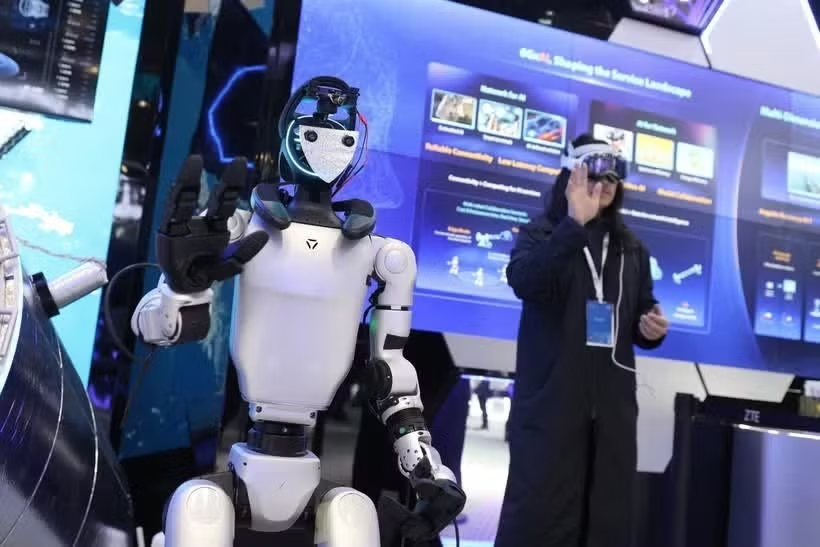
According to the researcher, France and the European Union (EU) are stepping up investment in robotics to strengthen industrial competitiveness and strategic autonomy. Robotics and intelligent machines are among the priority areas of France's 2030 investment plan and the EU's industrial development strategy.
Europe's strengths include its research foundation, automation expertise and close links between research institutes, universities and businesses. The SPARC public-private partnership received 700 million EUR (782 million USD) from the European Commission during 2014–2020, alongside business commitments worth three times that amount. France's 2030 investment plan also allocated 34 million EUR to robotics research over eight years and supported 20 robotics and intelligent-machine projects in 2024.
Europe accounted for around 20% of global robotics research publications during 2019–2024 and is home to major manufacturers such as Germany's KUKA, Switzerland's ABB and Denmark's Universal Robots. However, commercialising research results remains a challenge.
Thanh said France and the EU could be suitable partners for Vietnam in robotics research, integration, testing and training, complementing equipment and technology supplies from other countries. While the US has advantages in AI models and investment capital and China in large-scale hardware manufacturing, Europe offers strong research capabilities, automation expertise and rigorous safety and testing standards.
Vietnam has established initial foundations for developing the sector, he said, citing the Politburo's Resolution No. 57-NQ/TW that identities science, technology and innovation as a breakthrough of leading importance, the Prime Minister's Decision No. 21/2026/QD-TTg listing robotics and automation as strategic technologies, and the Law on AI that took effect on March 1 this year.
Thanh proposed three priorities for cooperation with France and the EU: identifying domestic needs and capabilities and selecting pilot projects that can serve as a foundation for both research and industry; establishing research partnerships modelled after the CNRS and implementing these initiatives step by step; and promoting industrial cooperation to help Vietnamese businesses participate more deeply in robotics value chains and stay ahead of humanoid robotics and AI trends.
He highlighted CNRS's international research projects (IRPs), typically lasting around five years, and international research laboratories (IRLs), which bring together joint research programmes, personnel and infrastructure, as potential cooperation models.
CNRS has applied similar models in Asia, including a joint robotics laboratory with Japan's National Institute of Advanced Industrial Science and Technology in Tsukuba. It also collaborates with Vietnam in mathematics, hydrogen production, and plant genome research, but a robotics partnership has yet to be established.
Rather than immediately building a large research centre, Thanh recommended a four-stage roadmap, beginning with an assessment of domestic needs and the selection of one or two practical applications. This would be followed by an IRP-based research project combining French expertise in robot control and motion planning with open-source AI models adapted to Vietnamese data, alongside joint doctoral training.
The third stage would establish shared testing facilities for researchers and businesses to validate robots under real-world conditions. Hoa Lac Hi-Tech Park could be a suitable location, given the presence of the National Innovation Centre and ongoing autonomous technology testing activities. A joint IRL could then be established once research results, qualified personnel and financial commitments are secured.
Beyond research, Thanh suggested three areas for industrial cooperation with France and the EU, namely robot integration and technical services, components and supply chains, and humanoid robotics and AI.
Vietnamese universities and businesses could work with European manufacturers to train engineers, develop professional certification systems and establish local maintenance networks.
Domestic companies could also supply precision components, including structural frames, drive modules, control boards and power electronics. The cooperation agreement between VinRobotics and German semiconductor group Infineon to establish a joint competence centre is an example of progress in this direction.
For humanoid robots, which remain largely at the pilot stage, Vietnam could use its manufacturing base and prototypes developed by companies such as VinRobotics and VinMotion to become a testing and operational data collection hub for joint projects with European partners. Open-source AI models could also help domestic firms develop applications without depending on a single supplier.
Thanh stressed that cooperation agreements should clearly define responsibilities, intellectual property rights, data usage, commercialisation of research results and maintenance obligations to ensure Vietnamese partners retain ownership of their data and outcomes.
The France–Vietnam Agreement on Cooperation in Science, Technology and Innovation, signed on May 26, 2025, provides an institutional framework for such partnerships. Funding could come from domestic science and technology funds, bilateral programmes, EU initiatives such as Horizon Europe and business contributions, he added.