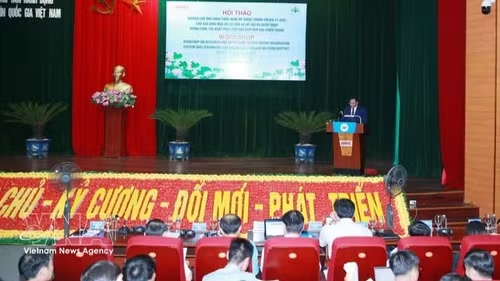
Ahead of World Red Cross and Red Crescent Day on May 8 and the 80th anniversary of the Vietnam Red Cross Society (VRCS), Humanitarian Month 2026 has been launched under the theme “80 years – A journey of compassion for the community”.
This year’s campaign marks a strategic shift, tilting resources decisively away from one-off emergency handouts toward sustainable livelihood packages that aim to lift poor and vulnerable households out of aid dependency for good.
Emergency relief takes a back seat
The VRCS’s Nghe An provincial chapter is targeting roughly 8 billion VND (307,000 USD) in May to fund humanitarian activities for poor and vulnerable groups. Alongside community healthcare, voluntary blood donation, and infrastructure projects, the central thrust is sustainable income generation support in hard-hit areas.
Nghe An is one of three provinces selected to pilot the “Compassionate Community – Connecting Love” model, under which every poor household in Luu Phong village, Tuong Duong commune will receive livelihood assistance and every disadvantaged student will receive scholarships and school supplies, while local authorities will develop commemorative projects tied to the 80-year theme.
The Nghe An model is designed as a long-term intervention to help locals settle down their lives and build resilience against natural disasters and climate change.
A defining feature of Humanitarian Month 2026 is the distinct pivot from short-term relief to durable livelihood support. While past assistance packages averaged around 5 million VND per household, the VRCS now plans to raise the floor to roughly 12 million VND, giving beneficiaries the capital runway to set up viable production models capable of delivering steady income.
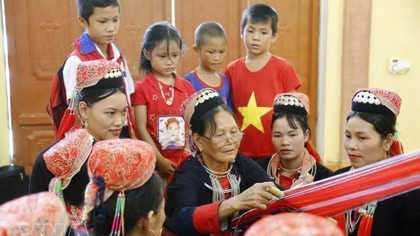
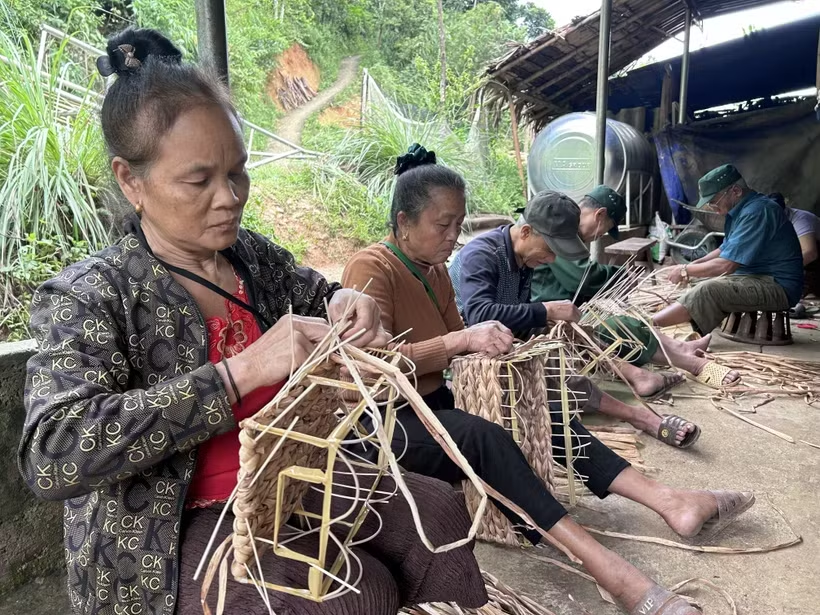
The VRCS Central Committee is also exploring partnerships with cooperative alliances to enable beneficiaries to participate in cooperatives, production groups, and production-linked models. Under this approach, they can participate in crop, livestock, or handicraft models suited to the conditions of each area, aiming to diversify livelihoods, increase economic efficiency, and gradually stabilise their lives.
Pilot models during the campaign will be evaluated as a basis for eventual nationwide scaling.
From one-off aid to resilient communities
VRCS Vice President and Secretary General Nguyen Hai Anh said that after years of focusing overwhelmingly on emergency relief for disaster-, epidemic-, and crisis-hit populations, the VRCS is now embedding sustainable livelihood support as a core pillar of the 2026 campaign.
Livelihood schemes have already been seeded through initiatives like the “Cow Bank” and distributions of crops, livestock, fertiliser, and production techniques in disadvantaged and disaster-prone areas, but the VRCS’s 12th term draws a harder strategic line toward long-term assistance, targeting not just material inputs but knowledge, skills, and production methods that generate independent income.
Going forward, livelihood schemes will be tightly linked to sustainable development and climate adaptation, with support models tailored to local natural conditions, climate data, and actual need to ensure crop and livestock choices remain productive over time.
Another shift is the push for “green” humanitarian activities, in which aid efforts simultaneously advance environmental protection and safer, more cohesive communities. The wider ambition is not about helping locals survive immediate hardship but foster socially responsible, united communities while curbing domestic violence, child abuse, and social fragmentation.
Inside this roadmap, the “Compassionate Community – Connecting Love” model rolled out during Humanitarian Month 2026 is seen as the first building block for the flagship “Safe Communities – Disaster Preparedness” programme planned for 2026-2031, aimed at strengthening community-level capacity to adapt to disasters, epidemics, and social risks while boosting recovery capacity among vulnerable groups.
Humanitarian Month 2026 is slated to raise around 500 billion VND for relief activities, support more than 17,000 poor and disadvantaged households, and activate activities in every commune and ward nationwide. The “Compassionate Community – Connecting Love” pilot will be deployed in Nghe An, Tuyen Quang, and An Giang provinces.