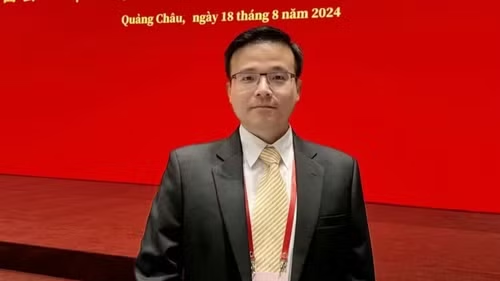
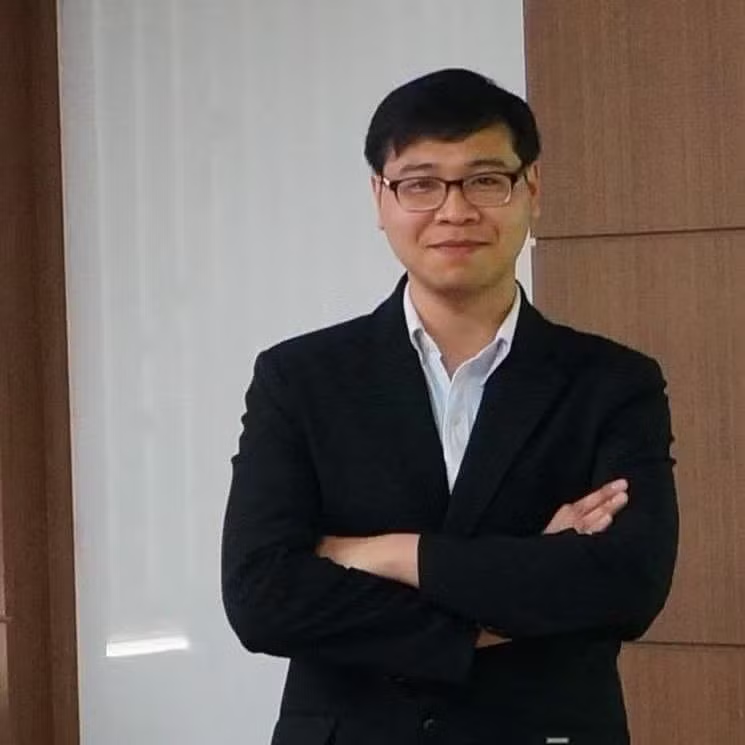
Vietnam should pick its quantum path carefully as the technology moves from the lab to the market, avoiding too thin investment and putting national security and sovereignty, foundational capabilities and the training of application-oriented engineers first, said Dr. Ngo Chi Vinh, General Manager and senior scientist at AlchLight LLC in New York state.
Vinh told Vietnam News Agency reporters in Washington that Vietnam could gradually enter the quantum value chain by focusing on areas where it can build competitive edges and clearing key bottlenecks in the sector.
Vietnam can draw important lessons from how other countries built their quantum strategies, he said, noting that Vietnam has made notable progress on policy and direction, including resolutions and decisions on quantum technology.
He named two priorities for this stage. The first is national security and sovereignty, particularly post-quantum cryptography (PQC) and cybersecurity. Decision 1226/QD-TTg, which approves a scheme to encourage the socialisation of civilian cryptography research, development and application for 2026-2030, with a vision to 2035, adds a timeline to move critical systems to the international standards published in August 2024.
The second is building foundational capabilities, centred on training application-oriented engineers. They will form the teams that leading experts need when they return to Vietnam.
Vinh also stressed the need for coordination among the State, universities and companies. The Resolution 57-NQ/TW on breakthroughs in science, technology, innovation and national digital transformation set up a Central Steering Committee, but Vietnam still needs a specific focal agency for quantum technology, since responsibilities now span multiple bodies.
The State could also act as an initial customer by setting transition deadlines for the finance and telecommunications sectors. It is a relatively low-cost tool with broad impact as clear deadlines let organisations build the changes into annual plans and budgets, and give domestic firms a real market to invest in.
On talent retention, Decision 1483/QD-TTg, which approves a system of research and testing centres and national key labs for strategic technologies, introduced two mechanisms that point in the right direction, including performance- and position-based contract pay, and permission for labs to keep service revenue for reinvestment.
Vietnam should also consider adding industry-commissioned contracts and products brought to market to its research evaluation criteria, alongside existing indicators such as the number of published papers, he said.
In his view, workforce development should start with application-oriented engineers. Training a specialist can take 10-15 years, while an application-oriented engineer can be trained in two to four, making it the more achievable near-term goal.
He advised introducing quantum technology into university curricula, preferably within existing disciplines rather than by creating new majors. Courses on quantum technology and post-quantum cryptography will suit information technology, electronics and telecommunications, semiconductor technology, information security and applied mathematics.
Mathematics is where Vietnam has an edge worth building on. Both leading post-quantum cryptography standards rest on lattice-based mathematical problems, which can be studied without clean rooms or costly equipment. More important, if Vietnam is to set its own national standards, its experts must be able to evaluate the algorithms independently, a job that cannot be outsourced.
Folding quantum technology into existing disciplines, however, requires ways for employers to tell qualified quantum engineers from other engineers. Vinh proposed noting the specialisation in a diploma supplement, or creating a tiered national competency certification system. The latter could assess software engineers through practical projects and hardware engineers through hands-on lab experience.
A practical fix to the shortage of lecturers and qualified assessors is to prioritise training for around 50-100 lecturers who already have backgrounds in information technology, electronics and telecommunications, semiconductor technology, information security or mathematics. Their existing expertise will shorten training time and make it more effective.
With highly skilled personnel in short supply, flexible arrangements will work better at this stage than requiring experts to return permanently. Options include inviting experts to work in Vietnam part-time for two to three months a year or letting them work remotely, allowing Vietnam to tap their expertise while they stay affiliated with leading global labs that have advanced quantum infrastructure and networks.
On security, Vinh said Vietnam should set clear project classification criteria at the proposal approval stage, with three levels: public, restricted and confidential.
As quantum technology shifts from lab research to commercial products and services, Vietnam should map four layers of capability in its ecosystem before deciding which stages of commercialisation to pursue. They are the sovereignty layer, covering cryptography and measurement standards; the foundational layer, covering mathematics and algorithms; the engineering layer, covering sensors, components and materials; and the system integration and market layer.
Over the next three to five years, Vietnam could develop products and services, including post-quantum cryptography migration services, quantum random number generator (QRNG) devices and, potentially, subsurface surveys of transport infrastructure using quantum sensors.
Over the longer term, he suggested a phased roadmap: relying on international infrastructure through 2030, developing an understanding of core technologies by 2040, and building its own components and software by 2050. The ultimate goal should be to master key technologies and secure a role in global value chains by tackling critical bottlenecks in the technology ecosystem, rather than staying confined to low-value contract manufacturing, he added.