Strong science - technology promotion efforts drive Vietnam's innovation ranking higher

Vietnam’s innovation output ranking also rose two places from 37th to 35th, helping the country meet the target set by the Government in Resolution No. 02/NQ-CP for 2026.
Vietnam ranked 43rd out of 139 economies in the 2026 Global Innovation Index (GII) report released by the World Intellectual Property Organisation (WIPO), one place higher than in 2025. Since 2016, the country’s ranking has risen 16 places from 59th to 43rd.

Vietnam’s innovation output ranking also rose two places from 37th to 35th, helping the country meet the target set by the Government in Resolution No. 02/NQ-CP for 2026.

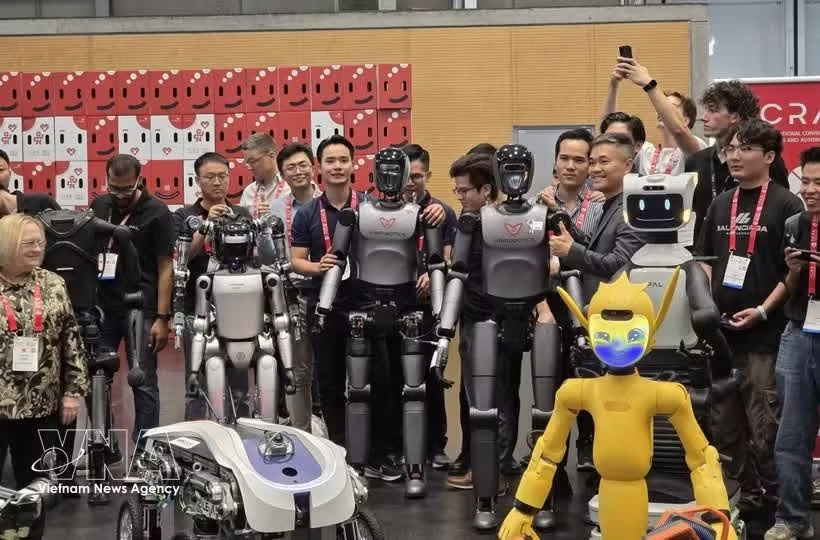
robot.jpg
VinRobotics' VR-H3 robot participates in the robot parade at ICRA 2026 (Photo: VNA)

The GII is a globally recognised tool for assessing national innovation capacity and is used by governments as a reference for policymaking in science, technology and innovation. In Vietnam, the Government has made the index an important management tool, with ministries, agencies and localities sharing responsibility for improving performance and the Ministry of Science and Technology serving as the coordinating focal point.

Minister of Science and Technology Vu Hai Quan attributed the improvement in innovation output to the strong implementation of Politburo Resolution No. 57-NQ/TW over the past year. Investment in science, technology, innovation and digital transformation has increased substantially, while the relevant policy and legal framework is being improved.

The growing participation of the State, businesses, research institutes and universities has also helped lay the foundations for an innovation ecosystem, he said.

Regarding the GII targets for 2030 and 2045, Quan said Vietnam still has much work to do to enter the global top 40 by 2030 and top 30 by 2045. Priorities include improving the quality of human resources, particularly highly qualified personnel for strategic technology sectors, increasing international scientific publications and patents, and strengthening business participation in innovation and research and development.

Vietnamese businesses need to increase investment in finance and human resources and integrate technology and digital transformation more deeply into production and business to improve product quality, added value and labour productivity. Stronger business engagement will be essential to achieving the country’s innovation targets, he said.

Vietnam retained second place among lower-middle-income economies, behind India at 38th. Within ASEAN, Vietnam remained third after Singapore and Malaysia, ahead of Thailand and above the target set in Resolution No. 01/NQ-CP for 2026.

WIPO identified Vietnam as one of seven middle-income economies that have improved their rankings most rapidly since 2013, alongside China, India, Türkiye, the Philippines, Morocco and Indonesia. Vietnam was also among three economies whose innovation performance significantly exceeded their level of development, together with China and India. For 16 consecutive years, its innovation performance has been above the level expected for its development, reflecting its ability to turn innovation inputs into outputs.

The implementation of Resolution No. 57-NQ/TW is now shifting from policy formulation towards practical implementation, with science, technology and innovation being placed at the centre of the country’s development model.
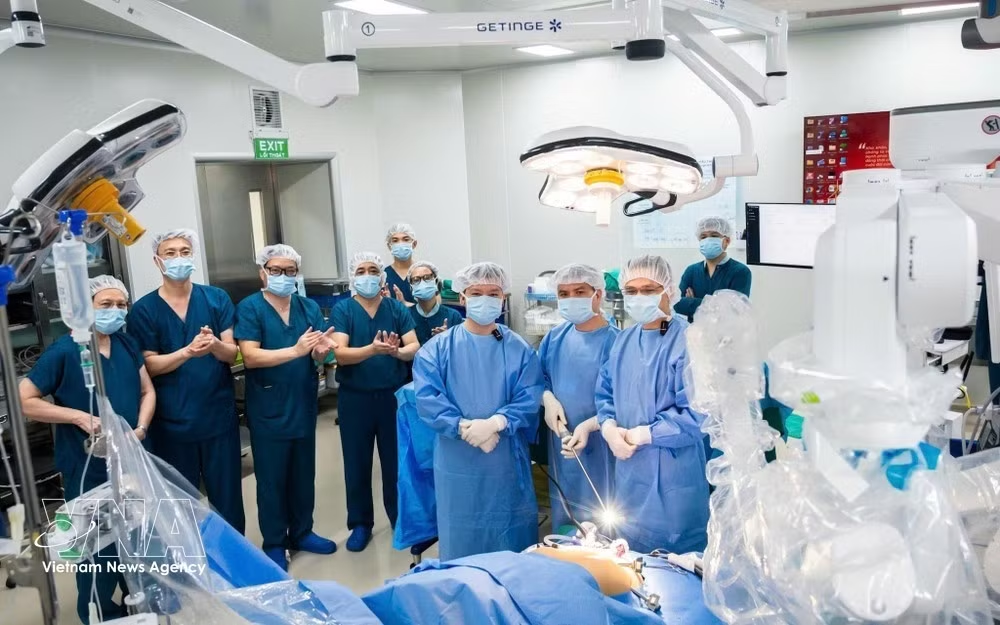
On August 3, 2026, the Vinmec Health System announced the successful operation of Vietnam's first two-way remote robotic surgery network (Photo: VNA)

Key priorities are to improve the legal and institutional framework, prioritise State resources for science, technology, innovation and R&D, encourage businesses to increase R&D investment, attract high-tech and strategic technology projects, and shift management from a focus on inputs towards results and substantive effectiveness.

Macro-level reforms, including the two-tier local administration model and the streamlining of management bodies, are also creating a more favourable institutional environment for mobilising and allocating development resources. Together, these measures are intended to connect public resources with the growing capacity, innovation and investment of businesses.

The GII 2026 results show that Vietnam’s high-tech exports and manufacturing continue to account for a significant share of trade and industrial production, while creative goods production remains among the world’s leading performers. The country has three billion-dollar unicorns and has seen the emergence of science-focused start-ups.

R&D investment has also improved, encouraging greater business spending and attracting new foreign investment projects in R&D and high technology. Vietnam’s innovation output ranking rose two places, reflecting progress in converting inputs into knowledge and technology products and generating economic and social impacts.

WIPO’s GII uses around 80 indicators covering areas from R&D and high-tech trade to skilled employment and intellectual property licensing to assess innovation performance in nearly 140 economies. It serves as a global benchmark for policymakers and businesses.

The 2026 GII was released by WIPO under the guidance of the GII Advisory Board and the Global Innovation Index Industry Association Network (GIIIAN). Now in its 19th edition, the index has evolved into a widely used tool for measuring innovation and shaping economic policy.

In WIPO’s 2025-2026 survey, 78% of participating member states, or 93 out of 120 countries, said they use the GII to improve innovation policies and data.

The 2026 GII ranks 139 economies through 79 indicators grouped into Innovation Input pillars covering institutions, human capital and research, infrastructure, market sophistication and business sophistication, and Innovation Output pillars covering knowledge and technology outputs and creative outputs.

A new feature of the 2026 index is the inclusion of indicators on new R&D projects and high-tech FDI, based on announced investment projects.

en.vietnamplus.vn

Other News

Hanoi approves controlled pilot of two technology projects

Hanoi approves controlled pilot of two technology projects

The two projects involve an intelligent autonomous transportation system developed by Phenikaa-X JSC and a technology for producing mixed rare-earth oxides with a purity of over 95% on a semi-industrial scale developed by the Mining Technology and Construction Consultancy JSC.

Banking industry in AI era: When data becomes competitive advantage

Banking industry in AI era: When data becomes competitive advantage

In just a few years, AI has evolved from an experimental technology into an “assistant” for many banks, supporting everything from customer service, credit approval, and fraud detection to risk management. However, as the technological gap between institutions narrows, a new question is emerging: What will determine banks' competitive advantage in the AI era?

Bac Ninh considers establishing AI centre of excellence

Bac Ninh considers establishing AI centre of excellence

A meeting has been held in Bac Ninh to discuss potential cooperation with Plug and Play in developing the northern province’s innovation ecosystem and establishing an artificial intelligence (AI) centre of excellence, with Standing Vice Chairman of the provincial People’s Committee Mai Son receiving a delegation from the global innovation platform.

Hanoi allows 24-month trial of autonomous vehicles at Hoa Lac

Hanoi allows 24-month trial of autonomous vehicles at Hoa Lac

The project aims to assess the safety, reliability and readiness of autonomous vehicles under real traffic conditions, as well as the effectiveness of autonomous public transport and compatibility with existing systems. Its results will contribute to developing technical standards, operating procedures and management models suited to Hanoi’s traffic conditions.

Singapore's experience suggests solutions to Vietnam's human resources challenge in AI era

Singapore's experience suggests solutions to Vietnam's human resources challenge in AI era

As Vietnam accelerates digital transformation and high-tech development, Singapore’s experience and the engagement of global technology companies demonstrate that human resources preparation must stay ahead of the curve. The ability to filter knowledge, collaborate, innovate and effectively use AI will increasingly become essential to helping workers adapt to a changing labour market and strengthening the competitiveness of Vietnam’s economy in the new era.

Protecting national security amid digital transformation, cyberspace

Protecting national security amid digital transformation, cyberspace

Cybersecurity, information security and data security risks must be identified and addressed early and from afar, with appropriate defensive measures ready to neutralise threats and protect national interests in cyberspace, said Lieutenant General Le Xuan Minh, Director of the Ministry of Public Security’s Department of Cybersecurity and Hi-tech Crime Prevention (A05).

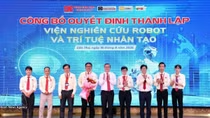
Mekong Delta launches first robotics, AI research institute

Mekong Delta launches first robotics, AI research institute

Dr. Nguyen Van Quang, Rector of Nam Can Tho University, said the university is developing a value chain covering training, research, technology development, testing, technology transfer and commercialisation. The model is designed to link research more closely with practical needs, ensuring that technologies generate products and products create value for society.

Vietnam positioned to harness AI wave, World Bank report says

Vietnam positioned to harness AI wave, World Bank report says

The WB report identifies Vietnam as one of the few economies outside the European Union (EU) to have adopted a comprehensive AI regulatory framework as early as 2025. Vietnam applies a risk-tiered approach similar to that of the EU AI Act, imposing different obligations depending on whether an AI system poses “unacceptable,” “high,” “low” or “minimal” risks. The approach is viewed as a strategic step towards ensuring safe and transparent AI governance.

AI offers both opportunities, challenges for Vietnam's growth

AI offers both opportunities, challenges for Vietnam's growth

Dr. Ho Duc Thang, a full-time member of the National Assembly’s Committee for Cultural and Educational, said productivity is the key to sustaining double-digit economic growth, and AI has greater potential to improve productivity than any previous technology.

Top leader unveils people-centred vision for new development model

Top leader unveils people-centred vision for new development model

Vietnam's growth model, long fueled by low-cost labour, resource extraction, contract manufacturing, expanded investment, and capital accumulation, has run out of road. The country now needs a sweeping reform agenda to shift from extensive growth to a model driven by productivity, knowledge, science and technology, innovation, and digital transformation.