Viet Nam, Bulgaria push agricultural research, training

The Agricultural University Plovdiv values cooperation with Viet Nam and stays ready to share experience and expertise and explore joint research and technology transfer opportunities.

Sofia (VNA) - Vietnamese Ambassador to Bulgaria Nguyen Thi Minh Nguyet met with leaders of the Agricultural University Plovdiv on October 13 to drive cooperation in education, scientific research and agricultural technology transfer.

Talking with Rector Prof. Boryana Ivanova, Nguyet commended the university’s long tradition in education and research, calling both key pillars of the two countries’ traditional friendship, particularly after ties were elevated to a strategic partnership in October 2025.

She urged both sides to speed up the delivery of the Memorandum of Understanding (MoU) signed in 2023 between Agricultural University Plovdiv and the Viet Nam National University of Agriculture. They should review outcomes, set priority areas and pick feasible activities to launch from 2027, she said. She also called for closer collaboration among universities, research institutes and businesses to better align research with production needs and accelerate technology transfer.

Ivanova, for her part, said the university values cooperation with Viet Nam and stays ready to share experience and expertise and explore joint research and technology transfer opportunities.

According to her, the Agricultural University Plovdiv is one of Bulgaria’s leading establishments in agricultural education. It ranked first in crop production and plant protection and second in animal husbandry in Bulgaria’s 2025 higher education ranking.

Its strengths span plant breeding, plant biotechnology, cultivation techniques, plant protection, viticulture and winemaking, as well as research into essential oil crops, medicinal plants and sustainable agriculture. It teaches courses in English on plant protection, plant biotechnology, agricultural economics, tourism and environment, and offers academic exchanges, scholarships and Erasmus+ programme for international students.

The two sides identified areas with cooperation potential, including research and breeding of crop varieties adapted to climate change, essential oil and medicinal plants, high technology, greenhouse technology and post-harvest processing.
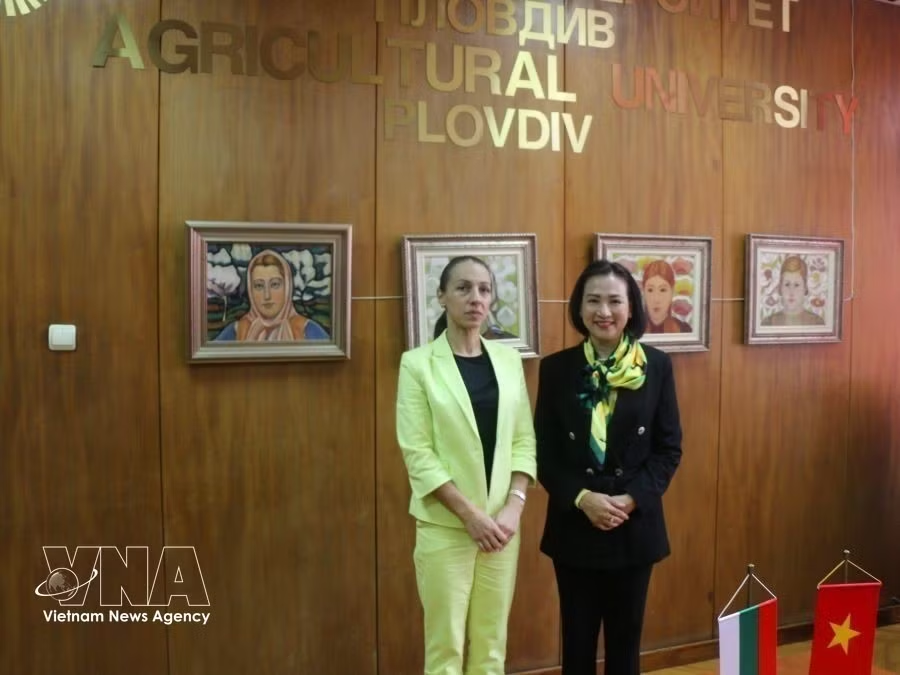
Vietnamese Ambassador to Bulgaria Nguyen Thi Minh Nguyet (R) and Rector of the Agricultural University Plovdiv Prof. Boryana Ivanova (Photo: VNA)

Proposed activities include exchanges of lecturers, students and doctoral candidates, scientific workshops, short-term training courses and joint research projects.

Both sides agreed to keep their technical focal points in contact, advance the existing MoU and explore new cooperation suited to each country’s strengths and needs.

The Vietnamese Embassy stands ready to facilitate connections and turn cooperation in agricultural education, research and technology transfer into practical results, Nguyet said.

The same day, the ambassador visited Gimel Organic in Pazardzhik city to learn about its operations and meet Vietnamese workers employed there. The company produces and packages organic agricultural products, including cucumbers, tomatoes, vegetables and packaged lettuce, for export to European markets. It employs 35 Vietnamese workers, some for about five years, and is completing procedures to recruit more.

Nguyet pledged to look after the welfare of Vietnamese citizens abroad and protect their legitimate rights and interests. She also urged the company to keep ensuring proper working and living conditions and safeguard Vietnamese workers’ legitimate rights and interests, while staying in coordination with the embassy to promptly address any issues that arise./.
en.vietnamplus.vn

Other News

Top leader calls for greater contribution from Vietnamese experts in Canada

Top leader calls for greater contribution from Vietnamese experts in Canada

At a meeting with representatives of the Canadian Vietnamese Scientists and Experts Association (CVSEA) on September 25 (local time), the top leader praised the contributions and professional capabilities of Vietnamese experts and intellectuals in Canada, describing them as a valuable intellectual resource and an important bridge connecting Vietnam with Canada and the wider world.

Hanoi approves controlled pilot of two technology projects

Hanoi approves controlled pilot of two technology projects

The two projects involve an intelligent autonomous transportation system developed by Phenikaa-X JSC and a technology for producing mixed rare-earth oxides with a purity of over 95% on a semi-industrial scale developed by the Mining Technology and Construction Consultancy JSC.

Banking industry in AI era: When data becomes competitive advantage

Banking industry in AI era: When data becomes competitive advantage

In just a few years, AI has evolved from an experimental technology into an “assistant” for many banks, supporting everything from customer service, credit approval, and fraud detection to risk management. However, as the technological gap between institutions narrows, a new question is emerging: What will determine banks' competitive advantage in the AI era?

Bac Ninh considers establishing AI centre of excellence

Bac Ninh considers establishing AI centre of excellence

A meeting has been held in Bac Ninh to discuss potential cooperation with Plug and Play in developing the northern province’s innovation ecosystem and establishing an artificial intelligence (AI) centre of excellence, with Standing Vice Chairman of the provincial People’s Committee Mai Son receiving a delegation from the global innovation platform.

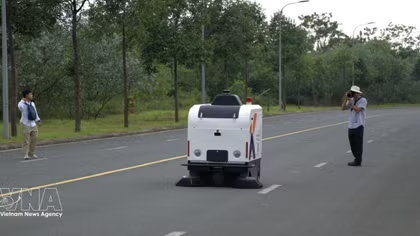
Hanoi allows 24-month trial of autonomous vehicles at Hoa Lac

Hanoi allows 24-month trial of autonomous vehicles at Hoa Lac

The project aims to assess the safety, reliability and readiness of autonomous vehicles under real traffic conditions, as well as the effectiveness of autonomous public transport and compatibility with existing systems. Its results will contribute to developing technical standards, operating procedures and management models suited to Hanoi’s traffic conditions.

Singapore's experience suggests solutions to Vietnam's human resources challenge in AI era

Singapore's experience suggests solutions to Vietnam's human resources challenge in AI era

As Vietnam accelerates digital transformation and high-tech development, Singapore’s experience and the engagement of global technology companies demonstrate that human resources preparation must stay ahead of the curve. The ability to filter knowledge, collaborate, innovate and effectively use AI will increasingly become essential to helping workers adapt to a changing labour market and strengthening the competitiveness of Vietnam’s economy in the new era.

Protecting national security amid digital transformation, cyberspace

Protecting national security amid digital transformation, cyberspace

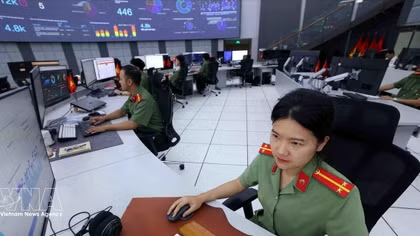
Cybersecurity, information security and data security risks must be identified and addressed early and from afar, with appropriate defensive measures ready to neutralise threats and protect national interests in cyberspace, said Lieutenant General Le Xuan Minh, Director of the Ministry of Public Security’s Department of Cybersecurity and Hi-tech Crime Prevention (A05).

Mekong Delta launches first robotics, AI research institute

Mekong Delta launches first robotics, AI research institute

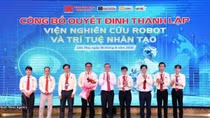
Dr. Nguyen Van Quang, Rector of Nam Can Tho University, said the university is developing a value chain covering training, research, technology development, testing, technology transfer and commercialisation. The model is designed to link research more closely with practical needs, ensuring that technologies generate products and products create value for society.

Vietnam positioned to harness AI wave, World Bank report says

Vietnam positioned to harness AI wave, World Bank report says

The WB report identifies Vietnam as one of the few economies outside the European Union (EU) to have adopted a comprehensive AI regulatory framework as early as 2025. Vietnam applies a risk-tiered approach similar to that of the EU AI Act, imposing different obligations depending on whether an AI system poses “unacceptable,” “high,” “low” or “minimal” risks. The approach is viewed as a strategic step towards ensuring safe and transparent AI governance.

AI offers both opportunities, challenges for Vietnam's growth

AI offers both opportunities, challenges for Vietnam's growth

Dr. Ho Duc Thang, a full-time member of the National Assembly’s Committee for Cultural and Educational, said productivity is the key to sustaining double-digit economic growth, and AI has greater potential to improve productivity than any previous technology.