Bac Ninh considers establishing AI centre of excellence

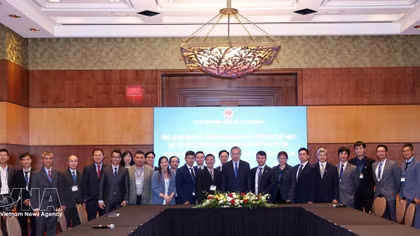
A meeting has been held in Bac Ninh to discuss potential cooperation with Plug and Play in developing the northern province’s innovation ecosystem and establishing an artificial intelligence (AI) centre of excellence, with Standing Vice Chairman of the provincial People’s Committee Mai Son receiving a delegation from the global innovation platform.

A meeting has been held in Bac Ninh to discuss potential cooperation with Plug and Play in developing the northern province’s innovation ecosystem and establishing an artificial intelligence (AI) centre of excellence, with Standing Vice Chairman of the provincial People’s Committee Mai Son receiving a delegation from the global innovation platform.

Plug and Play is a global innovation platform and venture capital firm headquartered in Silicon Valley, the US. It specialises in connecting startups with major corporations, investment funds and governments to promote the development and adoption of new technologies.

At the working session, representatives from Plug and Play outlined plans to develop an open innovation platform connecting corporations, businesses, universities, research institutions, investment funds and startups. The proposed AI centre of excellence will focus on strategic technology areas, including AI, semiconductors, advanced manufacturing, robotics and clean energy.

1-5411.jpg
Bac Ninh considers the establishment of AI centre of excellence to drive innovation. (Photo: VNA)

Key activities will include assessing the local innovation ecosystem; developing a five-year roadmap to promote AI adoption and innovation; implementing accelerator programmes, and supporting businesses to access markets, connect with international experts and investors, and develop high-quality human resources.

Under the proposal, Plug and Play seeks to work with Bac Ninh to assess the province's innovation ecosystem, identify priority sectors and build a specific cooperation plan and roadmap. It also aims to connect local businesses, universities, research institutions and investment funds to participate in the open innovation ecosystem.

In the initial stage, potential areas for cooperation have been identified as semiconductors, advanced manufacturing, robotics and energy.

Speaking at the session, Son emphasised that Bac Ninh has consistently viewed science, technology and innovation as an important driver of development.

The province has recorded positive results in these areas, with several indicators ranking among the country’s highest. Its digital economy accounts for 46% of GRDP while its Provincial Innovation Index (PII) ranks sixth nationwide. It also ranks among the best performers in the Satisfaction Index of Public Administrative Services for people and businesses.

Bac Ninh ranks second nationwide in total registered FDI, with more than 50 billion USD, behind only Ho Chi Minh City, while its export turnover ranks first in the country.

However, despite these achievements, innovation activities in the province remain limited, and the participation of domestic businesses in global value chains has yet to match their potential, he pointed out.

Bac Ninh aims to encourage domestic enterprises to step up technological investment and innovation, strengthen their capabilities and gradually meet the requirements of major corporations, thereby enabling them to engage more deeply in global value chains.

Welcoming the proposal to establish an AI centre of excellence in Bac Ninh, the Standing Vice Chairman said the initiative is well aligned with the province’s strengths in electronics manufacturing, its business ecosystem and its development orientations for the semiconductor and high-tech industries.

He asked Plug and Play to develop a detailed proposal for the centre, clearly outlining its implementation roadmap, support requirements, operating mechanism and resource mobilisation plan.

Bac Ninh pledged to create favourable conditions for Plug and Play to conduct surveys and establish the centre. It will also help connect startups, FDI enterprises and domestic businesses to promote the commissioning of AI-based solutions to address challenges and business needs, Son affirmed.


en.vietnamplus.vn

Other News

Top leader calls for greater contribution from Vietnamese experts in Canada

Top leader calls for greater contribution from Vietnamese experts in Canada

At a meeting with representatives of the Canadian Vietnamese Scientists and Experts Association (CVSEA) on September 25 (local time), the top leader praised the contributions and professional capabilities of Vietnamese experts and intellectuals in Canada, describing them as a valuable intellectual resource and an important bridge connecting Vietnam with Canada and the wider world.

Hanoi approves controlled pilot of two technology projects

Hanoi approves controlled pilot of two technology projects

The two projects involve an intelligent autonomous transportation system developed by Phenikaa-X JSC and a technology for producing mixed rare-earth oxides with a purity of over 95% on a semi-industrial scale developed by the Mining Technology and Construction Consultancy JSC.

Banking industry in AI era: When data becomes competitive advantage

Banking industry in AI era: When data becomes competitive advantage

In just a few years, AI has evolved from an experimental technology into an “assistant” for many banks, supporting everything from customer service, credit approval, and fraud detection to risk management. However, as the technological gap between institutions narrows, a new question is emerging: What will determine banks' competitive advantage in the AI era?

Hanoi allows 24-month trial of autonomous vehicles at Hoa Lac

Hanoi allows 24-month trial of autonomous vehicles at Hoa Lac

The project aims to assess the safety, reliability and readiness of autonomous vehicles under real traffic conditions, as well as the effectiveness of autonomous public transport and compatibility with existing systems. Its results will contribute to developing technical standards, operating procedures and management models suited to Hanoi’s traffic conditions.

Singapore's experience suggests solutions to Vietnam's human resources challenge in AI era

Singapore's experience suggests solutions to Vietnam's human resources challenge in AI era

As Vietnam accelerates digital transformation and high-tech development, Singapore’s experience and the engagement of global technology companies demonstrate that human resources preparation must stay ahead of the curve. The ability to filter knowledge, collaborate, innovate and effectively use AI will increasingly become essential to helping workers adapt to a changing labour market and strengthening the competitiveness of Vietnam’s economy in the new era.

Protecting national security amid digital transformation, cyberspace

Protecting national security amid digital transformation, cyberspace

Cybersecurity, information security and data security risks must be identified and addressed early and from afar, with appropriate defensive measures ready to neutralise threats and protect national interests in cyberspace, said Lieutenant General Le Xuan Minh, Director of the Ministry of Public Security’s Department of Cybersecurity and Hi-tech Crime Prevention (A05).

Mekong Delta launches first robotics, AI research institute

Mekong Delta launches first robotics, AI research institute

Dr. Nguyen Van Quang, Rector of Nam Can Tho University, said the university is developing a value chain covering training, research, technology development, testing, technology transfer and commercialisation. The model is designed to link research more closely with practical needs, ensuring that technologies generate products and products create value for society.

Vietnam positioned to harness AI wave, World Bank report says

Vietnam positioned to harness AI wave, World Bank report says

The WB report identifies Vietnam as one of the few economies outside the European Union (EU) to have adopted a comprehensive AI regulatory framework as early as 2025. Vietnam applies a risk-tiered approach similar to that of the EU AI Act, imposing different obligations depending on whether an AI system poses “unacceptable,” “high,” “low” or “minimal” risks. The approach is viewed as a strategic step towards ensuring safe and transparent AI governance.