Vietnam is facing the dual task of accelerating high-tech workforce training while preparing for labour shifts in labour-intensive sectors, and can learn from Singapore’s experience in solving this problem, according to Singapore-based experts.
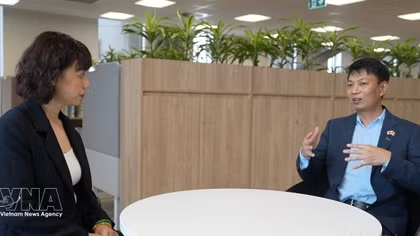
Professor Vu Minh Khuong of the National University of Singapore (NUS) said Singapore’s experience shows that education and human resources development must be given top priority as they are decisive to a country’s competitiveness and future.
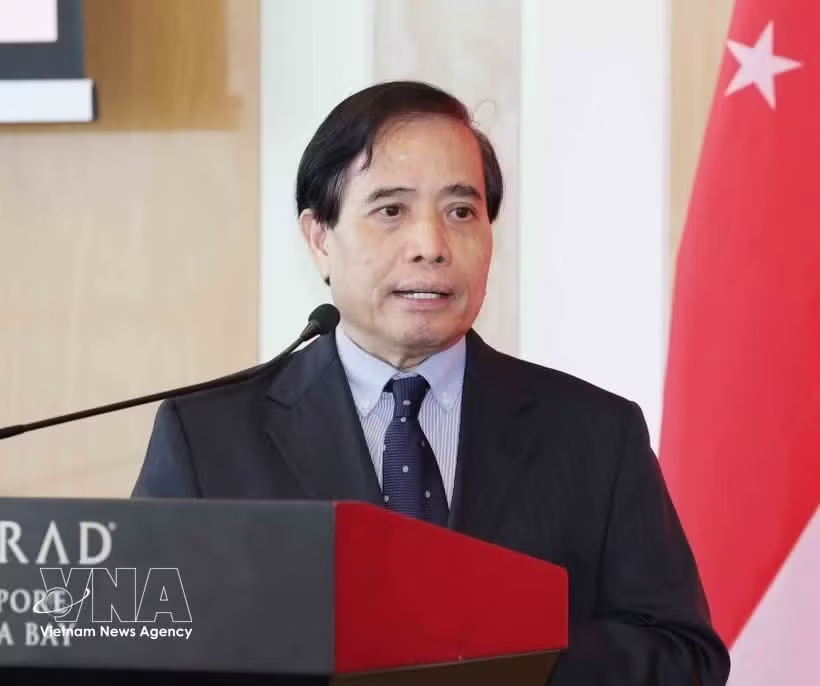
According to the expert, education in the AI era should focus on three core capabilities. The first is the ability to filter and process knowledge as people are increasingly exposed to vast amounts of information. The key is no longer simply how much knowledge one can remember, but how to find, assess and use information to solve problems. This approach also calls for changes in teaching, learning and assessment. Rather than restricting students’ use of AI or the Internet, education should allow them to use such tools and assess their ability to apply technology to specific problems.
The second is the ability to listen to, absorb different perspectives and collaborate with others. Khuong said future workers will need not only professional expertise but also the capacity to synthesise diverse views and work effectively with others. The third is creativity – the ability to generate new ideas, solutions and values. This is also one of the key factors that distinguish high-quality human resources in the age of AI.
Technology companies are also playing a growing role in equipping workers with new skills. Shanti Alexander, Meta’s Director of Policy Programmes and Campaigns for Asia-Pacific, said the company is committed to supporting the comprehensive, useful and accessible development and application of AI in Vietnam. Meta is working with STEAM for Vietnam, Hocmai and Vietnet-ITC Centre to help businesses apply AI in production and business activities, while partnering with the National Innovation Centre (NIC) to support the technology developer community.
Meta and the NIC recently held an AI hackathon that attracted more than 1,000 developers to build AI solutions to real-world problems within 48 hours. The two sides are also implementing the ViGen project to develop high-quality open datasets for Vietnam, providing a foundation for AI models and solutions better suited to the country’s language, needs and conditions.
Education is another key focus. Meta is working with Vietnamese partners on AI skills programmes for teachers, aiming to train nearly 1,000 educators this year. AI is thus becoming not only a field requiring specialised human resources but also a tool for renovating teaching and learning methods. Meanwhile, the economic restructuring process is creating new challenges for labour-intensive sectors. Ernie Koh, Vice Chairman of the Singapore Business Federation (SBF)’s South-East Asia Business Group, noted that Vietnam’s labour market is changing as economic growth accelerates in localities beyond Hanoi and Ho Chi Minh City, creating more local job opportunities and reducing workers’ need to move to major economic hubs.
Drawing on his experience in a labour-intensive manufacturing sector, Koh said such industries in Vietnam will face increasing pressure to transform as the economy moves further towards high technology and more young, skilled workers shift to higher-value sectors. He also highlighted the potential role of labour mobility within ASEAN in addressing shortages in specific markets while supporting regional workforce restructuring.
These assessments show that Vietnam’s human resources challenge in the AI era goes beyond training more engineers or technology specialists. It requires a broader approach encompassing education reform, AI skills development for the existing workforce, stronger cooperation among the State, educational institutions and technology companies, and policies to facilitate labour mobility across sectors.
As Vietnam accelerates digital transformation and high-tech development, Singapore’s experience and the engagement of global technology companies demonstrate that human resources preparation must stay ahead of the curve. The ability to filter knowledge, collaborate, innovate and effectively use AI will increasingly become essential to helping workers adapt to a changing labour market and strengthening the competitiveness of Vietnam’s economy in the new era.