Vietnam, New Zealand can lift sci-tech, workforce training cooperation to new level: expert

The state visit to New Zealand by Party General Secretary and President To Lam has opened the door to cooperation, and the key task now is turning that opportunity into a pathway for people, students, scientists, and businesses to move forward together.

Vietnam and New Zealand can lift science, technology, and workforce training to a new level because their economies are highly complementary and both sides are determined to act, said. Prof. Dr Nguyen Hoang Minh, a computer science expert at Auckland University of Technology (AUT).

Speaking to the Vietnam News Agency (VNA) after attending events during General Secretary of the Communist Party of Vietnam Central Committee and President To Lam’s visit, Minh, who is also Vice Chairman of the Vietnamese Knowledge Network in New Zealand (VietKnowledge NZ) and a member of the AUT Academic Board, called it a special and deeply moving experience.
1-1819.jpg
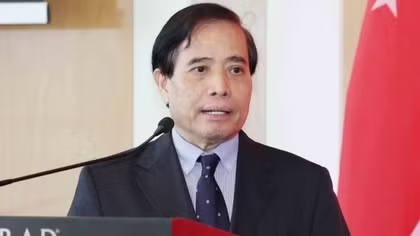
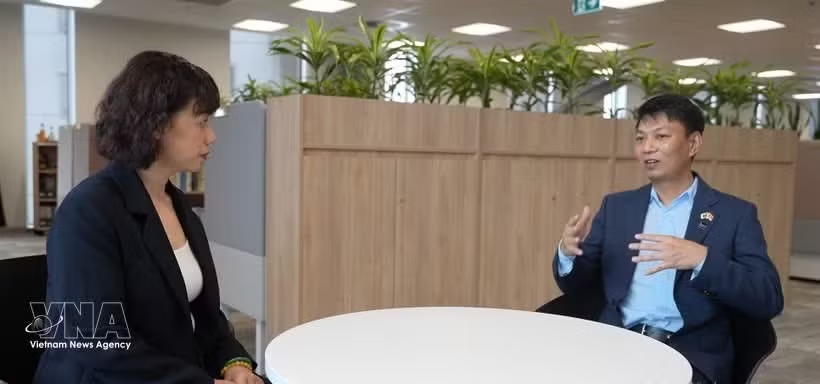
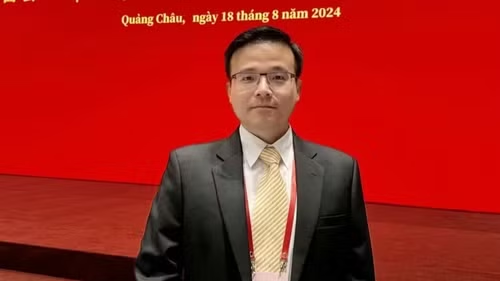
Prof. Dr Nguyen Hoang Minh, a computer science expert at Auckland University of Technology (L), grants an interview to the Vietnam News Agency. (Photo: VNA)

After 25 years of living, studying, and working in New Zealand, he said he remains deeply attached to Vietnam, and the top leader’s presence among the Vietnamese community in New Zealand brought pride, closeness, and a heightened sense of responsibility among Vietnamese intellectuals there.

According to Minh, the state visit is not merely a diplomatic ritual. More importantly, it fostered political trust and raised ambitions for cooperation.

He said Vietnam has a young workforce, a dynamic market, and ample demand for innovation while New Zealand brings strengths in education, science, high-tech agriculture, and sustainable development. The two economies are highly complementary. The visit has opened the door to cooperation, and the key task now is turning that opportunity into a pathway for people, students, scientists, and businesses to move forward together.

The expert flagged three priority cooperation areas. First, both sides should tackle real-world challenges by directing joint work into smart agriculture, climate change response, environmental protection, digital education, and responsible artificial intelligence. Combining New Zealand’s research and commercialisation ecosystem with Vietnam’s large-scale resources, rich datasets, and dynamic young workforce would translate research into practice, moving it beyond the lab and directly into orchards, classrooms, hospitals, and enterprises.

Second, the two countries should build and maintain an effective two-way flow of knowledge. Vietnam should continue sending students and researchers to New Zealand to study, conduct research, and work. New Zealand scientists and experts should spend more time in Vietnam to tap data, markets, and field conditions.

Third, scientific cooperation should place the younger generation at the centre of all development strategies. Minh said around 20-30% of the students he supervises are Vietnamese. Education should go beyond university or postgraduate degrees, and the core goal is equipping young people to solve practical problems and build international networks as human resources form the most valuable asset determining long-term success.

Minh stressed that every initiative should spell out who is responsible, when it starts, and how results will be measured.

Innovation, he said, needs a mechanism to connect the “right people at the right time”, matching problems at Vietnamese universities with New Zealand technology and business capacity, with knowledge networks serving as a bridge. Success should be measured by the number of people trained, technologies deployed, and partnerships that last.

Affirming that patriotism can be gauged by contributions to the homeland, he expressed confidence that Vietnamese intellectuals in New Zealand have the skills, networks, and ambition to work with counterparts and turn cooperation opportunities into concrete results.
en.vietnamplus.vn

Other News

Top leader unveils people-centred vision for new development model

Top leader unveils people-centred vision for new development model

Vietnam's growth model, long fueled by low-cost labour, resource extraction, contract manufacturing, expanded investment, and capital accumulation, has run out of road. The country now needs a sweeping reform agenda to shift from extensive growth to a model driven by productivity, knowledge, science and technology, innovation, and digital transformation.

First national semiconductor chip prototyping support centre makes debut

First national semiconductor chip prototyping support centre makes debut

Vietnam's semiconductor ecosystem now comprises around 60 chip design companies, some 7,000 chip design engineers and 166 universities offering semiconductor-related training programmes. Initial registrations from 12 organisations indicate demand for the prototyping of approximately 30,000 chips.

Vietnam targets at least 10 large strategic technology firms by 2030

Vietnam targets at least 10 large strategic technology firms by 2030

Deputy Prime Minister Ho Quoc Dung has signed a decision approving a plan to develop large domestic strategic technology enterprises in the 2026–2030 period, aimed at advancing digital infrastructure, digital human resources, digital data, strategic technologies and cybersecurity.

Protecting users crucial in building digital trust: Experts

Protecting users crucial in building digital trust: Experts

In Vietnam, digital transformation in the finance and banking sector is accelerating cashless payments, expanding access to financial services, improving market transparency and supporting economic growth and macroeconomic management.

Fostering skilled workforce for innovation era: experts

Fostering skilled workforce for innovation era: experts

Experts said close coordination among State management agencies, research institutes, universities, and businesses will improve training quality and serve the dual goals of quality education and practical research application.

Startup forum bridges Silicon Valley and local innovation ecosystem

Startup forum bridges Silicon Valley and local innovation ecosystem

The University of Economics Ho Chi Minh City (UEH), Saigon Asset Management (SAM), and Plug and Play Tech Centre co-hosted the “From Vietnam to Silicon Valley” forum, exploring AI innovation, venture capital, and pathways to integrate Vietnam’s startup ecosystem with Silicon Valley and global markets.

Experts call for stronger action against fake news online

Experts call for stronger action against fake news online

Experts have warned that fake news, misinformation and harmful online content are increasingly shaping public perceptions, particularly among young people, and stressed the need for stronger legal safeguards, technology tools and wider dissemination of credible information to tackle the problem effectively.

Protecting digital future in post-quantum, AI era

Protecting digital future in post-quantum, AI era

Participants highlighted the importance of building a proactive, synchronised and sustainable national cybersecurity ecosystem through closer cooperation among regulators, technology firms, research institutions and cybersecurity experts.