Government issues mechanisms to attract experts, young talent to data innovation, exploitation

Decree No. 386/2026/ND-CP dated October 12, comprises five chapters and 54 articles specifying mechanisms to attract experts, young talent and breakthrough initiatives; access to and exploitation of data; financing and venture capital; dedicated data innovation spaces; and the development of data products and services, and the data economy.

Hanoi (VNA) - Deputy Prime Minister Ho Quoc Dung has signed a decree stipulating breakthrough development mechanisms for innovation and the exploitation of national data, as well as activities at the Data Innovation and Exploitation Centre under the National Data Centre.
4.jpg
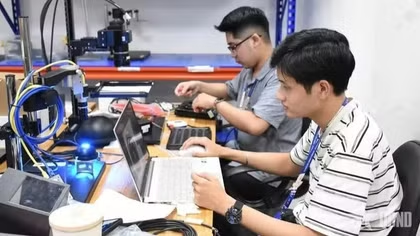
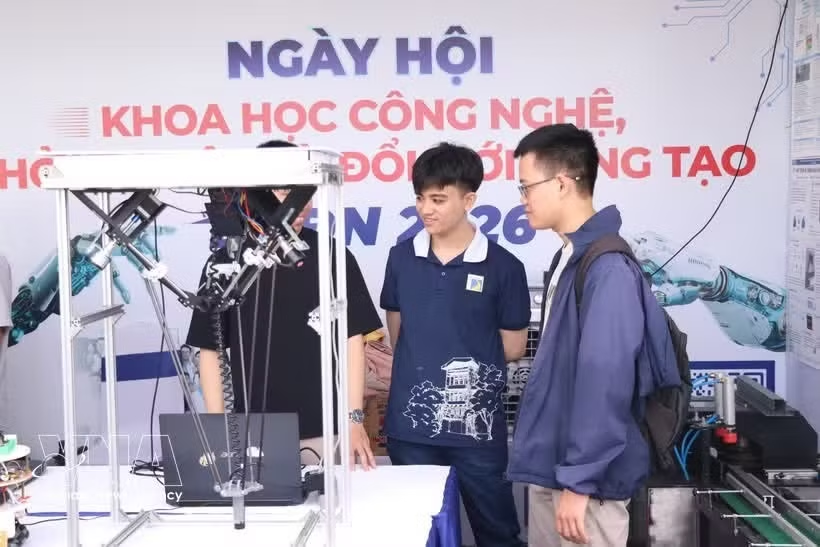
Students from the University of Science and Technology under the University of Da Nang showcase their technology products at the 2026 Technology, Entrepreneurship, and Innovation Festival (Photo: VNA)

Decree No. 386/2026/ND-CP dated October 12, comprises five chapters and 54 articles specifying mechanisms to attract experts, young talent and breakthrough initiatives; access to and exploitation of data; financing and venture capital; dedicated data innovation spaces; and the development of data products and services, and the data economy.

The decree applies to the centre, Vietnamese and foreign agencies, organisations and individuals involved in innovation and data exploitation activities in Vietnam.

Particularly, along with providing detailed criteria for experts and young talents, Article 5 of the decree sets out mechanisms for attracting them to innovation and data exploitation activities. Accordingly, eligible experts and young talent will be entitled to one or more preferential policies, including those in recruitment, financial support, training, and scientific research.

According to the decree, agencies and organisations may enter into special agreements with experts and young talent on salaries, bonuses, intellectual property rights, rights to exploit research results, and the sharing of benefits generated by products, services, initiatives and added value from data innovation and exploitation. Such arrangements must ensure transparency and a balance of interests among the State, employing organisations and the experts or young talent concerned.

Income will be determined according to the performance of assigned tasks, positions held, products delivered, level of contribution and output results. Heads of agencies and organisations are authorised to approve income, bonuses and benefit-sharing rates after obtaining opinions from relevant professional units or evaluation councils. For tasks funded by the state budget, approval authority must comply with laws on state budget management, science and technology, innovation and other relevant legislation.

Funding may come from state budget allocations for assigned tasks, lawful revenues of the relevant units, or socialised funding, sponsorships and aid in accordance with the law. Expenditure must be used for its intended purposes, remain within approved estimates, be supported by documentation and be subject to internal controls.

Experts and young talent will receive the most favourable personal income tax incentives available under tax legislation, including personal income tax exemptions equivalent to those provided under the financial policy framework for international financial centres in Vietnam.

Those receiving incentives must commit to fulfilling assigned tasks, delivering specified products and results, meeting implementation schedules, and complying with the law, agreements, contracts or task-assignment decisions.

Incentives may be terminated, adjusted or withdrawn in accordance with the relevant agreement, contract, incentive decision and applicable law if recipients fail to meet their output commitments, breach their obligations, misuse the incentives, cease to satisfy eligibility conditions, or commit fraud or deliberate violations of the law.

However, incentives will not be withdrawn for objective risks that have been identified, reported and handled in accordance with the prescribed procedures, or for failed experiments falling within the accepted risk parameters for science and technology and innovation activities under Article 52 of the decree and other relevant legislation.

The decree will take effect on December 1, 2026./.

en.vietnamplus.vn

Other News

Top leader calls for greater contribution from Vietnamese experts in Canada

Top leader calls for greater contribution from Vietnamese experts in Canada

At a meeting with representatives of the Canadian Vietnamese Scientists and Experts Association (CVSEA) on September 25 (local time), the top leader praised the contributions and professional capabilities of Vietnamese experts and intellectuals in Canada, describing them as a valuable intellectual resource and an important bridge connecting Vietnam with Canada and the wider world.

Hanoi approves controlled pilot of two technology projects

Hanoi approves controlled pilot of two technology projects

The two projects involve an intelligent autonomous transportation system developed by Phenikaa-X JSC and a technology for producing mixed rare-earth oxides with a purity of over 95% on a semi-industrial scale developed by the Mining Technology and Construction Consultancy JSC.

Banking industry in AI era: When data becomes competitive advantage

Banking industry in AI era: When data becomes competitive advantage

In just a few years, AI has evolved from an experimental technology into an “assistant” for many banks, supporting everything from customer service, credit approval, and fraud detection to risk management. However, as the technological gap between institutions narrows, a new question is emerging: What will determine banks' competitive advantage in the AI era?

Bac Ninh considers establishing AI centre of excellence

Bac Ninh considers establishing AI centre of excellence

A meeting has been held in Bac Ninh to discuss potential cooperation with Plug and Play in developing the northern province’s innovation ecosystem and establishing an artificial intelligence (AI) centre of excellence, with Standing Vice Chairman of the provincial People’s Committee Mai Son receiving a delegation from the global innovation platform.

Hanoi allows 24-month trial of autonomous vehicles at Hoa Lac

Hanoi allows 24-month trial of autonomous vehicles at Hoa Lac

The project aims to assess the safety, reliability and readiness of autonomous vehicles under real traffic conditions, as well as the effectiveness of autonomous public transport and compatibility with existing systems. Its results will contribute to developing technical standards, operating procedures and management models suited to Hanoi’s traffic conditions.

Singapore's experience suggests solutions to Vietnam's human resources challenge in AI era

Singapore's experience suggests solutions to Vietnam's human resources challenge in AI era

As Vietnam accelerates digital transformation and high-tech development, Singapore’s experience and the engagement of global technology companies demonstrate that human resources preparation must stay ahead of the curve. The ability to filter knowledge, collaborate, innovate and effectively use AI will increasingly become essential to helping workers adapt to a changing labour market and strengthening the competitiveness of Vietnam’s economy in the new era.

Protecting national security amid digital transformation, cyberspace

Protecting national security amid digital transformation, cyberspace

Cybersecurity, information security and data security risks must be identified and addressed early and from afar, with appropriate defensive measures ready to neutralise threats and protect national interests in cyberspace, said Lieutenant General Le Xuan Minh, Director of the Ministry of Public Security’s Department of Cybersecurity and Hi-tech Crime Prevention (A05).

Mekong Delta launches first robotics, AI research institute

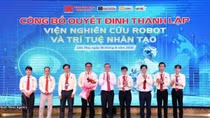
Mekong Delta launches first robotics, AI research institute

Dr. Nguyen Van Quang, Rector of Nam Can Tho University, said the university is developing a value chain covering training, research, technology development, testing, technology transfer and commercialisation. The model is designed to link research more closely with practical needs, ensuring that technologies generate products and products create value for society.

Vietnam positioned to harness AI wave, World Bank report says

Vietnam positioned to harness AI wave, World Bank report says

The WB report identifies Vietnam as one of the few economies outside the European Union (EU) to have adopted a comprehensive AI regulatory framework as early as 2025. Vietnam applies a risk-tiered approach similar to that of the EU AI Act, imposing different obligations depending on whether an AI system poses “unacceptable,” “high,” “low” or “minimal” risks. The approach is viewed as a strategic step towards ensuring safe and transparent AI governance.

AI offers both opportunities, challenges for Vietnam's growth

AI offers both opportunities, challenges for Vietnam's growth

Dr. Ho Duc Thang, a full-time member of the National Assembly’s Committee for Cultural and Educational, said productivity is the key to sustaining double-digit economic growth, and AI has greater potential to improve productivity than any previous technology.