AI offers both opportunities, challenges for Vietnam's growth

Dr. Ho Duc Thang, a full-time member of the National Assembly’s Committee for Cultural and Educational, said productivity is the key to sustaining double-digit economic growth, and AI has greater potential to improve productivity than any previous technology.

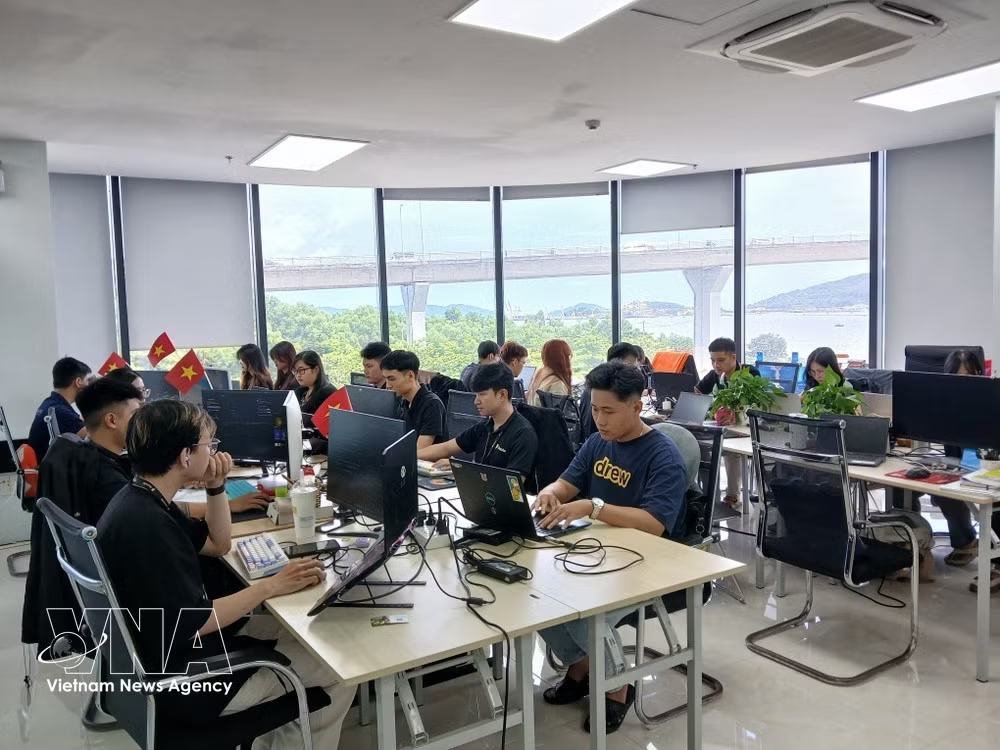
Da Nang city aims to become one of Vietnam’s three largest semiconductor and integrated circuit (IC) hubs, with a workforce of about 5,000 highly skilled professionals meeting global standards. (Illustrative photo: VNA)

As Vietnam is striving to achieve ambitious growth targets in the 2026–2030 period, artificial intelligence (AI) offers an opportunity to transform its growth model; but without adequate infrastructure, skilled human resources, quality data and an enabling policy framework, the technology could also widen inequality, disrupt employment and increase technological dependence, experts cautioned.

Dr. Ho Duc Thang, a full-time member of the National Assembly’s Committee for Cultural and Educational, said productivity is the key to sustaining double-digit economic growth, and AI has greater potential to improve productivity than any previous technology.

Research led by Prof. Dr. Tran Tho Dat estimates that AI could make a significant contribution to Vietnam’s GDP growth over the coming decades. Depending on different development scenarios, AI could add between 0.72 and 2.05 percentage points to annual GDP growth by 2030, with an even larger impact by 2045 (1.92–4 percentage points).

While these projections depend on various assumptions, they demonstrate that effective policies and implementation capacity could substantially influence the country’s long-term economic performance.

The study also identifies information and communications technology, finance – banking, science – technology, and processing – manufacturing as the sectors likely to generate the greatest benefits from AI. Together, they account for about 37% of GDP but could contribute more than half of AI’s overall economic impact thanks to their high level of digitalisation, data abundance and strong spillover effects.

Despite its enormous potential, AI does not automatically create economic value. Dr. Nguyen Dinh Truc, Director of the Institute of Vietnam and World Economy, noted that productivity gains will only materialise when AI is integrated into business operations, supported by reliable data, capable personnel and stronger accountability. Simply using AI tools for drafting documents or generating reports may improve convenience but does not necessarily enhance enterprise-wide productivity.

The labour market is also expected to undergo significant changes.

Rather than replacing workers outright, AI is reshaping the division of labour, with entry-level and routine jobs facing the greatest pressure. Meanwhile, experienced professionals who can evaluate and effectively apply AI-generated results are likely to benefit the most. This could widen the gap between high-skilled and low-skilled workers, as well as between large enterprises with strong digital capabilities and smaller firms with limited resources, Thang said.

Infrastructure and data remain major challenges. Building advanced AI systems requires substantial computing capacity and energy resources, while excessive reliance on foreign platforms could expose Vietnam to technological dependence. At the same time, poor-quality or biased data may reduce AI reliability and create risks related to privacy, cybersecurity and misinformation.

Experts therefore stress that Vietnam should move beyond simply adopting AI to creating value through AI. Priority should be given to sectors with the greatest economic impact, while AI infrastructure should be developed as shared national infrastructure to improve access for businesses, particularly small- and medium-sized enterprises.

Alongside investment in infrastructure, Vietnam also needs financial mechanisms to support technology enterprises, incentives for research and development, and policies that promote innovation while ensuring the safe and responsible use of AI.

Ultimately, experts agree that people will remain at the centre of AI-driven development. Equipping the workforce with professional expertise, critical thinking and the ability to verify AI-generated information will be essential to ensuring that AI becomes a sustainable engine of Vietnam’s future economic growth.

en.vietnamplus.vn

Other News

First national semiconductor chip prototyping support centre makes debut

First national semiconductor chip prototyping support centre makes debut

Vietnam's semiconductor ecosystem now comprises around 60 chip design companies, some 7,000 chip design engineers and 166 universities offering semiconductor-related training programmes. Initial registrations from 12 organisations indicate demand for the prototyping of approximately 30,000 chips.

Vietnam targets at least 10 large strategic technology firms by 2030

Vietnam targets at least 10 large strategic technology firms by 2030

Deputy Prime Minister Ho Quoc Dung has signed a decision approving a plan to develop large domestic strategic technology enterprises in the 2026–2030 period, aimed at advancing digital infrastructure, digital human resources, digital data, strategic technologies and cybersecurity.

Protecting users crucial in building digital trust: Experts

Protecting users crucial in building digital trust: Experts

In Vietnam, digital transformation in the finance and banking sector is accelerating cashless payments, expanding access to financial services, improving market transparency and supporting economic growth and macroeconomic management.

Fostering skilled workforce for innovation era: experts

Fostering skilled workforce for innovation era: experts

Experts said close coordination among State management agencies, research institutes, universities, and businesses will improve training quality and serve the dual goals of quality education and practical research application.

Startup forum bridges Silicon Valley and local innovation ecosystem

Startup forum bridges Silicon Valley and local innovation ecosystem

The University of Economics Ho Chi Minh City (UEH), Saigon Asset Management (SAM), and Plug and Play Tech Centre co-hosted the “From Vietnam to Silicon Valley” forum, exploring AI innovation, venture capital, and pathways to integrate Vietnam’s startup ecosystem with Silicon Valley and global markets.

Experts call for stronger action against fake news online

Experts call for stronger action against fake news online

Experts have warned that fake news, misinformation and harmful online content are increasingly shaping public perceptions, particularly among young people, and stressed the need for stronger legal safeguards, technology tools and wider dissemination of credible information to tackle the problem effectively.

Protecting digital future in post-quantum, AI era

Protecting digital future in post-quantum, AI era

Participants highlighted the importance of building a proactive, synchronised and sustainable national cybersecurity ecosystem through closer cooperation among regulators, technology firms, research institutions and cybersecurity experts.

Vietnam attends SAHA 2026 defence, aerospace exhibition in Türkiye

Vietnam attends SAHA 2026 defence, aerospace exhibition in Türkiye

Vietnam’s participation in SAHA 2026 International Defence & Aerospace Exhibition in Istanbul reflects the country’s consistent policy of enhancing international defence integration and promoting defence industry cooperation towards self-reliance, self-strengthening, modernisation and dual-use development.