Hanoi allows 24-month trial of autonomous vehicles at Hoa Lac

The project aims to assess the safety, reliability and readiness of autonomous vehicles under real traffic conditions, as well as the effectiveness of autonomous public transport and compatibility with existing systems. Its results will contribute to developing technical standards, operating procedures and management models suited to Hanoi’s traffic conditions.

Hanoi (VNA) – Hanoi has allowed Phenikaa-X JSC to conduct controlled testing of a smart autonomous transport system, including autonomous buses, robotaxis, automated cleaning robots and delivery robots, at Hoa Lac Hi-Tech Park and the Hoa Lac campus of Vietnam National University, Hanoi.

download-2.png
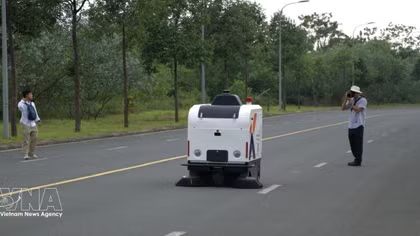
A mini autonomous bus undergoing testing in Hanoi (Photo: Phenikaa-X)

Under Decision No. 4554/QD-UBND issued by the Hanoi People’s Committee on August 25, the trial will last 24 months. Vehicles may operate only on designated routes equipped with high-resolution digital maps and monitoring systems.

The project aims to assess the safety, reliability and readiness of autonomous vehicles under real traffic conditions, as well as the effectiveness of autonomous public transport and compatibility with existing systems. Its results will contribute to developing technical standards, operating procedures and management models suited to Hanoi’s traffic conditions.

The system integrates LiDAR, cameras, HD 2D and 3D digital maps, high-precision GPS and artificial intelligence algorithms, including machine learning and deep learning. Operations will be conducted in for specific groups of vehicles and routes under defined conditions an din designated phases.

At Hoa Lac Hi-Tech Park, robotaxis and delivery robots will be tested for on-demand passenger transport and deliveries along a route of about 11.5km.

At the Hoa Lac campus, autonomous buses are expected to transport students between dormitories, lecture halls, military training facilities and bus connections. Cleaning and delivery robots will also be tested along a route of about 2.8km.

Testing will take place from 9am to 4:30pm daily, including weekends and holidays where necessary. Speeds will be determined for each route and are expected not to exceed 40km per hour. Vehicles must not operate during heavy rain, thunderstorms, flooding, strong winds, dense fog, natural disasters or infrastructure incidents affecting traffic safety.

Autonomous buses and robotaxis must have onboard safety supervisors capable of taking manual control in emergencies or when safe operating limits are exceeded. Supervisors must hold appropriate driving licences and receive relevant training. Cleaning and delivery robots must also have personnel supervising them on site.

Each trial run is limited to eight passengers on an autonomous bus and four on a robotaxi, excluding safety supervisors. Commercial transport services and fees are prohibited during the trial.

The city will temporarily waive certain requirements on registration, licence plates, inspection and operating permits within the trial area, subject to alternative safety measures.

The Hanoi Management Board of Hi-Tech Parks and Industrial Parks will oversee the trials, while the Department of Science and Technology will evaluate the results and advise the municipal administration on post-trial policies./.
VNA
en.vietnamplus.vn

Other News

Mekong Delta launches first robotics, AI research institute

Mekong Delta launches first robotics, AI research institute

Dr. Nguyen Van Quang, Rector of Nam Can Tho University, said the university is developing a value chain covering training, research, technology development, testing, technology transfer and commercialisation. The model is designed to link research more closely with practical needs, ensuring that technologies generate products and products create value for society.

Vietnam positioned to harness AI wave, World Bank report says

Vietnam positioned to harness AI wave, World Bank report says

The WB report identifies Vietnam as one of the few economies outside the European Union (EU) to have adopted a comprehensive AI regulatory framework as early as 2025. Vietnam applies a risk-tiered approach similar to that of the EU AI Act, imposing different obligations depending on whether an AI system poses “unacceptable,” “high,” “low” or “minimal” risks. The approach is viewed as a strategic step towards ensuring safe and transparent AI governance.

AI offers both opportunities, challenges for Vietnam's growth

AI offers both opportunities, challenges for Vietnam's growth

Dr. Ho Duc Thang, a full-time member of the National Assembly’s Committee for Cultural and Educational, said productivity is the key to sustaining double-digit economic growth, and AI has greater potential to improve productivity than any previous technology.

Top leader unveils people-centred vision for new development model

Top leader unveils people-centred vision for new development model

Vietnam's growth model, long fueled by low-cost labour, resource extraction, contract manufacturing, expanded investment, and capital accumulation, has run out of road. The country now needs a sweeping reform agenda to shift from extensive growth to a model driven by productivity, knowledge, science and technology, innovation, and digital transformation.

First national semiconductor chip prototyping support centre makes debut

First national semiconductor chip prototyping support centre makes debut

Vietnam's semiconductor ecosystem now comprises around 60 chip design companies, some 7,000 chip design engineers and 166 universities offering semiconductor-related training programmes. Initial registrations from 12 organisations indicate demand for the prototyping of approximately 30,000 chips.

Vietnam targets at least 10 large strategic technology firms by 2030

Vietnam targets at least 10 large strategic technology firms by 2030

Deputy Prime Minister Ho Quoc Dung has signed a decision approving a plan to develop large domestic strategic technology enterprises in the 2026–2030 period, aimed at advancing digital infrastructure, digital human resources, digital data, strategic technologies and cybersecurity.