Vietnam positioned to harness AI wave, World Bank report says

The WB report identifies Vietnam as one of the few economies outside the European Union (EU) to have adopted a comprehensive AI regulatory framework as early as 2025. Vietnam applies a risk-tiered approach similar to that of the EU AI Act, imposing different obligations depending on whether an AI system poses “unacceptable,” “high,” “low” or “minimal” risks. The approach is viewed as a strategic step towards ensuring safe and transparent AI governance.

These economies have benefited from growing investment in semiconductors, electronic components and data-centre equipment.

The report identifies Vietnam as one of the few economies outside the European Union (EU) to have adopted a comprehensive AI regulatory framework as early as 2025. Vietnam applies a risk-tiered approach similar to that of the EU AI Act, imposing different obligations depending on whether an AI system poses “unacceptable,” “high,” “low” or “minimal” risks. The approach is viewed as a strategic step towards ensuring safe and transparent AI governance.

1.jpg
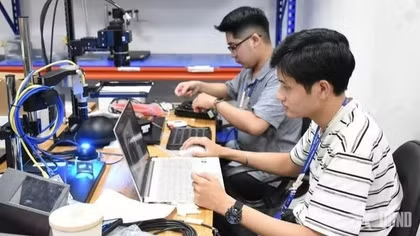
AI Day 2026 product showcase area. (Photo: VNA)

The report, however, offers an important caution through a case study from Vietnam: AI cannot simply be “imported”. An AI model developed by the University of Oxford to classify patients suspected of having COVID-19, which performed well in the UK, saw its performance decline sharply when tested at two hospitals in Vietnam. Differences in demographic and epidemiological characteristics between the populations were a key factor. The example underscores the need for Vietnam to invest in local data and strengthen its capacity to fine-tune AI systems to domestic conditions so that the technology can better serve its people.

In the labour market, the report notes that while wealthy economies are concerned about AI-related job displacement, the risk is lower in Vietnam due to the large share of workers engaged in agriculture and labour-intensive manufacturing. In the garment sector, for instance, automated cutting and sewing technologies have existed for decades, but remain relatively uncommon in Vietnam because local labour costs are still more competitive than investment in AI and robotics.

This is an economically rational response, but also a reminder of the need to upgrade workers’ skills as technology becomes increasingly affordable.

AI offers Vietnam an opportunity to accelerate its development and strengthen its position on the global technology map. With proactive policymaking, the country is moving in the right direction. However, Gaurav Nayyar, Director of the World Development team in charge of the 2026 report, said Vietnam and developing countries in general need to build the foundations now – including energy infrastructure, connectivity, skills and institutions – to be ready to adopt and adapt AI for the benefit of their people./.


en.vietnamplus.vn

Other News

Top leader unveils people-centred vision for new development model

Top leader unveils people-centred vision for new development model

Vietnam's growth model, long fueled by low-cost labour, resource extraction, contract manufacturing, expanded investment, and capital accumulation, has run out of road. The country now needs a sweeping reform agenda to shift from extensive growth to a model driven by productivity, knowledge, science and technology, innovation, and digital transformation.

First national semiconductor chip prototyping support centre makes debut

First national semiconductor chip prototyping support centre makes debut

Vietnam's semiconductor ecosystem now comprises around 60 chip design companies, some 7,000 chip design engineers and 166 universities offering semiconductor-related training programmes. Initial registrations from 12 organisations indicate demand for the prototyping of approximately 30,000 chips.

Vietnam targets at least 10 large strategic technology firms by 2030

Vietnam targets at least 10 large strategic technology firms by 2030

Deputy Prime Minister Ho Quoc Dung has signed a decision approving a plan to develop large domestic strategic technology enterprises in the 2026–2030 period, aimed at advancing digital infrastructure, digital human resources, digital data, strategic technologies and cybersecurity.

Protecting users crucial in building digital trust: Experts

Protecting users crucial in building digital trust: Experts

In Vietnam, digital transformation in the finance and banking sector is accelerating cashless payments, expanding access to financial services, improving market transparency and supporting economic growth and macroeconomic management.

Fostering skilled workforce for innovation era: experts

Fostering skilled workforce for innovation era: experts

Experts said close coordination among State management agencies, research institutes, universities, and businesses will improve training quality and serve the dual goals of quality education and practical research application.

Startup forum bridges Silicon Valley and local innovation ecosystem

Startup forum bridges Silicon Valley and local innovation ecosystem

The University of Economics Ho Chi Minh City (UEH), Saigon Asset Management (SAM), and Plug and Play Tech Centre co-hosted the “From Vietnam to Silicon Valley” forum, exploring AI innovation, venture capital, and pathways to integrate Vietnam’s startup ecosystem with Silicon Valley and global markets.

Experts call for stronger action against fake news online

Experts call for stronger action against fake news online

Experts have warned that fake news, misinformation and harmful online content are increasingly shaping public perceptions, particularly among young people, and stressed the need for stronger legal safeguards, technology tools and wider dissemination of credible information to tackle the problem effectively.

Protecting digital future in post-quantum, AI era

Protecting digital future in post-quantum, AI era

Participants highlighted the importance of building a proactive, synchronised and sustainable national cybersecurity ecosystem through closer cooperation among regulators, technology firms, research institutions and cybersecurity experts.