Experts have called for a stronger innovation ecosystem and closer collaboration between the State, research institutions and businesses to unlock the potential of Vietnam's science and technology sector, where most enterprises remain small in scale, face resource constraints and continue to encounter significant challenges in research and innovation.
According to the State Agency for Technology and Innovation under the Ministry of Science and Technology, Vietnam is now home to nearly 4,000 start-ups and enterprises operating in the fields of science, technology and innovation, supported by a workforce of more than 30,000 highly skilled professionals.
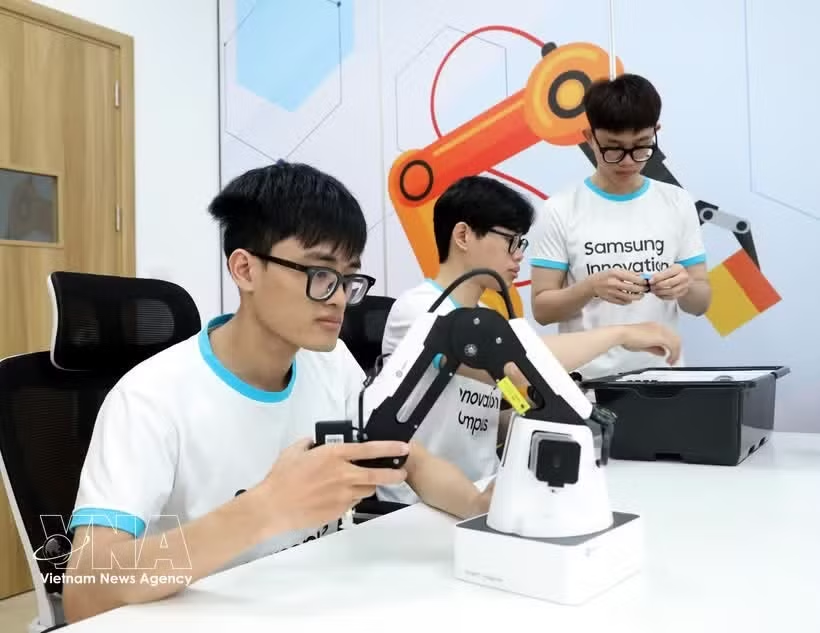
In 2025, sci-tech enterprises generated an estimated 196 trillion VND (7.45 billion USD) in revenue, with private firms accounting for 98.5% of the total number of those in the sector.
The Ministry of Science and Technology said it has continued to strengthen the legal and policy framework, notably through the submission of Decree No. 268/2025/ND-CP to the Government for issuance, which provides detailed guidance on the Law on Science, Technology and Innovation and establishes legal criteria for recognising innovative start-ups.
The ministry also submited to the Government for approval of Decree No. 264/2025/ND-CP on venture capital funds to improve access to investment capital, and Decree No. 271/2025/ND-CP, which creates a legal framework enabling research institutes and universities in Hanoi to establish spin-off companies.
Decentralisation has also been advanced through Decree No. 133/2025/ND-CP, which transfers full authority for recognising high-tech enterprises to provincial/municipal People's Committees. The national innovation strategy has been translated into action through the 2025 innovation action programme and strategic orientations through 2030, alongside the expansion of innovation centres in key localities. The country’s science and technology market has also made significant progress with the launch of the national science and technology exchange, which is connected to data from 19 local technology exchanges.
However, experts noted that while the number of sci-tech enterprises is relatively large, only a limited number has achieved significant scale.
According to Hoang Duc Thao, Chairman of the Vietnam Association of Science and Technology Enterprises, said its member companies have developed hundreds of innovations that have delivered tangible benefits to businesses and society, with some technology firms generating annual revenues of tens of trillions of Vietnamese dong. These achievements demonstrate the sector's considerable economic potential. Nevertheless, opportunities for breakthrough growth remain constrained by limitations in technology, capital, human resources, business networks and intense competition among firms pursuing similar objectives.
While most research outcomes remain at the laboratory or proof-of-concept stage, technology companies generally require solutions that have already been validated and can be rapidly commercialised. The shortage of professional technology transfer intermediaries has limited cooperation between researchers and businesses, increasing costs, extending development timelines and raising risks for start-ups seeking to adopt new technologies.
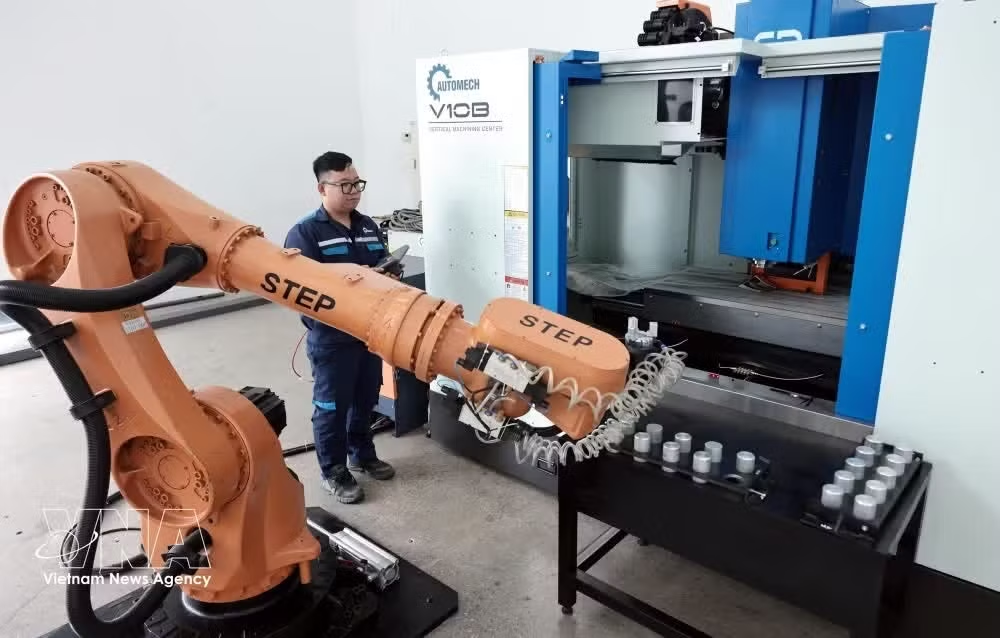
Many experts have, therefore, called for the development of professional technology transfer organisations to strengthen links between research institutes, universities and businesses. They also recommended establishing mechanisms to support companies in accessing new technologies, creating digital technology marketplaces and setting up risk-sharing funds for technology transfer to reduce research costs, share commercialisation risks and accelerate product development.
Dr Dang Duc Anh, Acting Director of the Institute for Policy and Strategy Studies under the Party Central Committee's Commission for Policies and Strategies, noted that addressing the challenges facing sci-tech enterprises will require closer cooperation between government agencies, research institutes, universities and businesses to promote technology transfer and the commercialisation of research outcomes.
He added that companies also need stronger policy support to invest in research and development, improve access to concessional finance, adopt new technologies and attract highly skilled talents./.