Digital technology helps standardise supply chains, sustain export competitiveness

Experts noted that supply chain optimisation and risk management are no longer isolated tasks for individual companies but a requirement for the entire export ecosystem. With guidance from regulators, support from industry experts and their own efforts, Vietnamese exporters are expected to enhance their competitiveness and turn technical barriers and market volatility into opportunities for sustainable growth in global markets.

Rising logistics costs, tightening technical barriers and increasingly stringent green standards are placing growing pressure on Vietnamese exporters, making supply chain standardisation through digital technology an urgent requirement to maintain competitiveness in global markets.

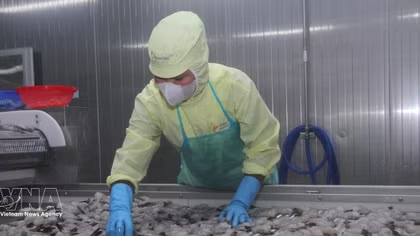
1.jpg
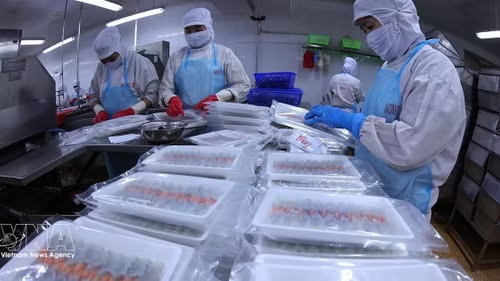
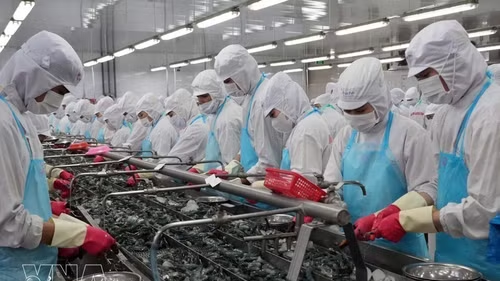
Workers process seafood for exports. (Photo: VNA)

As industrial production and trade showed signs of recovery in the second quarter of 2026, businesses continued to face mounting challenges from inflation, geopolitical tensions and disruptions in global logistics networks.

According to the National Statistics Office, imports of raw materials and components have been rising faster than exports, putting pressure on the trade balance. At the same time, instability in regions such as the Middle East has pushed up shipping and logistics costs, increasing the burden on enterprises’ working capital.

Beyond market volatility and geopolitical risks, sustainability standards are also reshaping global trade rules. Major export markets of Vietnam, including the EU, the US and Japan, are tightening requirements related to the Carbon Border Adjustment Mechanism (CBAM), digital product passports and supply chain traceability.

Economist Le Quoc Phuong said global supply chains are being restructured toward greater safety, transparency and environmental sustainability rather than relying solely on low-cost advantages.

Vietnamese enterprises therefore face not only risks linked to freight costs and exchange rate fluctuations, but also growing pressure to comply with new international standards, he said, warning that companies without effective risk management systems and supply chain optimisation strategies could see their profit margins eroded by rising compliance costs.

In response, many exporters have begun restructuring their operations and shifting from passive production models to proactive optimisation of the entire supply chain, from sourcing materials to manufacturing, packaging and transportation.

Nguyen Van Le, Director of Binh Minh Interior Wood Manufacturing and Export JSC, said markets such as the EU and the US are imposing increasingly strict requirements on supply chain transparency, sustainable forestry certification and intellectual property protection.

“Instead of focusing solely on delivery speed, we are now required to ensure that the entire production process complies with market standards,” he said.

The company has invested in enterprise resource planning (ERP) software to digitalise material tracking. Although the initial investment was significant, the system has helped reduce intermediate waste by around 15% while improving traceability capabilities for international partners.

Experts said the green transition and supply chain upgrading process require substantial financial and technical resources, making stronger policy support essential, particularly for small- and medium-sized enterprises.

Nguyen Cam Trang, Deputy Director of the Agency of Foreign Trade under the Ministry of Industry and Trade, said the ministry is working with Vietnam’s trade offices abroad and industry associations to develop an early warning database on trade defence measures and supply chain risks.

The ministry will also strengthen training programmes on risk management and coordinate with financial institutions to help businesses access preferential financing for production modernisation and compliance with international standards, she said.

Experts noted that supply chain optimisation and risk management are no longer isolated tasks for individual companies but a requirement for the entire export ecosystem. With guidance from regulators, support from industry experts and their own efforts, Vietnamese exporters are expected to enhance their competitiveness and turn technical barriers and market volatility into opportunities for sustainable growth in global markets./.


en.vietnamplus.vn

Other News

Eco-industrial parks seen as catalyst for higher-quality FDI

Eco-industrial parks seen as catalyst for higher-quality FDI

The eco-industrial park model will help Vietnam meet international environmental standards while creating opportunities to improve growth quality and economic competitiveness. Many multinational corporations now view green standards, emissions reduction and energy efficiency as key conditions when selecting investment destinations.

Promoting Vietnamese Brands at an International Food Fair in Gwangju

Promoting Vietnamese Brands at an International Food Fair in Gwangju

Alongside exhibition activities, trade promotion, and business networking programs, the “Gwangju Global Food Fair 2026” also witnessed the signing ceremony of a Memorandum of Understanding (MOU) between the Vietnam–Korea Businessmen & Investment Association (VKBIA) and the Gwangju Tourism Organization of South Korea.

Hanoi proposes subsidies to accelerate shift to electric vehicles

Hanoi proposes subsidies to accelerate shift to electric vehicles

Under a draft resolution currently open for public feedback by the municipal People’s Committee, residents with permanent or temporary residence registration in Hanoi for at least two consecutive years, who own petrol-powered motorbikes registered before the resolution takes effect, will be eligible for support when purchasing electric motorbikes priced at 10 million VND or more.

Private economic sector poised for breakthrough growth

Private economic sector poised for breakthrough growth

More than a year after the Politburo's Resolution No. 68-NQ/TW on private sector development came into effect, expectations now extend beyond increasing the number of enterprises. The goal is to build a stronger business community with greater resilience, larger ambitions and the capacity to compete in global supply chains.

Vietnam remains ASEAN growth leader in 2026 despite global headwinds: WB

Vietnam remains ASEAN growth leader in 2026 despite global headwinds: WB

Vietnam is expected to remain one of ASEAN’s fastest-growing economies in 2026, supported by resilient exports, strong investment inflows and an ambitious reform agenda, despite mounting global uncertainties, according to the World Bank’s latest Vietnam Economic Update released on May 15.

Ministry establishes monitoring framework for carbon market

Ministry establishes monitoring framework for carbon market

Under a new circular, the exchange of greenhouse gas emission quotas and carbon credits is conducted on the domestic carbon credit exchange through the carbon trading system, which is interconnected with the national registration system.

Biofuel ready for nationwide rollout

Biofuel ready for nationwide rollout

For biofuels, particularly E10, to develop successfully, stronger and more coordinated policies are needed, especially pricing mechanisms capable of creating a sufficiently attractive gap between E10 and mineral-based petrol, an expert has said.

Vietnamese farm produce promoted at African investment, trade forum

Vietnamese farm produce promoted at African investment, trade forum

The 12th Africa Forum for Investment & Commerce (AFIC 12) opened in Algiers, the capital of Algeria, on May 9, drawing around 2,000 participants, including officials, economists, businesses, financial and development organizagtions from 43 African countries and international partners, including Vietnam.

Int'l medical, pharmaceutical expo opens in Hanoi

Int'l medical, pharmaceutical expo opens in Hanoi

The exhibition, which runs until May 9 at the Hanoi International Centre for Exhibition, showcases advanced products and technologies across a range of fields, including pharmaceuticals, drug manufacturing machinery and equipment, medical devices, hospital and clinic services and dental equipment.