Vietnam enters investment grade credit rating category for first time

Vietnam has maintained robust growth, outperforming other Southeast Asian economies. Its ongoing government reforms aimed at streamlining the state apparatus, promoting the private sector, improving the institutional framework and developing capital markets will strengthen the country’s growth potential and economic resilience.

Vietnam’s foreign currency issuer credit rating has been upgraded from BB+, with a positive outlook, to BBB-, with a stable outlook, by Rating and Investment Information, Inc. (R&I) on October 8, the Ministry of Finance announced.

This marks the first time Vietnam has entered the investment grade category.

According to the ministry, the upgrade reflects R&I’s positive assessment of Vietnam’s economic growth fundamentals, structural reform prospects, fiscal headroom and resilience to external shocks. It expects strong growth to continue, supported by a shift towards a productivity- and innovation-driven growth model, expanded public investment and sustained foreign direct investment (FDI) inflows.
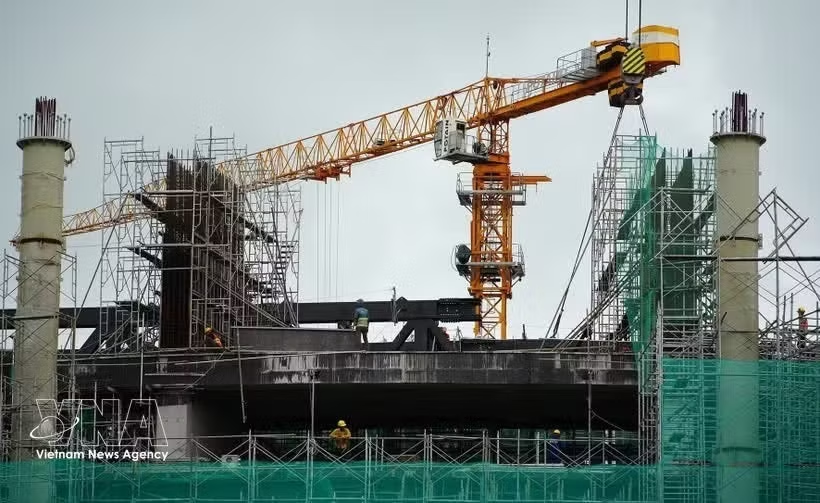
1.jpg
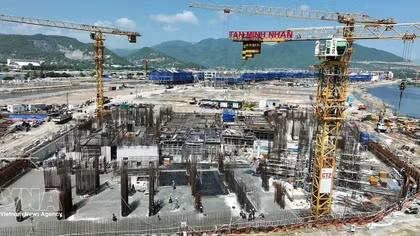
Construction of technical infrastructure facilities serving APEC 2027 in Phu Quoc Special Zone, An Giang province. (Illustrative photo: VNA)

During the sovereign credit rating assessments in April and May, the Ministry of Finance proactively worked with relevant ministries and agencies and held direct discussions with R&I. Drawing on Vietnam’s macroeconomic performance in recent years and experience working with international rating agencies Moody’s, Fitch and S&P, the ministry provided updated information on the country’s macroeconomic situation, public finances, public debt and reform achievements.

R&I noted that Vietnam has maintained robust growth, outperforming other Southeast Asian economies. It said ongoing government reforms aimed at streamlining the state apparatus, promoting the private sector, improving the institutional framework and developing capital markets will strengthen the country’s growth potential and economic resilience. The agency welcomed the comprehensive reform programme and expects consistent implementation to help sustain high growth more steadily.

On fiscal matters, R&I observed that Vietnam’s public debt-to-GDP ratio remains relatively low, providing room to increase development investment. Although the budget deficit and public debt ratio are projected to rise in the coming years, the agency sees no immediate concerns over debt sustainability, as expanded public investment is expected to support future growth while the Government seeks to control recurrent expenditure.

Externally, a persistent current account surplus, sustained FDI inflows and relatively low external debt burdens bolster Vietnam’s resilience to external shocks. However, R&I highlighted risks related to credit growth, banking liquidity, real estate lending, financial system capital adequacy and foreign exchange reserves.

The Ministry of Finance described the upgrade as a major milestone in Vietnam’s efforts to strengthen sovereign creditworthiness through sustained growth, fiscal prudence and comprehensive reforms. It is expected to boost investor confidence, enhance Vietnam’s standing in international markets and facilitate long-term capital mobilisation for socio-economic development.

The ministry and other government agencies will continue working closely with R&I and other rating agencies, providing timely and comprehensive information to ensure accurate and up-to-date assessments of Vietnam’s sovereign credit profile.

en.vietnamplus.vn

Other News

Vietnam's national brand value jumps 45% to over 462 bln USD

Vietnam's national brand value jumps 45% to over 462 bln USD

Deputy Minister of Industry and Trade Luong Hoang Thai outlined Vietnam's National Brand Programme 's achievements, the role of business community and plans for brand development in a press interview ahead of the 10th Vietnam National Brand Product recognition ceremony on October 16.

Vietnam revises scheme to improve sovereign credit rating by 2030

Vietnam revises scheme to improve sovereign credit rating by 2030

Under the decision, Vietnam aims to become a developing country with modern industry and upper-middle income by 2030, while building a competitive and effective governance system and a dynamic economy driven by science, technology, innovation and digital transformation.

Vietnam posts GDP growth of 9.95% in Q3

Vietnam posts GDP growth of 9.95% in Q3

In the first nine months, Vietnam's GDP was estimated to increase 9.01% from the same period last year. Agriculture, forestry and fisheries grew 4.02%, contributing 5.35% to overall gross value added growth; industry and construction rose 11.21%, contributing 49.62%; and services expanded 8.69%, contributing 45.03%.

Vietnam sees 149,700 new businesses in nine months

Vietnam sees 149,700 new businesses in nine months

Vietnam recorded nearly 149,700 newly established enterprises in the first nine months of 2026, up 3.2% year-on-year, with total registered capital rising 32.7% to over 1.88 quadrillion VND (71.6 billion USD).

Vietnam accelerates innovation to boost growth, competitiveness

Vietnam accelerates innovation to boost growth, competitiveness

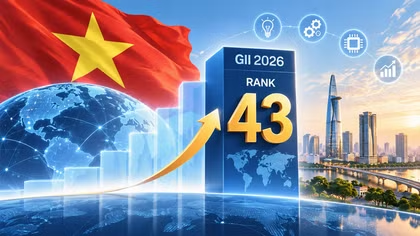
By 2030, Vietnam aims to rank among the world’s top 40 in the GII; raise total social investment in R&D to at least 2% of GDP, with non-State funding accounting for over 60%; increase international scientific publications by an average of 10% annually; and raise the number of patent applications and granted patents by an average of 16-18% annually.

Vietnam sees high growth prospects

Vietnam sees high growth prospects

Experts from the Institute of Vietnam and World Economy under the Vietnam Academy of Social Sciences noted the quality of recent growth as the high growth rate has been recorded against an increasingly higher comparative base.

Vietnam seeks bigger share of global Halal market

Vietnam seeks bigger share of global Halal market

Vietnam's Halal exports remain modest at around 900 million USD a year, accounting for less than 1% of the global market. Most exports are still raw agricultural and seafood products. Only around 1,000–1,300 Vietnamese businesses obtained or maintained Halal certification during 2024–2026.

Hanoi sets up inter-agency mechanism to operate carbon market

Hanoi sets up inter-agency mechanism to operate carbon market

Under a decision of the municipal People’s Committee on establishing an inter-agency working group, departments and agencies are responsible for identifying facilities subject to greenhouse gas inventories, developing emissions-reduction plans and studying projects capable of generating carbon credits.

Shrimp exports reach 3.3 billion USD in eight months

Shrimp exports reach 3.3 billion USD in eight months

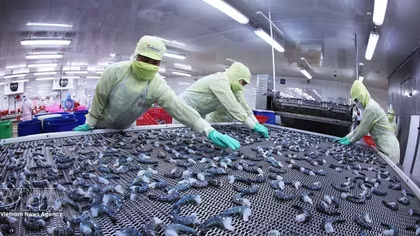
According to data from the Vietnam Customs cited by the Vietnam Association of Seafood Exporters and Producers (VASEP), shrimp exports reached 478.5 million USD in August, up 4.2% from the same month last year. The eight-month total stood at 3.3 billion USD, representing a year-on-year increase of 12%.

Russian investors explore opportunities in Vietnam's real estate market

Russian investors explore opportunities in Vietnam's real estate market

Vietnam is seen as a potential market, with considerable room for growth in real estate, particularly commercial property, compared with some regional markets. Strong Vietnam-Russia ties and opportunities to establish foreign-invested enterprises are also considered favourable for Russian investors.

Phu Quoc airport planning adjusted to serve APEC 2027

Phu Quoc airport planning adjusted to serve APEC 2027

For 2021-2030, the Civil Aviation Authority of Vietnam proposed bringing forward the investment in a parallel taxiway system and a connecting taxiway north of Runway No. 2 at Phu Quoc International Airport, in order to connect with the aircraft maintenance and repair facility (hangar) planned for the northern area of ​​the airport.

Policy, infrastructure emerge as new advantages in FDI attraction

Policy, infrastructure emerge as new advantages in FDI attraction

From policy and infrastructure to industrial real estate, Vietnam’s FDI advantages are broadening towards a more integrated production ecosystem, offering investors a stronger combination of conditions for high-value, technology-intensive and long-term projects.