Vietnam unlocks new development space from sea

As the country enters a new development phase with greater demands for stronger marine-economy growth, institutional bottlenecks have emerged and need to be addressed.

Implementing Resolution No. 20-NQ/TW, dated July 28, 2026, of the Party Central Committee on building and developing Vietnam into a strong maritime-based nation and promoting high-tech marine aquaculture, Vietnam has a major opportunity to unlock the potential of the sea, generate prosperity from marine resources and enhance its competitiveness regionally and globally.

To turn offshore and deep-sea areas into new development space and a long-term growth driver, marine aquaculture will depend not only on natural advantages, but increasingly on institutional capacity, governance quality, mastery of science and technology, and business participation.
thuyen.jpg
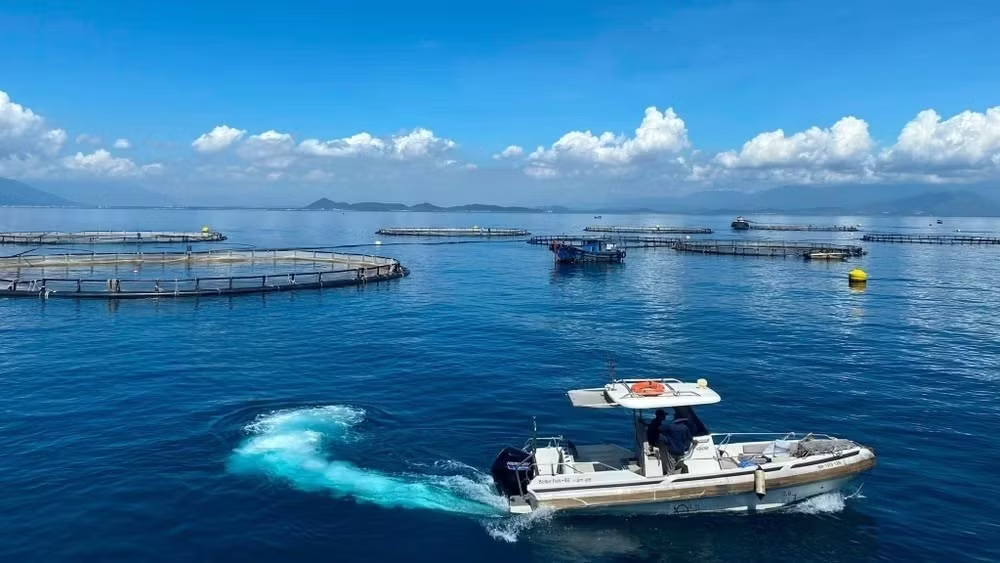
Australis Vietnam Seafood Co., Ltd.'s high-tech deep-water barramundi farming site in Van Phong Bay, Khanh Hoa province. (Photo: nhandan.vn)

Awakening sea with high technology

Following the administrative reorganisation, the central province of Khanh Hoa has a vast marine area, with nearly 500km of coastline and bays such as Nha Trang, Cam Ranh and Van Phong, offering major advantages in tourism, fisheries, seaports and marine science and technology.

To promote modern marine aquaculture and a strong marine economy, the Khanh Hoa provincial People’s Council recently approved nearly 60 billion VND (2.31 million USD) in support to help local residents replace outdated marine farming cages with high-tech systems.

As a pioneer in AI-powered automation for aquaculture, including automated feeding systems and net-washing robots, STP Group has worked with Phat Co Fisheries Cooperative to develop an aquaculture farm combined with experiential tourism in Quang Ninh city.

Nguyen Thi Hai Binh, General Director of STP Group, said the company is researching and applying science and technology solutions to develop sustainable marine aquaculture while protecting the environment.

Marine aquaculture should be developed within a “multi-layered” marine space and closely linked with science and technology, she said. This approach creates multiple layers of value within the same marine space, from aquaculture and ecotourism to scientific research, environmental education and sustainable livelihoods.

When properly planned and organised, a marine area can generate multiple layers of value within the same space.

The success of modern barramundi farming systems in Van Phong or the aquaculture and tourism farm on Phat Co Island could serve as models for the future development of Vietnam’s marine aquaculture sector.

Unlocking institutional resources

A review of the implementation of the 2015 Law on Marine and Island Resources and Environment showed that many provisions have proved effective in integrated management of marine and island resources and environmental protection. However, as the country enters a new development phase with greater demands for stronger marine-economy growth, institutional bottlenecks have emerged and need to be addressed.
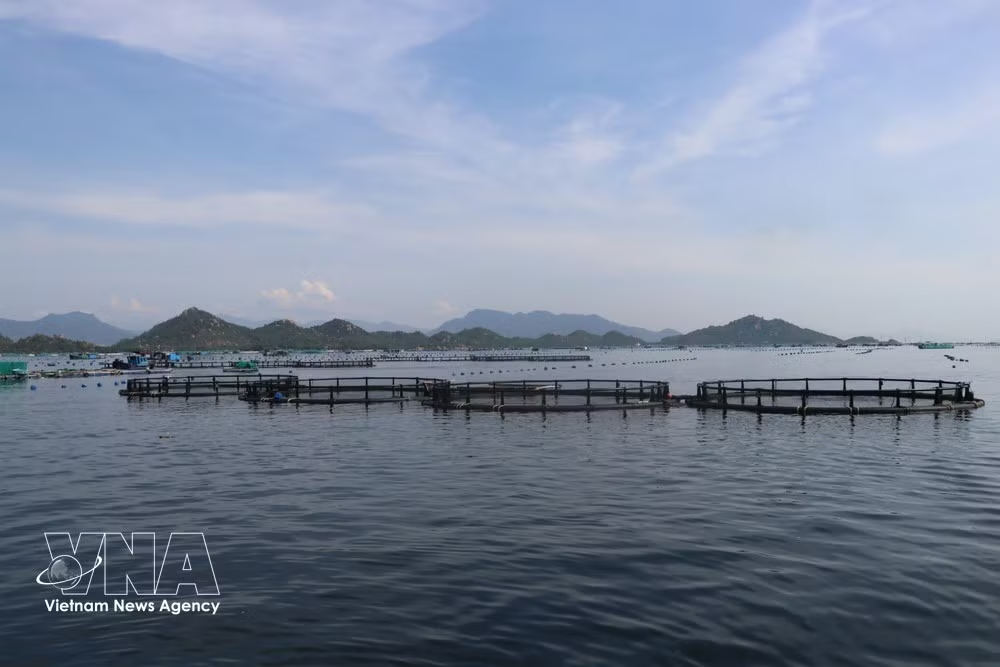
Farming fish in HDPE cages at Dam Bay, Khanh Hoa (Photo: VNA)

On August 7, 2026, the Government issued Resolution No. 218/NQ-CP on the action programme to implement Resolution No. 20-NQ/TW on building and developing Vietnam into a strong maritime nation. The programme identifies nine breakthrough groups of tasks for 2026-2030, with a vision to 2045, providing a basis for ministries, sectors and localities to formulate implementation plans.

Associate Professor and Dr Nguyen Huu Dung, Chairman of the Vietnam Marine Aquaculture Association, said that as room for land-based aquaculture continues to shrink, the ocean is the “last field” available to create new growth momentum.

However, Vietnam’s marine aquaculture potential has yet to be fully harnessed, he said. Bottlenecks lie not only in cage technology but also in production organisation. Policies on allocation of marine areas need to become clearer and more stable.

Residents, cooperatives and businesses need a solid, long-term legal basis to invest in modern farming cages, monitoring systems, seed, feed and logistics services. As offshore aquaculture requires substantial investment and faces considerable risks from natural disasters, long-term credit and marine aquaculture insurance are particularly important.

Resolution No. 218/NQ-CP identifies nine breakthrough groups of tasks for 2026-2030, with a vision to 2045. Among them, institutional improvement and reform of national marine spatial planning are identified as foundations for breakthroughs in developing Vietnam into a strong maritime nation.

The Vietnam Agency of Seas and Islands is currently tasked with leading the drafting of amendments to the Law on Marine and Island Resources and Environment, with the aim of institutionalising the major orientations set out in Resolution No. 20-NQ/TW.

Nguyen Quoc Toan, Director of the agency, said the sea is not merely a place for resource exploitation but also a strategic development space for the nation and therefore needs to be managed in a unified, modern and sustainable manner.

New policies will have positive impacts on most marine economic sectors, particularly those requiring stable, long-term access to marine space and involving large-scale investment, such as industrial marine aquaculture.
en.vietnamplus.vn

Other News

Vietnam accelerates innovation to boost growth, competitiveness

Vietnam accelerates innovation to boost growth, competitiveness

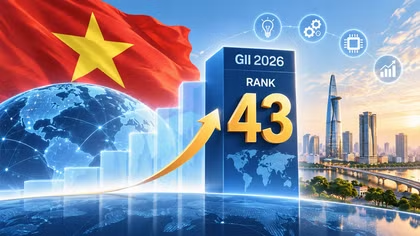
By 2030, Vietnam aims to rank among the world’s top 40 in the GII; raise total social investment in R&D to at least 2% of GDP, with non-State funding accounting for over 60%; increase international scientific publications by an average of 10% annually; and raise the number of patent applications and granted patents by an average of 16-18% annually.

Vietnam sees high growth prospects

Vietnam sees high growth prospects

Experts from the Institute of Vietnam and World Economy under the Vietnam Academy of Social Sciences noted the quality of recent growth as the high growth rate has been recorded against an increasingly higher comparative base.

Vietnam seeks bigger share of global Halal market

Vietnam seeks bigger share of global Halal market

Vietnam's Halal exports remain modest at around 900 million USD a year, accounting for less than 1% of the global market. Most exports are still raw agricultural and seafood products. Only around 1,000–1,300 Vietnamese businesses obtained or maintained Halal certification during 2024–2026.

Hanoi sets up inter-agency mechanism to operate carbon market

Hanoi sets up inter-agency mechanism to operate carbon market

Under a decision of the municipal People’s Committee on establishing an inter-agency working group, departments and agencies are responsible for identifying facilities subject to greenhouse gas inventories, developing emissions-reduction plans and studying projects capable of generating carbon credits.

Shrimp exports reach 3.3 billion USD in eight months

Shrimp exports reach 3.3 billion USD in eight months

According to data from the Vietnam Customs cited by the Vietnam Association of Seafood Exporters and Producers (VASEP), shrimp exports reached 478.5 million USD in August, up 4.2% from the same month last year. The eight-month total stood at 3.3 billion USD, representing a year-on-year increase of 12%.

Russian investors explore opportunities in Vietnam's real estate market

Russian investors explore opportunities in Vietnam's real estate market

Vietnam is seen as a potential market, with considerable room for growth in real estate, particularly commercial property, compared with some regional markets. Strong Vietnam-Russia ties and opportunities to establish foreign-invested enterprises are also considered favourable for Russian investors.

Phu Quoc airport planning adjusted to serve APEC 2027

Phu Quoc airport planning adjusted to serve APEC 2027

For 2021-2030, the Civil Aviation Authority of Vietnam proposed bringing forward the investment in a parallel taxiway system and a connecting taxiway north of Runway No. 2 at Phu Quoc International Airport, in order to connect with the aircraft maintenance and repair facility (hangar) planned for the northern area of ​​the airport.

Policy, infrastructure emerge as new advantages in FDI attraction

Policy, infrastructure emerge as new advantages in FDI attraction

From policy and infrastructure to industrial real estate, Vietnam’s FDI advantages are broadening towards a more integrated production ecosystem, offering investors a stronger combination of conditions for high-value, technology-intensive and long-term projects.

Logistics upgrade vital to 1-trillion-USD trade target: experts

Logistics upgrade vital to 1-trillion-USD trade target: experts

As trade expands, systemic bottlenecks across transport networks, warehousing, ports, border gates, and industrial zones are becoming more apparent. Experts emphasise the need to shift from a fragmented, project-by-project approach toward strategic management structured around trade corridors and integrated supply chains.

Ample room for Vietnam, US to deepen cooperation

Ample room for Vietnam, US to deepen cooperation

Do Ngoc Hung, Trade Counsellor and head of the Vietnam Trade Office in the US, said what stands out is not only the growth in trade volume but also the increasingly deep economic ties between the two countries.

Flexible fiscal policy helps drive economic growth

Flexible fiscal policy helps drive economic growth

According to the Ministry of Finance, State budget revenue in the first eight months of 2026 was estimated at 2.02 quadrillion VND (77.7 billion USD), equivalent to 80% of the annual estimate and up 16% year-on-year. Domestic revenue reached 1.75 quadrillion VND, accounting for 86.6% of total revenue and rising 16.6%.

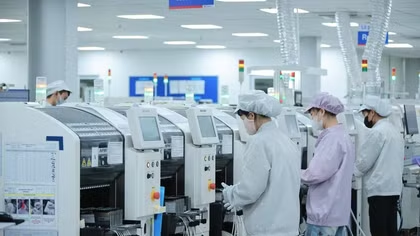
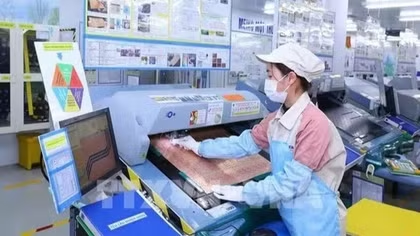
Electronic components are produced at a factory in Hanoi. (Photo: VNA)

Hanoi's imports surge 41% in first eight months of 2026

Hanoi aims to achieve average annual export growth of at least 12% during 2026-30, with the city seeking to diversify export markets, boost high-tech and value-added products and reduce reliance on traditional markets.

New opportunities for Vietnam's seafood exports

New opportunities for Vietnam's seafood exports

The Vietnam-EFTA Free Trade Agreement brings together two groups of highly complementary economies. EFTA members Switzerland, Norway, Iceland and Liechtenstein have strengths in technology, innovation, finance, clean energy and sustainable development, while Vietnam is one of Asia’s most dynamic economies and is emerging as a major regional manufacturing, trade and investment hub.