Legislature approves 30% income tax cut for small enterprises, business households

The resolution, comprising two articles, provides for a 30% reduction in personal and corporate income tax for the 2026-2027 tax periods for individuals, business households and enterprises with annual revenue of no more than 10 billion VND (381,000 USD).

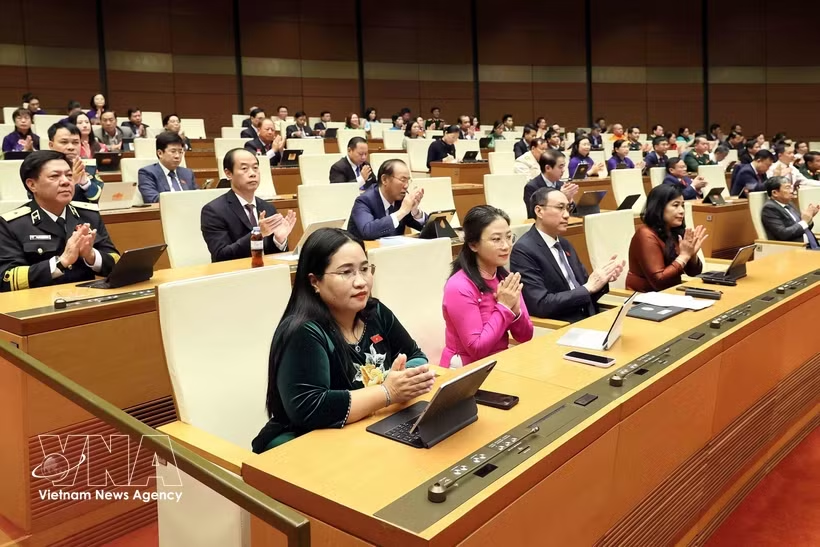
Hanoi (VNA) – The 16th National Assembly on August 24 approved a resolution reducing personal and corporate income taxes for individuals, business households and enterprises, with 480 out of 481 participating lawmakers voting in favour at its first extraordinary session.
tai-xuong-5.png
The 16th National Assembly on August 24 approve a resolution reducing personal and corporate income taxes for individuals, business households and enterprises. (Photo: VNA)

The resolution, comprising two articles, provides for a 30% reduction in personal and corporate income tax for the 2026-2027 tax periods for individuals, business households and enterprises with annual revenue of no more than 10 billion VND (381,000 USD).

The policy will not apply to enterprises established through the division or separation of other enterprises after the resolution takes effect if the combined revenue of the resulting enterprises exceeds 10 billion VND in 2026 or 2027. For enterprises already eligible for tax incentives under the Law on Corporate Income Tax or other laws and National Assembly resolutions, the 30% reduction will be calculated on the corporate income tax payable after applicable tax incentives have been deducted.

The resolution takes effect from August 24 and applies to the 2026 and 2027 tax periods.

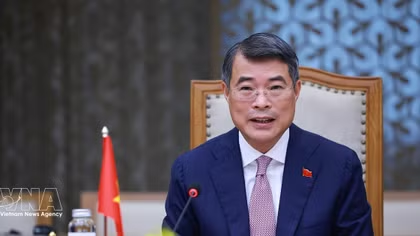
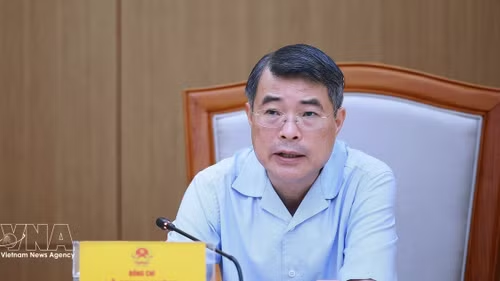
According to Minister of Finance Ngo Van Tuan, the Government and National Assembly have introduced a range of measures to support people and businesses, including cutting value-added tax (VAT) on most goods from 10% to 8%, reducing environmental protection taxes on petrol, oil and lubricants, and implementing tax measures for fuel and aviation fuel. More than 40 types of fees and charges have also been exempted or reduced.

Citing surveys by the Vietnam Chamber of Commerce and Industry (VCCI), the Vietnam Association of Small and Medium Enterprises, and the Private Economic Development Research Board (Board IV), Tuan said micro-scale business households, individual businesses, and enterprises are currently among the groups facing the greatest difficulties and having limited resilience.

These groups account for a large proportion of the country’s business community, making targeted tax relief more appropriate than broad-based tax cuts, he noted.

Regarding the 10-billion-VND revenue threshold, the minister said the measure will cover 99.86% of individuals and business households and more than 81.11% of enterprises.

The 30% reduction, he said, represents meaningful support for beneficiaries while remaining compatible with the State budget’s balancing capacity and is consistent with support levels adopted in several previous policies./.
VNA
en.vietnamplus.vn

Other News

Lawmakers debate real estate, budget, nuclear project changes

Lawmakers debate real estate, budget, nuclear project changes

The draft revised real estate law is intended to turn Party and State guidelines into statute, codify tested resolutions that have been tested in practice, and shift power under the two-tier local administration model. It seeks to cut investment and business conditions, accelerate digital transformation, improve market transparency and predictability, strengthen market regulation, and clear practical bottlenecks to support a healthy property market.

Vietnam values relationship with US: Deputy Foreign Minister

Vietnam values relationship with US: Deputy Foreign Minister

Deputy Foreign Minister Dang Hoang Giang said Vietnam-US ties have maintained positive momentum following the February 2026 meeting between General Secretary of the Communist Party of Vietnam Central Committee and President To Lam and President Donald Trump, with regular exchanges and expanding cooperation across various fields.

Government proposes 30% income tax cut for small businesses

Government proposes 30% income tax cut for small businesses

The personal income tax payable for the 2026 and 2027 tax years is proposed to be reduced by 30% for resident individuals earning income from business activities, provided their annual revenue does not exceed 10 billion VND (about 383,600 USD).

National Assembly adds three items to agenda of first extraordinary session

National Assembly adds three items to agenda of first extraordinary session

The NA Standing Committee recommends adding three items to the agenda: separating the Ninh Thuan nuclear power project into independent projects; mechanisms and policies for sea-reclamation urban development projects to be incorporated into the draft Law on Urban Development; and a draft NA resolution on reducing personal income tax and corporate income tax for individuals and businesses.

Vietnam seeks to deepen strategic partnership with Kazakhstan

Vietnam seeks to deepen strategic partnership with Kazakhstan

Ambassador Nguyen Thanh Le affirmed that he will work closely with Kazakhstan’s Ministry of Foreign Affairs, ministries, agencies and localities to effectively implement high-level agreements, strengthen political trust and promote cooperation in trade, investment, transport and logistics, tourism, culture, education and people-to-people exchanges.

Amendments to Land Law aim to achieve three key goals

Amendments to Land Law aim to achieve three key goals

The Government has identified three major objectives: promptly institutionalising Party policies on land, private-sector development and national digital transformation; addressing urgent practical obstacles to unlock resources and support the goal of double-digit economic growth; and building a modern, streamlined and effective land management system through stronger decentralisation and administrative reform.

Draft laws must support management reform, stronger decentralisation: PM

Draft laws must support management reform, stronger decentralisation: PM

Participants looked into 11 draft laws and one draft resolution, including laws amending and supplementing several articles of laws on non-agricultural land use tax and corporate income tax; natural resources tax; securities; accounting and independent auditing; the Labour Code; and laws on archives, gender equality, Red Cross activities and employment.