EU-funded project supports circular Arabica coffee production in Son La

The project “Circular solutions for coffee MSMEs in Son La province” (CAFE-CIRCLE) aims to help more than 150 coffee businesses and cooperatives adopt circular production practices, reduce pollution and unlock new economic opportunities from coffee by-products.

EU-funded project supports circular Arabica coffee production in Son La

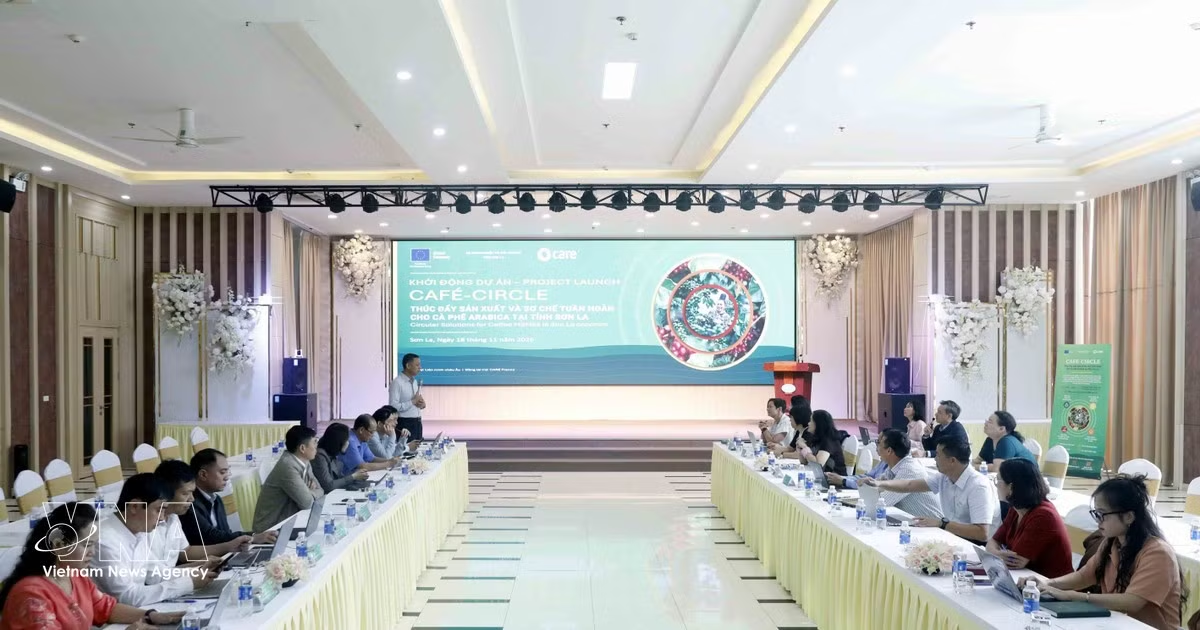
Son La (VNA) - A 1.75-million-EUR (1.92 million USD) project funded by the European Union (EU) and co-financed by CARE France was launched in Son La province on November 18 to promote circular production and processing in the Arabica coffee value chain, helping businesses reduce waste and improve resource efficiency.

The project “Circular solutions for coffee MSMEs in Son La province” (CAFE-CIRCLE) will be implemented by CARE France and CARE International in Vietnam, in coordination with the provincial Department of Agriculture and Environment and local partners, through December 2029. It aims to help more than 150 coffee businesses and cooperatives adopt circular production practices, reduce pollution and unlock new economic opportunities from coffee by-products.

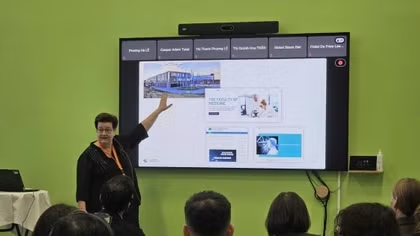
Speaking at the event, Brenda Candries, Programme Manager of the EU Delegation to Vietnam, said the coffee industry's future competitiveness will depend not only on product quality but also on resource efficiency and responsible production. Through CAFE-CIRCLE, the EU aims to help local businesses reduce environmental impacts and create new economic opportunities. She noted that this investment demonstrates a commitment to building a greener, more competitive and inclusive coffee value chain.

The project will focus on coffee-growing and processing areas, particularly Chieng Mung, Chieng Mai and Muong Chanh communes and neighbouring production clusters.

It focuses on three interconnected solutions - water efficiency and pollution reduction, waste-to-value innovation, and cleaner energy and improved quality.

Accordingly, it will introduce water-saving coffee pulping equipment and affordable biological wastewater treatment systems; convert coffee pulp and husks into bio-organic fertilizers and explore higher-value products such as cascara tea; and promote solar-assisted drying systems to improve energy efficiency and maintain coffee quality.

These interventions will be complemented by technical training, business development support and market connections.

By December 2029, CAFE-CIRCLE aims to establish five demonstration models, document ten case studies and enable at least 100 businesses and cooperatives to adopt circular practices. More than 6,000 farming households could benefit indirectly.

To address financial barriers, CAFE-CIRCLE will establish a competitive small-grant facility supporting approximately 25 MSMEs and cooperatives, with grants of up to 15,000 EUR per business and a minimum 30% matching contribution from recipients.

The project will also facilitate access to green finance, encourage partnerships and demonstrate commercially viable circular business models.

Prioritising women-led businesses and ethnic minority communities, the project seeks to demonstrate how environmental responsibility, resource efficiency and business competitiveness can reinforce one another, contributing to a greener and more inclusive coffee value chain in Vietnam.

Vietnam is among the world’s leading coffee producers, with more than 718,000 hectares of coffee plantations and annual production exceeding 1.95 million tonnes in 2024. According to a 2025 study by the United Nations Development Programme (UNDP) and the Institute of Strategy and Policy on Agriculture and Environment (ISPAE), the industry generates approximately 1.6 million tonnes of dry coffee husks annually, representing significant potential for resource recovery.

However, much of this potential remains untapped. Coffee processing generates substantial organic waste and wastewater, contributing to environmental pollution. In Son La, a major Arabica coffee-growing region, these challenges directly affect local communities and businesses.

An assessment by UNDP and the International Water Management Institute (IWMI) identified key barriers to adopting circular practices, including limited technical knowledge, inadequate wastewater treatment infrastructure, difficulties in recovering processing waste, and insufficient investment. Smaller enterprises and cooperatives face particular challenges in accessing affordable technologies and financing.


en.vietnamplus.vn

Other News

Vietnam, China widen economic, trade cooperation space

Vietnam, China widen economic, trade cooperation space

General Secretary of the Communist Party of Vietnam Central Committee and President To Lam’s trip to China for the 33rd APEC Economic Leaders’ Week and bilateral engagements is expected to add new momentum, including deeper economic connectivity, broader trade, investment and supply chain links, and a more balanced, substantive economic relationship that matches both sides’ potential.

VEFTA implementation requires exporters to restructure supply chains: Experts

VEFTA implementation requires exporters to restructure supply chains: Experts

Under VEFTA, tariff reductions to zero will be meaningless for Vietnam’s key export sectors, including textiles and garments, footwear, and agricultural and aquatic products, if goods are found to contain banned chemicals, violate rules of origin or lack transparency regarding their carbon footprints.

IMF sees positive growth prospects for Vietnam, urges cautious monetary policy

IMF sees positive growth prospects for Vietnam, urges cautious monetary policy

Martin Sommer, head of the IMF’s Article IV consultation mission team to Vietnam, noted that inflation risks in Vietnam remain under control, but several factors could add to price pressures. He therefore called for cautious monetary policy management and readiness to respond promptly if inflationary pressures increased.

Seven green-tech startups secure 770,000 USD at Net Zero Challenge 2026

Seven green-tech startups secure 770,000 USD at Net Zero Challenge 2026

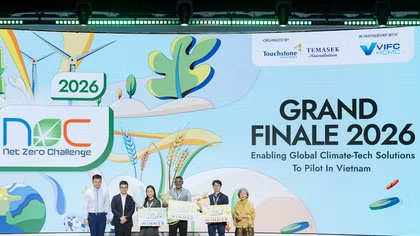
In its fourth year, the competition attracted more than 1,100 applications from 80 countries and territories, making it the most competitive edition since its launch in 2023. Nine finalists presented solutions in three categories, namely renewable energy and carbon removal; food systems and sustainable agriculture; and circular economy and waste management.

Vietnam remains an attractive destination for Japanese businesses

Vietnam remains an attractive destination for Japanese businesses

Fukai Akihiko, President and Representative Director at Gunma Bank and head of a business delegation from Japan’s Gunma prefecture, said cooperation between Gunma and Vietnam has continued to expand in recent years. Around 15,000 Vietnamese people currently live in Gunma, forming the largest foreign community in the prefecture.

Vietnam and Sweden step up cooperation in telecom infrastructure, cybersecurity

Vietnam and Sweden step up cooperation in telecom infrastructure, cybersecurity

Vietnam is accelerating institutional reforms, improving its investment and business environment, developing infrastructure and enhancing human resources quality. The Government stands ready to cooperate with leading global corporations investing in sectors of strategic importance to the country's development.

Vietnam-Japan trade machine has room to run

Vietnam-Japan trade machine has room to run

Economic, trade and investment cooperation remains the core pillar and the main engine of comprehensive, sustainable bilateral ties. General Secretary of the Communist Party of Vietnam Central Committee and President To Lam’s official visit to Japan is therefore a key moment to reinforce political trust, deepen the Comprehensive Strategic Partnership and open new cooperation opportunities in the next growth phase.

Vietnamese goods eye greater access to the Australian market

Vietnamese goods eye greater access to the Australian market

Participants at the Vietnam-Western Australia Business Forum 2026 in Perth on November 6 highlighted strong prospects for Vietnamese rice, agricultural produce and food products in the Australian market as local businesses seek to diversify supply chains.

WTO hails Vietnam's 20-year journey since accession

WTO hails Vietnam's 20-year journey since accession

Joining the World Trade Organisation (WTO) was a strategic choice for Vietnam, closely associated with its Doi Moi (Renewal) process, opening-up policy and international economic integration. Over the past two decades, international economic integration has become a driving force for institutional reforms, trade expansion, foreign investment attraction and enhancement of the country's international standing.

US to send largest-ever agricultural trade mission to Vietnam

US to send largest-ever agricultural trade mission to Vietnam

The USDA’s statistics show that Vietnam was the seventh-largest export market for American agricultural and related products in 2025, with import turnover of nearly 5.6 billion USD. The US’s 2025 agricultural exports to Vietnam increased 38% from 2024.

APEC 2027 seen as fresh impetus for Vietnam-Russia cooperation

APEC 2027 seen as fresh impetus for Vietnam-Russia cooperation

VOV.VN - Vietnam’s hosting of the Asia-Pacific Economic Cooperation (APEC) summit in 2027 is expected to create new momentum for cooperation between Vietnam and Russia, with opportunities to expand ties across a range of areas of mutual interest, according to Russian expert Tatyana Gorchakova.

Vietnam and Denmark expand cooperation in high-tech healthcare

Vietnam and Denmark expand cooperation in high-tech healthcare

Ambassador Nguyen Le Thanh called on Vietnamese and Danish partners to identify priority areas and promote research and training programmes, knowledge transfer and technology application in line with Politburo's Resolution No. 57-NQ/TW on breakthroughs in science – technology development, innovation and national digital transformation.

Improving FDI quality to strengthen growth momentum

Improving FDI quality to strengthen growth momentum

Rapid growth in registered capital is encouraging, but unless these commitments are promptly converted into implemented projects and productive capacity, their contribution to economic growth will remain constrained.