Hanoi (VNA) – Vietnam is gradually moving from awareness to action and placing science, technology and innovation among the foundations of a new development model, with innovation increasingly recognised as a key driver of growth, productivity, competitiveness and economic resilience.
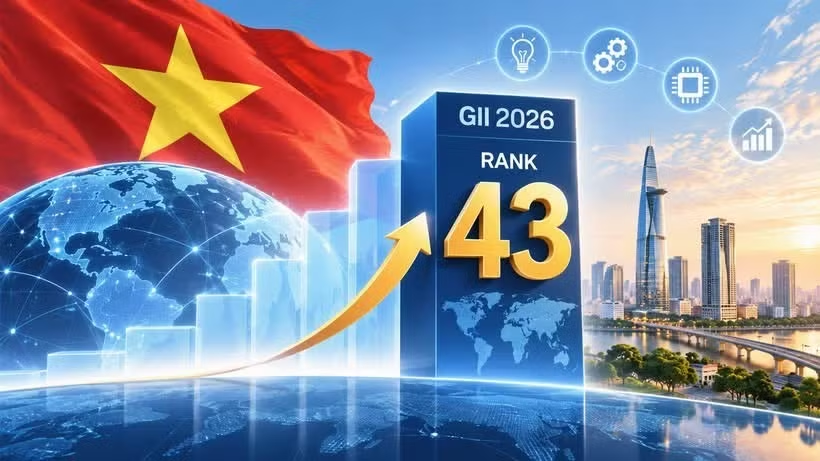
According to the 2026 Global Innovation Index (GII) report by the World Intellectual Property Organisation (WIPO), Vietnam ranks 43rd among 139 countries and economies, up one place from 2025. It remains second among lower-middle-income economies, after India, and third in ASEAN, behind Singapore and Malaysia.
Positive changes in innovation capacity
Since 2016, Vietnam’s GII ranking has risen 16 places, from 59th to 43rd, while its innovation output ranking climbed two places to 35th. WIPO identified Vietnam as one of seven middle-income economies with the fastest improvement in ranking since 2013 and one of three countries whose innovation performance exceeds expectations as compared with its level of development.
Several output indicators improved notably in 2026. Patent applications by country of origin rose three places to 63rd; high-tech output climbed one place to 25th; production and export complexity increased eight places to 44th; and industrial design applications by country of origin rose three places to 48th.
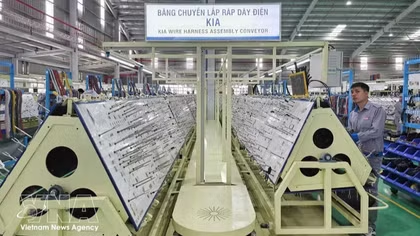
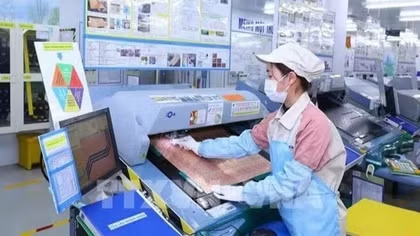
Vietnam continued to perform strongly in high-tech and creative goods exports, while ranking highly in high-tech imports, mobile app downloads and labour productivity growth.

Minister of Science and Technology Vu Hai Quan said the two-place rise in Vietnam’s innovation output ranking was noteworthy, reflecting the resolute implementation of the Political Bureau’s Resolution No. 57-NQ/TW on breakthroughs in science and technology development, innovation and national digital transformation over the past year.
He attributed the progress to three main factors: increased investment in science, technology, innovation and digital transformation; gradual improvements in policies and laws following the implementation of Resolution No. 57-NQ/TW; and growing participation by the State, businesses, research institutes and universities, helping to form an innovation ecosystem.
Vietnam has also shifted its approach by placing science, technology and innovation at the centre of its socio-economic development model, while improving institutions, prioritising resources for research and development (R&D), encouraging businesses to invest in R&D and moving from input-based to output-based management.
Target of placing GII among the world’s top 40 by 2030
The 2026 GII also points to areas requiring further improvement, including knowledge outputs such as patents and scientific publications, as well as the availability of high-quality human resources at research institutes, universities and businesses. Some indicators related to education, research and knowledge-intensive labour remain low, affecting the ability to create, absorb and master new knowledge and technologies.
Resolution No. 57-NQ/TW identifies science, technology, innovation and national digital transformation as key breakthroughs and major drivers of prosperous development in the new era.
According to Quan, the implementation of Resolution No. 57-NQ/TW has brought changes in awareness, institutions and resources. He stressed the need to accelerate the shift from policy directions to concrete results in research, technology application and commercialisation.
The Science, Technology and Innovation Development Strategy through 2030, revised and supplemented under Decision No. 604/QD-TTg dated April 2, 2026, identifies science, technology and innovation as key drivers of economic growth, contributing to higher productivity, improved growth quality and national competitiveness, while building capacity to master core and strategic technologies and laying the foundation for national technological autonomy.
By 2030, Vietnam aims to rank among the world’s top 40 in the GII; raise total social investment in R&D to at least 2% of GDP, with non-State funding accounting for over 60%; increase international scientific publications by an average of 10% annually; and raise the number of patent applications and granted patents by an average of 16-18% annually. More than 40% of businesses are targeted to engage in innovation activities, while at least 30% of research results from institutes and universities are expected to be commercialised.
Key tasks include improving institutions and financial mechanisms, mobilising social resources, developing science, technology, innovation and national data infrastructure, strengthening high-quality human resources, and enhancing links among the State, businesses, research institutes and universities.
Vietnam will also encourage greater investment in R&D and innovation, attract major domestic and foreign companies to invest in R&D and strategic technologies, and develop the innovation startup ecosystem and science and technology market.
Under Decree No. 268/2025/ND-CP, October 1 is designated as National Innovation Day, led by the Ministry of Science and Technology.
Innovation Day 2026, themed “Innovation - A Development Driver for the Whole of Society,” highlights the direct connection between innovation and national development while broadening participation from management agencies, scientific organisations, universities and businesses to communities and citizens.
Vietnam Innovation Day 2026 will take place at the National Convention Centre in Hanoi this month, alongside the release of the 2026 Annual Innovation Report, the 2026 Provincial Innovation Index (PII) and awards for the 2026 Science Initiative contest.
The programme will also feature specialised forums on the future of science, technology, innovation and national digital transformation; innovation in finance and banking; and a Mekong subregion innovation forum.
Vietnam InnoShow 2026, along with technology application, transfer and innovation promotion activities, will provide opportunities for businesses, investors, research institutes, universities and innovative startups to explore cooperation opportunities./.