Removing bottlenecks crucial to offshore wind power development: insiders

Vietnam needs a comprehensive policy framework to remove legal and procedural bottlenecks and create conditions for offshore wind power projects to access long-term investment capital, helping to unlock the country’s substantial offshore wind potential, said insiders.

Vietnam needs a comprehensive policy framework to remove legal and procedural bottlenecks and create conditions for offshore wind power projects to access long-term investment capital, helping to unlock the country’s substantial offshore wind potential, said insiders.

With a coastline of more than 3,260 km, an exclusive economic zone of nearly 1 million sq.km and favourable, stable wind conditions, Vietnam boasts significant offshore wind resources. The World Bank estimates the country’s technical potential at about 600 GW, while a recent study by the Vietnam Meteorological and Hydrological Administration under the Ministry of Agriculture and Environment, in cooperation with the United Nations Development Programme (UNDP), puts the figure at 1,068 GW.

Despite this potential, the sector continues to face significant regulatory hurdles.
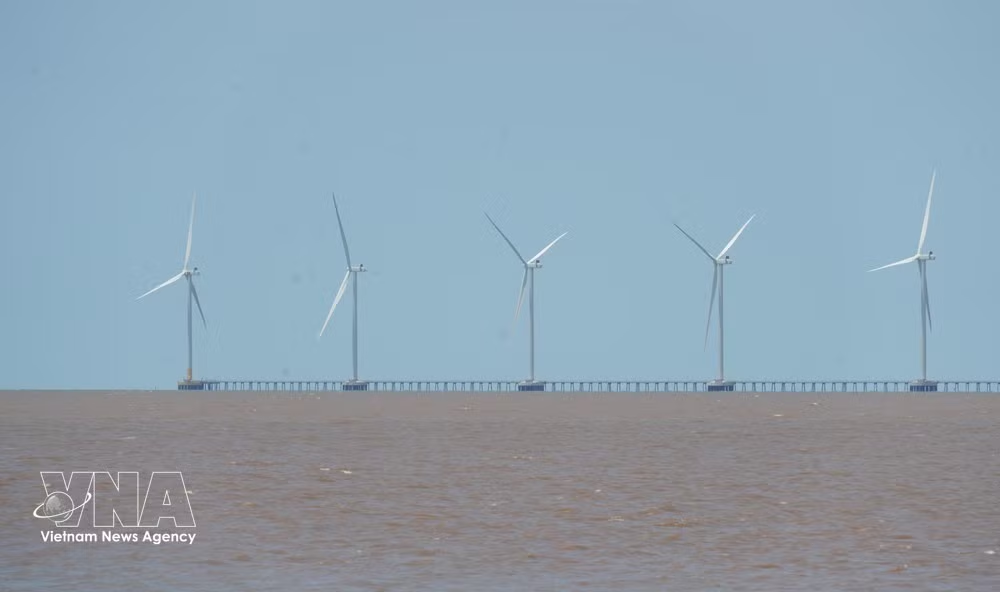
A view of Tan Thuan commune wind power project in Ca Mau province. (Photo: VNA)

Dr Nguyen Hung Dung, Vice Chairman and Secretary General of the Vietnam Petroleum Association, identified an incomplete and inconsistent legal framework as a key obstacle, noting that energy projects are governed by multiple laws covering electricity, investment, land, environmental protection, and marine resources, as well as other guiding decrees.

Decree No. 272/2026/ND-CP, issued by the Government on July 4, 2026, provides regulations on offshore wind surveys and development. However, several critical issues, including electricity prices, power purchase agreements (PPAs), risk-sharing arrangements and payment guarantees, remain unclear. These are among the factors considered by international lenders when assessing project financing, Dung said.

Sharing Dung’s views, National Assembly Deputy Nguyen Hai Nam said inconsistencies between the power development plan, marine spatial planning and related plans mean that although offshore wind power has been identified as a development priority, there is still insufficient basis for projects to be implemented in practice.

Regulations governing the allocation and leasing of marine areas for surveys, research and construction remain incomplete, he said, adding that questions surrounding long-term electricity prices, investor selection and the authority to approve investment policies also need to be clarified.

With projects requiring billions of US dollars, lengthy preparations, costly surveys and coordination among multiple agencies, Nam called for a unified framework covering development areas, survey procedures, marine-area allocation, investor selection and approval authority.

He also proposed a stable and competitive electricity pricing mechanism incorporating risk-sharing provisions, which, he said, would help investors mobilise long-term financing.

Dr Du Van Toan from the Institute of Meteorology, Hydrology, Environment and Marine Sciences under the Ministry of Agriculture and Environment said offshore wind could serve purposes beyond grid-connected power generation, including producing green hydrogen through water electrolysis. The hydrogen could subsequently be used to make green ammonia and other clean fuels for export.

He noted that countries with strong offshore wind potential, including the Netherlands, Denmark, the UK, Australia and several Middle Eastern countries, are exploring and developing these applications.

Toan said the forthcoming revision of the Electricity Law should establish not only a comprehensive legal framework for offshore wind but also an institutional foundation for the broader offshore energy industry.

He warned that missing this opportunity could have implications beyond the development of offshore wind, potentially limiting Vietnam’s participation in rapidly expanding global value chains for green hydrogen, green ammonia and other emerging energy sectors.

en.vietnamplus.vn

Other News

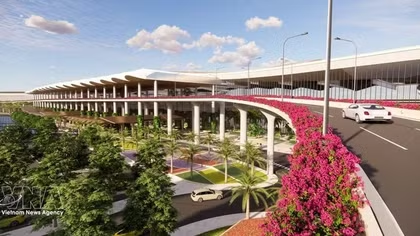
Phu Quoc airport planning adjusted to serve APEC 2027

Phu Quoc airport planning adjusted to serve APEC 2027

For 2021-2030, the Civil Aviation Authority of Vietnam proposed bringing forward the investment in a parallel taxiway system and a connecting taxiway north of Runway No. 2 at Phu Quoc International Airport, in order to connect with the aircraft maintenance and repair facility (hangar) planned for the northern area of ​​the airport.

Policy, infrastructure emerge as new advantages in FDI attraction

Policy, infrastructure emerge as new advantages in FDI attraction

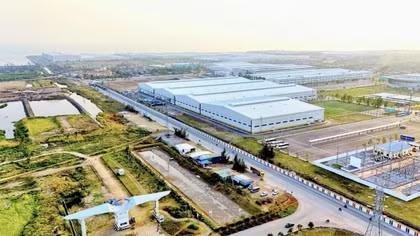
From policy and infrastructure to industrial real estate, Vietnam’s FDI advantages are broadening towards a more integrated production ecosystem, offering investors a stronger combination of conditions for high-value, technology-intensive and long-term projects.

Logistics upgrade vital to 1-trillion-USD trade target: experts

Logistics upgrade vital to 1-trillion-USD trade target: experts

As trade expands, systemic bottlenecks across transport networks, warehousing, ports, border gates, and industrial zones are becoming more apparent. Experts emphasise the need to shift from a fragmented, project-by-project approach toward strategic management structured around trade corridors and integrated supply chains.

Ample room for Vietnam, US to deepen cooperation

Ample room for Vietnam, US to deepen cooperation

Do Ngoc Hung, Trade Counsellor and head of the Vietnam Trade Office in the US, said what stands out is not only the growth in trade volume but also the increasingly deep economic ties between the two countries.

Flexible fiscal policy helps drive economic growth

Flexible fiscal policy helps drive economic growth

According to the Ministry of Finance, State budget revenue in the first eight months of 2026 was estimated at 2.02 quadrillion VND (77.7 billion USD), equivalent to 80% of the annual estimate and up 16% year-on-year. Domestic revenue reached 1.75 quadrillion VND, accounting for 86.6% of total revenue and rising 16.6%.

Electronic components are produced at a factory in Hanoi. (Photo: VNA)

Hanoi's imports surge 41% in first eight months of 2026

Hanoi aims to achieve average annual export growth of at least 12% during 2026-30, with the city seeking to diversify export markets, boost high-tech and value-added products and reduce reliance on traditional markets.

New opportunities for Vietnam's seafood exports

New opportunities for Vietnam's seafood exports

The Vietnam-EFTA Free Trade Agreement brings together two groups of highly complementary economies. EFTA members Switzerland, Norway, Iceland and Liechtenstein have strengths in technology, innovation, finance, clean energy and sustainable development, while Vietnam is one of Asia’s most dynamic economies and is emerging as a major regional manufacturing, trade and investment hub.

Ho Chi Minh City targets third-quarter growth of over 11%

Ho Chi Minh City targets third-quarter growth of over 11%

Ho Chi Minh City will continue to implement drastic measures to achieve double-digit growth, targeting GRDP growth of at least 11.07% in the third quarter of 2026, 9.43% in the first nine months and 12.3% in the fourth quarter, with a view to completing the full-year goal of 10% or more.

Vietnamese experts abroad join efforts to advance nuclear power development at home

Vietnamese experts abroad join efforts to advance nuclear power development at home

Held both in person and online, the seminar focused on the current status and opportunities for Vietnam’s nuclear power programme, human resources development, global trends in small modular reactors (SMRs), experience in ensuring safety and extending the operational life of nuclear power plants, and ways to mobilise Vietnamese experts abroad to contribute to the programme.

Port throughput in Hai Phong exceeds eight-month target

Port throughput in Hai Phong exceeds eight-month target

The strong performance followed a series of measures to optimise port capacity and improve the competitiveness of the city’s seaport system, with a focus on maximising the efficiency of the Lach Huyen international gateway port as new berths came into operation.